The look of it
An Actor’s Revenge is a 1963 Japanese drama film directed by Kon Ichikawa, adapting Otokichi Mikami’s novel via a screenplay co-written by Teinosuke Kinugasa and Natto Wada. It sets out to dramatise vengeance not as catharsis but as performance — a sustained, stylised act carried out by an onnagata actor who lives as a woman offstage and deploys femininity as both shield and weapon. The film does not seek psychological realism; it leans into kabuki’s conventions — exaggerated gesture, symbolic colour, deliberate artifice — while folding them into cinematic form. Its ambition is structural and tonal: to hold the audience at a remove, using voice-over narration, theatrical framing and doubling (Kazuo Hasegawa plays both Yukinojō and the thief Yamitarō) to question identity, agency and moral certainty. It treats revenge as ritual rather than impulse, and justice as indistinguishable from spectacle. The studio is NHK Broadcasting Center, and the production bears the imprint of mid-century Japanese studio craft: precise, unhurried, unapologetically formal. (158 words)
The shape of the story
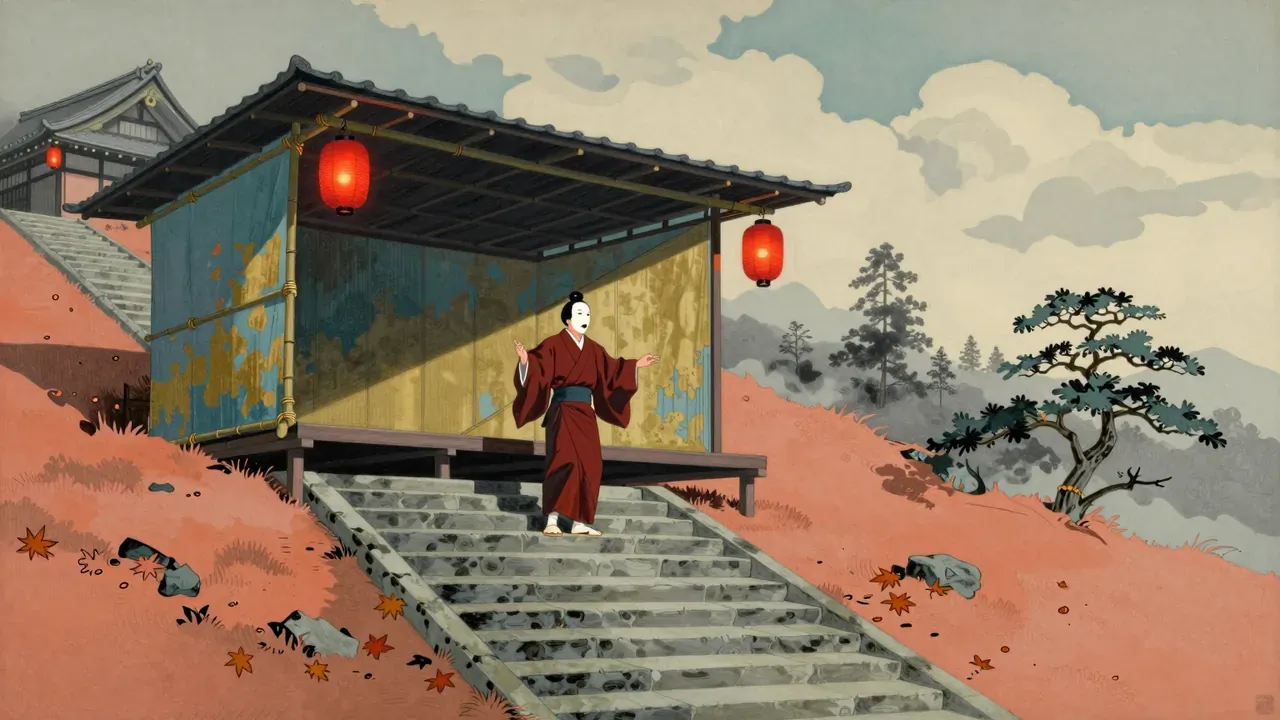
The story unfolds in late Edo-period Japan, following Yukinojō Nakamura — raised by a kabuki troupe after his parents’ suicide — as he targets three men responsible for their deaths. His method is indirect: manipulation, suggestion, public shaming, all staged with theatrical precision. Kazuo Hasegawa’s dual performance anchors the film: his Yukinojō moves with studied grace and speaks in measured, feminine cadence; his Yamitarō is sardonic, mobile, grounded in street logic. Yasushi Akutagawa’s score uses traditional instruments with modernist restraint, never underscoring emotion but punctuating shifts in tone. Yoshinobu Nishioka’s art direction favours shallow depth and painted backdrops, reinforcing the stage-bound sensibility. Musei Tokugawa’s benshi narration — dry, detached, occasionally ironic — frames each sequence like a programme note. Cinematography avoids naturalism: compositions are symmetrical, lighting often flat or high-contrast, with long takes that allow gesture and pause to carry meaning. There is no attempt to ‘explain’ Yukinojō’s psychology; his interiority is rendered through posture, costume, and silence. (159 words)
What holds
What lands most decisively is the film’s tonal consistency: its refusal to sentimentalise either vengeance or sacrifice. The death of Namiji — an innocent woman drawn into Yukinojō’s schemes — does not trigger anguish but a quiet, almost bureaucratic withdrawal. That restraint is persuasive, not cold. Hasegawa’s physical control — the tilt of a head, the way he holds a fan, the weight he gives a pause — makes the duality believable without needing exposition. The visual grammar also works: the recurring use of red (a kimono, a lantern, spilled sake) functions not as metaphor but as motif — a repeated note in a minor key. The thief Yamitarō’s interjections land because they are structurally necessary: he is the only character who names the absurdity of the enterprise, and his presence prevents the film from becoming a closed system of ritual. Even minor roles — Nakamura Ganjirō II’s Sansai Dobe, Saburō Date’s Kawaguchiya — register with economy and specificity. The film’s pacing, at 113 minutes, never rushes, yet never drags: each scene occupies its duration fully, trusting the viewer to absorb implication rather than explanation. (157 words)
What slips
What does not land is the emotional weight of Yukinojō’s final disappearance. The film builds toward resolution, but its ending feels less like culmination than cessation — a door closing without a click. The relationship with Ohatsu remains underdeveloped, her function largely symbolic: she is the one person who sees through the performance, yet her perspective is never granted narrative space. Some supporting characters — particularly the constables and townsfolk — verge on caricature without sufficient grounding in the film’s own logic; their reactions feel dictated by genre convention rather than internal motivation. The voice-over, though effective in moderation, occasionally overstates what the image already conveys, diluting ambiguity where the film is strongest. A few transitions between scenes rely too heavily on narration rather than visual continuity, briefly breaking the carefully sustained theatrical rhythm. The film’s commitment to artifice means it cannot accommodate psychological nuance — and while that is a choice, it leaves certain moral questions unanswered not by design but by omission. Those expecting moral reckoning or emotional release will find neither; the film offers observation, not judgement — and that distinction may frustrate viewers accustomed to closure. (159 words)
The weight of the theme
The themes that matter are performance as survival, gender as discipline, and vengeance as repetition rather than resolution. Yukinojō’s onnagata training is not disguise but embodiment — a lifelong rehearsal of selfhood that blurs the line between role and reality. His revenge is not personal catharsis but a re-enactment of inherited trauma, performed with the same rigour as a kabuki dance. The film treats justice as a social fiction: the three villains are undone not by law or conscience but by exposure, rumour, and the destabilising force of being seen — which is itself a theatrical act. Gender is presented not as identity but as labour: the effort required to speak, walk, and occupy space as a woman is shown as continuous, visible, and politically charged. Class is implicit but unspoken — the kabuki troupe moves through Edo like ghosts, tolerated but never integrated; the villains are merchants and officials whose power rests on appearances, making them vulnerable to the very tools they rely on. The film resists redemption arcs, national allegory, or historical commentary: its concerns are formal, behavioural, and existential. (158 words)
Who it is for
This film is for viewers who value compositional clarity, performative precision, and narrative restraint — those comfortable sitting with ambiguity and willing to parse meaning from gesture, costume, and framing rather than dialogue or exposition. It suits admirers of mid-century Japanese studio filmmaking, kabuki aesthetics, or directors like Mizoguchi and Naruse who treat time and space as expressive materials. It is not for viewers seeking psychological realism, fast pacing, or moral resolution. Those who require clear protagonist motivation, emotional payoff, or linear cause-and-effect will find it withholding. It assumes familiarity with basic kabuki conventions — not as prerequisite knowledge, but as a shared cultural shorthand the film does not pause to translate. A viewer unfamiliar with onnagata practice may miss layers of irony in Yukinojō’s offstage behaviour, though the film remains legible without that context. Someone who dislikes theatricality in cinema — heightened movement, symbolic colour, narrated exposition — will likely reject its methods outright. That is not a flaw in the film, but a boundary: it asks for attention, not empathy. (159 words)
Is it worth your evening?
Yes, it is worth your evening — provided you watch it as a work of choreographed cinema rather than a story-driven drama. Its 113 minutes unfold with the gravity of a ceremony: every shot calibrated, every pause considered, every performance held in check. It rewards close attention but does not demand interpretation; its meanings reside in the doing, not the saying. Those who dislike its pace or reserve may argue it is emotionally distant — and they are right, by design. But distance here is not indifference; it is the condition of its critique. To call it ‘cold’ mistakes control for absence. It would change its verdict only if you require films to offer solace, explanation, or moral instruction — none of which it attempts. For anyone open to cinema as discipline, as pattern, as sustained aesthetic argument, it repays attention fully. Its value lies not in what it reveals, but in how deliberately it withholds — and how precisely it constructs that withholding. (158 words)