The look of it
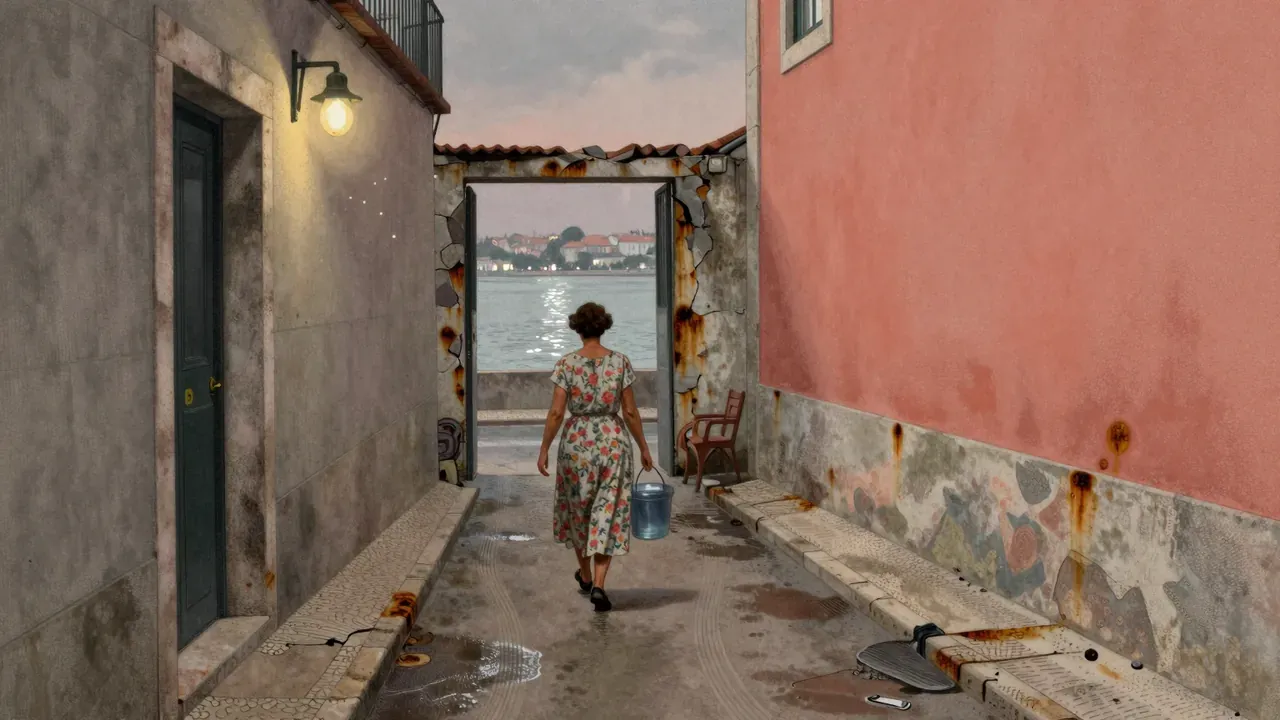
Ossos is a 1997 Portuguese art film set in the Fontainhas shanty district of Lisbon, where residents include immigrants from former Portuguese colonies in Africa. Pedro Costa wrote and directed it as the first part of a triptych examining that place and its people — followed by In Vanda’s Room and Colossal Youth. The film does not seek to narrate social realism in conventional terms. It avoids exposition, causal plotting, or psychological explanation. Instead, it observes: it holds space for silence, repetition, and physical endurance; it treats gesture, posture, and duration as narrative units. Its aim is not diagnosis but presence — to register how poverty, exhaustion, and care circulate without fanfare or resolution. It refuses uplift, moral framing, or authorial commentary. The camera stays still, often at a distance, watching people move through cramped rooms and narrow streets as if time itself were thickening around them. This is not documentary, though it uses non-professional actors living in Fontainhas; nor is it fiction in any familiar sense. It is a sustained formal proposition: that attention, rigorously applied, can be an ethical act.
The rhythm of it
The story unfolds in sparse, unemphatic episodes: Tina’s postpartum despair, her partner’s fumbling attempts to feed their newborn, Clotilde’s quiet labour as a maid, Eduarda’s gradual assumption of care. There are no flashbacks, no voiceover, almost no dialogue — what little speech occurs is flat, functional, often cut off mid-sentence. Performances are restrained to the point of vacancy: Maria Lipkina as Tina moves with the weight of unspoken depletion; Nuno Vaz as the father conveys helplessness not through expression but through hesitation — a pause before lifting the baby, a glance held too long at a closed door. Emmanuel Machuel’s cinematography keeps interiors dim and grainy, using available light and shallow depth of field to compress space and blur edges. Jackie Bastide’s editing sustains long takes — some over two minutes — refusing punctuation or emphasis. Sound design is sparse: footsteps on concrete, distant traffic, the hiss of a gas cylinder. Costume and production design avoid period signposting; clothes are worn, rooms are bare, walls are cracked. Nothing is embellished. Every choice serves the film’s refusal of hierarchy between event and stillness.
The weight of it
What lands is the cumulative weight of observation. The film makes visible what most cinema renders invisible: the sheer duration of waiting, of holding a child while hungry, of sitting on a bench after being told your baby is ill. It lands in the way Eduarda’s offer of food carries more narrative force than any monologue could; in how Clotilde’s return home after her first day’s work registers as both triumph and erasure; in the unbearable intimacy of Tina lying unconscious on a kitchen floor, not as climax but as one more fact among many. The long takes do not feel indulgent because they mirror the characters’ temporal reality — there is no hurry, no escape, no alternative rhythm. The cinematography’s restraint avoids voyeurism: the camera watches, but never interprets. When Tina places the gas cylinder beside the baby, the shot holds without trembling, without music, without cutting away — and that neutrality becomes the film’s moral centre. It lands not through empathy as feeling, but through fidelity to duration, texture, and silence.
The silence of it
What does not land is any sense of agency or consequence beyond the immediate frame. Characters drift without motivation we can grasp; decisions arrive without preparation, vanish without aftermath. The father’s shift from neglect to dependence on Eduarda feels less like development than substitution — one structure of care replacing another without explanation. Tina’s suicide attempts lack psychological scaffolding, so their recurrence risks numbness rather than tension. Some viewers will find the refusal of context alienating: we never learn why Tina and her partner live as they do, what histories brought them to Fontainhas, or how colonial legacies shape their present — though those histories are materially present in the district’s architecture and demographics. The film offers no analysis, only accumulation — and for those seeking clarity, causality, or even basic orientation, that refusal may read as evasion. Its austerity is absolute, and it asks the viewer to meet it on those terms, without compromise or translation.
The care in it
The themes that matter are care as labour, dependency as condition, and visibility as politics. Care here is neither sentimental nor heroic: it is embodied, uneven, improvised, often transactional — Eduarda feeds the father and takes the baby not out of charity but because she can, and because Clotilde needs work. Dependency is structural, not personal: no one chooses isolation, yet no one escapes it. The film traces how support networks form, fray, and re-form along lines of gender, class, and migration status — Clotilde cleans Eduarda’s apartment while Tina lies unconscious in its kitchen, and neither woman speaks of justice, only of what must be done next. Visibility operates on two levels: the camera insists on seeing people the city ignores, yet it refuses to render them legible to outsiders — no subtitles explain dialects, no captions name locations, no narration interprets gestures. The film treats marginality not as a problem to solve but as a reality to inhabit, and its central theme is the quiet, relentless persistence of life amid conditions designed to erase it.
The demand of it
This film is for viewers who value precision of attention over narrative propulsion, who find emotional resonance in stillness and texture rather than dialogue or plot turns. It rewards patience, tolerance for ambiguity, and familiarity with slow-cinema conventions. It is not for those who require clear character arcs, explanatory context, or catharsis — nor for those unfamiliar with the material conditions of urban poverty in post-colonial Europe. Some critics argue its aesthetic rigour borders on asceticism; others say its refusal of didacticism weakens its political force. A viewer who finds In Vanda’s Room or Colossal Youth compelling will likely respond to Ossos. But someone who values storytelling as explanation, or cinema as immersion, may leave frustrated. What would change the verdict? A single scene offering historical or institutional context — a radio broadcast, a news headline, a bureaucratic interaction — would not break the film’s form, but it might anchor its ethics in something beyond endurance.
The time of it
Yes, it is worth your evening — but only if you come prepared to watch, not consume. Ninety-four minutes pass slowly, deliberately, without concession. You will not leave with answers, but with impressions: the smell of damp concrete, the sound of a spoon scraping a tin, the way light falls across a cracked wall at dusk. Its value lies in its refusal to simplify, to flatter, or to resolve. It asks for nothing but time, and repays that time with unblinking honesty about how people hold each other together when everything else is falling apart. Those who expect entertainment, exposition, or emotional release will find it withholding. Those who trust that looking — truly, steadily, without judgment — is itself a kind of action, will find it unforgettable. It is not easy, but ease is not its purpose. Its worth is in its consistency: every frame honours the people it shows, not as symbols or victims, but as subjects whose lives demand attention on their own terms.