The opening note
The Innocents is a psychological horror film that adapts Henry James’s The Turn of the Screw not as a ghost story but as an inquiry into perception, repression, and narrative unreliability. It does not aim to frighten through spectacle or shock, but to unsettle by sustaining ambiguity: whether the apparitions are real, imagined, or projections of the governess’s unacknowledged desire and anxiety. Jack Clayton deliberately avoids the conventions of contemporary British horror — no blood, no monsters, no overt violence — instead treating the house, the silence, and Deborah Kerr’s face as primary sites of tension. The film’s ambition lies in its restraint: it asks the viewer to hold two contradictory readings — supernatural possession versus psychological collapse — without resolving them. Its fidelity is not to James’s text as doctrine, but to the novella’s structural uncertainty, which Clayton and Capote sharpen into a formal principle. The film refuses exposition, backstory, or moral framing; it offers only what Miss Giddens sees, hears, and interprets — then invites doubt about every interpretation. This is not horror as genre exercise, but horror as epistemological crisis. (158 words)
The look of it
The story unfolds through Miss Giddens’s perspective alone, with no counterpoint, no voiceover explanation, no cutaways to confirm or deny her visions. Deborah Kerr carries nearly the entire film, her performance calibrated between fervent conviction and brittle fragility — a tremor in the hand, a pause before speech, eyes widening not with terror but with dawning certainty. Freddie Francis’s cinematography uses deep focus to trap characters within layered frames: doorways, windows, and mirrors become thresholds between states of mind. Lighting is sparse and directional — faces half-submerged, corridors receding into black — while the CinemaScope frame feels less expansive than constricting. Georges Auric’s score is spare and dissonant, punctuated by Daphne Oram’s early electronic textures that hum beneath dialogue like subvocal dread. Jim Clark’s editing sustains rhythm through duration: long takes linger on reactions, not revelations. Even the children’s performances — Pamela Franklin’s unnerving stillness, Martin Stephens’s poised ambiguity — avoid caricature, making their behaviour legible as either innocence or calculation depending on where the viewer places their trust. (159 words)
The weight of silence
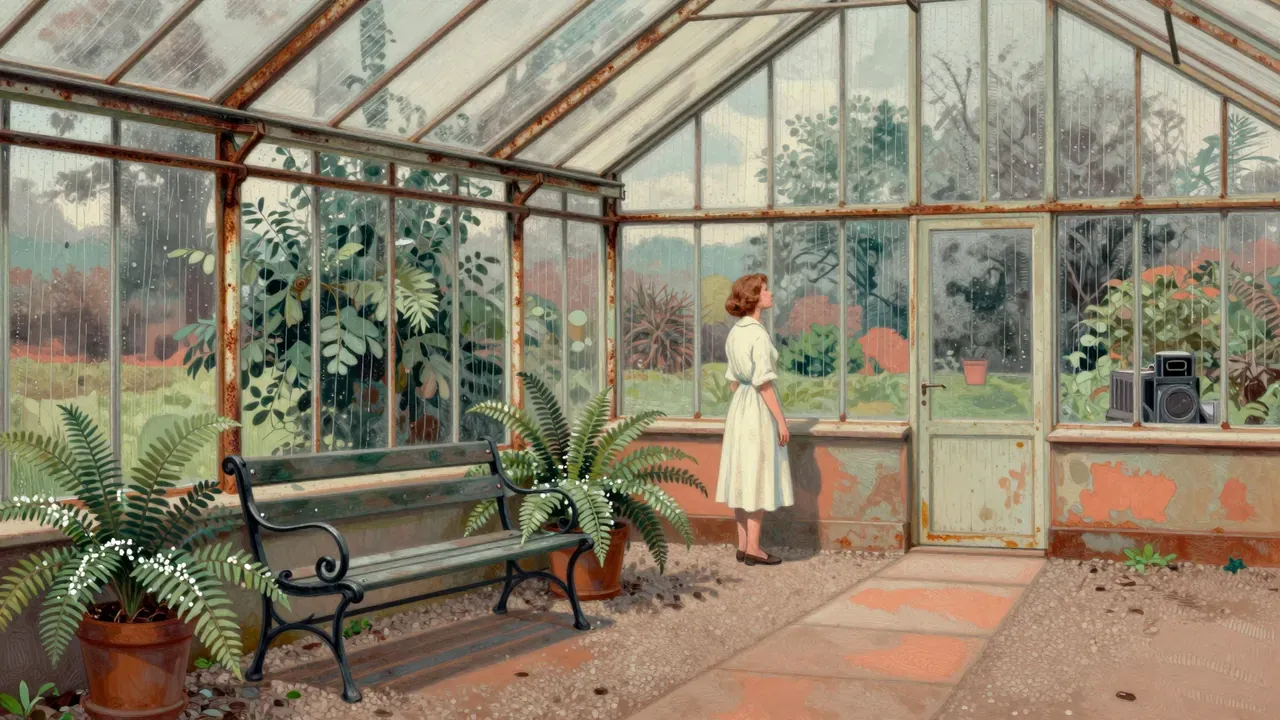
What lands most decisively is the film’s sustained tonal control: every shot, sound, and silence works toward the same unsettled equilibrium. The opening sequence — black screen, a child’s voice singing ‘O Willow Waly’, then Deborah Kerr’s clasped hands and tear-streaked face emerging from darkness — establishes intimacy and doubt in under a minute. The greenhouse scene, where Flora stares blankly past Miss Giddens at an empty corner, achieves horror not through what is seen but through the refusal to name what might be there. The final confrontation on the tower works because it denies catharsis: Miles’s death is neither exorcism nor breakdown, but an event whose meaning remains suspended between cause and symptom. The film’s visual grammar — reflections doubling figures, off-centre compositions, abrupt cuts to static objects — never explains itself, yet accumulates associative weight. Even minor details land: Megs Jenkins’s Mrs Grose speaks with the weary pragmatism of someone who has long stopped questioning what she sees, and that quiet resignation makes her more unsettling than any ghost. The film’s power is cumulative, built not on set-pieces but on the slow erosion of interpretive ground. (157 words)
What it refuses to say
What does not land is any attempt to read the film as social critique or period commentary. Its Victorian setting is functional, not interrogative: class, gender, or education are present only as conditions shaping Miss Giddens’s isolation and authority, not as subjects of analysis. The Freudian framework introduced by Capote remains suggestive rather than systematic — there are no dream sequences, no overt symbolism beyond what the eye can register, and no clinical language to anchor interpretation. Some viewers may find the pacing inert, particularly in the middle stretch where little ‘happens’ beyond shifts in light and posture. The film’s refusal to clarify also risks alienating those who require narrative resolution or emotional payoff; its austerity can read as withholding rather than deliberate. The absence of a funeral prologue — originally planned — leaves the governess’s psychology unmoored from any external context, which strengthens ambiguity but weakens pathos for some. And while the electronic sound design was innovative, its use is so sparing and integrated that it registers more as texture than technique — historically significant, but not perceptibly disruptive in the viewing experience. (156 words)
The shape of doubt
The themes that matter are self-deception, the instability of perception, and the violence of moral certainty. The film treats belief not as conviction but as contagion: Miss Giddens’s growing certainty spreads like fever, infecting her reading of the children, the staff, even the architecture. Her piety and propriety are not shields but instruments — the rosary, the hymns, the insistence on ‘goodness’ all become tools of projection and control. The house at Bly is not haunted by ghosts but saturated with unspoken histories: Quint and Jessel’s illicit relationship, the uncle’s abdication of care, the children’s orphaned status — all remain offscreen, yet shape every interaction. Repression here is not merely sexual but epistemic: the governess suppresses doubt as rigorously as desire. The film’s central question is not whether ghosts exist, but whether naming something evil — especially in others — is ever anything other than an act of will. That question persists because the film refuses to assign blame, diagnose pathology, or offer redemption. Its moral gravity lies in its refusal to simplify motive, memory, or motive. (154 words)
Who it asks for
This film is for viewers who value ambiguity over explanation, atmosphere over action, and psychological nuance over plot mechanics. It rewards attention to gesture, framing, and silence — those accustomed to classical narrative closure or genre signposting may find it frustrating or inert. It is not for those who require clear antagonists, causal logic, or emotional release; nor for those who approach horror expecting visceral reaction rather than lingering unease. Some critics have argued its restraint borders on coldness, and viewers attuned to expressive performance or thematic exposition may feel short-changed. A different verdict would follow if the film offered even one moment of objective confirmation — a glimpse of a ghost seen by another character, a diary entry contradicting Miss Giddens’s account — but it gives none. Its power depends entirely on sustaining doubt, and that demand is non-negotiable. Those unwilling to hold two readings at once will leave unsatisfied — not because the film fails, but because it fulfils its own terms uncompromisingly. (159 words)
Why it lasts
Yes, it is worth your evening — not as diversion, but as engagement. Its 100 minutes pass with the weight of something consequential, not because much occurs, but because every choice feels necessary and unrepeatable. It repays rewatching not to solve a mystery but to notice how the film constructs its uncertainty: how a glance lingers too long, how a door closes just before a line is spoken, how the soundtrack drops out before a scream might come. Its economy — no wasted shot, no redundant line — means nothing is filler. Those who expect horror to escalate, climax, or resolve will be disappointed; those who accept horror as a state of mind will find few films more exacting or enduring. Its reputation rests not on consensus but on persistence: fifty years on, it continues to provoke argument about what it shows and what it withholds. That durability is not accidental — it is built into the film’s structure, its silences, its refusal to speak for itself. To watch it is to enter a contract: you bring your attention, and it returns unease, precision, and clarity about the limits of knowing. (159 words)