What it is
Tokyo Olympiad is a documentary film about the 1964 Summer Olympics in Tokyo, commissioned by the Japanese government as a national showcase but shaped by Kon Ichikawa into something else: a cinematic portrait of human exertion, collective attention, and transient spectacle. It does not aim to record results or chronicle medal tallies; it avoids voiceover exposition, official speeches, and podium ceremonies as primary material. Instead, it treats the Games as a series of recurring physical and emotional motifs — the flex of a calf muscle, the pause before a vault, the silence after a fall, the slow dispersal of crowds under rain. Ichikawa’s intention, evident in structure and rhythm, is to hold time at the level of perception: not what happened, but how it felt to be there, watching, waiting, straining, breathing. The film assumes no prior knowledge of athletics, no investment in national standings. Its subject is embodiment itself — bodies in motion, at rest, in failure, in triumph — rendered with deliberate, unhurried attention. It is less a record than a recalibration of documentary purpose: from documentation to duration.
How it works
The film works through sustained observation rather than narrative progression. There is no script, no narrator in the original Japanese version, no score that swells on cue; Toshiro Mayuzumi’s music enters sparingly, often as punctuation or counterpoint, never as emotional instruction. Kazuo Miyagawa’s cinematography favours long takes, slow tracking shots across stadiums, and extreme close-ups — a trembling hand gripping a pole, sweat pooling in a collar, eyelids fluttering mid-race. Zoom lenses are used not for emphasis but for intimacy, collapsing distance without commentary. Editing avoids montage logic; sequences unfold in real time or near-real time — the marathon lasts over twelve minutes, the women’s 80m hurdles occupies nearly five. Performances are unmediated: athletes do not address the camera, nor are they interviewed. Their presence is physical fact, not biographical illustration. Nando Martellini appears only as a commentator’s voice on Italian radio broadcasts heard faintly in crowd scenes; Hirohito appears once, briefly, in ceremonial footage, his presence registered as light on fabric, not as authority. The film’s craft is its restraint: every decision defers interpretation to the viewer.
What lands
What lands is the cumulative weight of attention. Over 170 minutes, the film builds a tactile sense of scale — not of stadiums or crowds, but of effort measured in breath, tremor, and recovery. A shot of bare feet stepping onto the track, then the same feet, blistered and dusted, hours later, carries more narrative force than any medal ceremony. The editing of the men’s high jump — cutting between the arc of flight, the stillness of the bar, the athlete’s face mid-air — achieves a rare synthesis of physics and psychology. Miyagawa’s lighting renders sweat as liquid silver, shadows as soft as breath. Mayuzumi’s score, when it appears, does so as texture: a single oboe line beneath the rhythmic thud of hammer throws, or silence stretched so taut it vibrates. The film’s most resonant moments are those that refuse resolution: a runner collapsing just short of the finish, the camera holding on his chest rising and falling, no cut to reaction shots, no music, no explanation. That refusal becomes its moral centre — an insistence on presence over outcome, endurance over victory. It lands because it trusts duration to do the work of meaning.
What does not
What does not land is the expectation of conventional documentary utility. Viewers seeking historical context — the significance of Japan’s post-war reconstruction, the geopolitical weight of the Games, or even basic event chronology — will find none. There is no map, no timeline, no identification of nations beyond fleeting flags or uniforms. The film offers no statistics, no replays, no analysis of technique. Its avoidance of narration means some sequences remain opaque: the intricacies of gymnastics scoring, the rules of modern pentathlon, the stakes of relay baton exchanges. The pacing, deliberately uninflected, can feel inert to those accustomed to editorial urgency or dramatic escalation. Some critics at the time found its focus on fatigue and failure unpatriotic; others judged its length indulgent. The 93-minute US cut — with English narration added — attempts to correct this by imposing exposition, but flattens the film’s central achievement: its resistance to summary. What fails is not the film’s execution, but its compatibility with expectations of informational efficiency or national affirmation.
The themes that matter
The themes that matter are endurance, anonymity, and the quiet dignity of effort divorced from reward. Tokyo Olympiad treats sport not as competition but as ritual — repeated gestures across cultures, generations, and physiques. It foregrounds the body as site of both limitation and possibility: the way a sprinter’s jaw tightens before acceleration, how a diver’s spine curves in air, the exhaustion visible in a weightlifter’s knuckles. There is no hierarchy among events: the decathlon receives no more emphasis than the women’s javelin, and neither is granted more dignity than the shot putter’s solitary warm-up. The film also explores collective attention as a physical phenomenon — crowds not as mass but as shifting topography of faces, hands, hats, binoculars, all oriented toward a single point. Spectators are filmed with the same gravity as athletes: a child asleep on a parent’s shoulder, an elderly woman shielding her eyes, teenagers leaning forward in unison. These are not background elements but thematic anchors: proof that witnessing, too, is embodied labour. The film’s politics are implicit — a rejection of instrumentalised nationalism in favour of shared, wordless participation in human scale.
Who should watch it
It is for viewers who value sustained attention over exposition, who find resonance in physical detail rather than verbal explanation, and who accept that a film may ask them to sit with ambiguity rather than resolve it. It rewards patience, not expertise. Those who rely on narration to orient themselves, or who expect documentaries to clarify rather than complicate, will likely disengage. People drawn to sports films for triumph narratives or national pride may find its tone withholding. So too might viewers accustomed to rapid cuts, explanatory graphics, or emotional signposting — the film gives no cues for when to feel awe, sorrow, or exhilaration. Its pace assumes the viewer is willing to meet it halfway, to watch a hurdler’s stride three times before understanding its rhythm. That assumption excludes no one by design, but it does demand a particular kind of engagement — one that treats time not as a resource to be optimised, but as material to be inhabited. Without that willingness, the film remains distant, even alienating.
Is it worth your evening
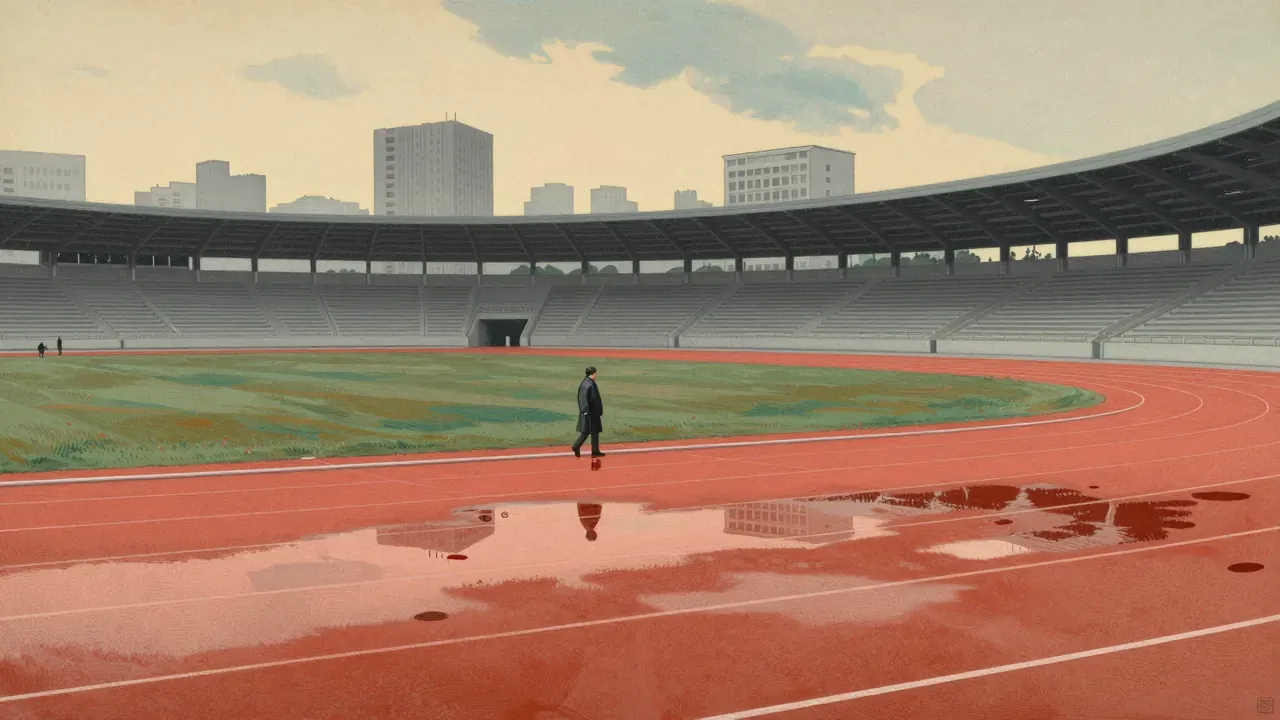
Yes, it is worth your evening — provided you set aside the expectation of being told what to think or feel. Its 170 minutes pass not as duration but as immersion: a rare chance to witness human movement without mediation, without agenda, without hurry. It repays attention not with answers but with heightened perception — of muscle, light, sound, silence. Those who watch it once may return to it years later and notice new details: the pattern of rain on a stadium roof, the way light catches a medal ribbon, the exact moment a runner’s expression shifts from concentration to surrender. Its endurance lies not in length but in legibility — each viewing reveals another layer of craft, another register of feeling. It is not for those who need closure, explanation, or momentum. But for anyone willing to let a film breathe at its own pace, Tokyo Olympiad remains unmatched in its quiet, unwavering fidelity to the physical fact of being alive in a body, in a crowd, in a moment that will not last.