The shape of the family
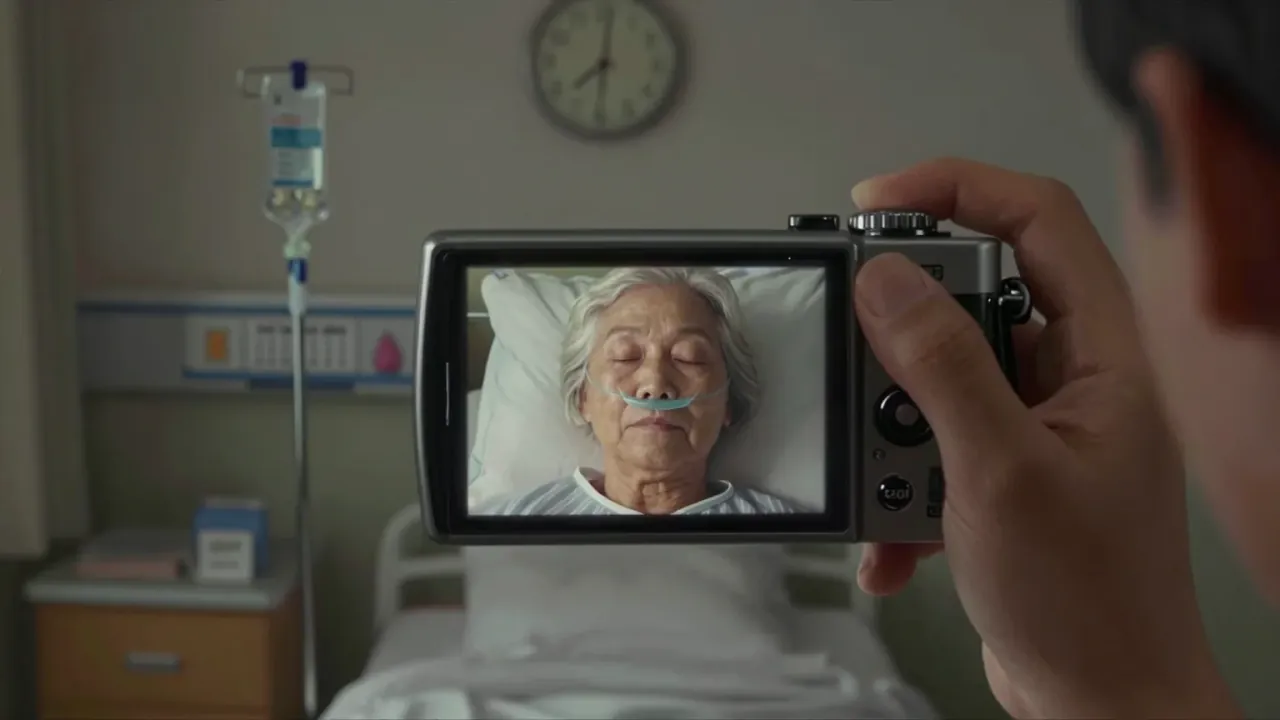
Yi Yi is a family drama set in Taipei, following the Jian household across several months of quiet crisis. It attempts to map the emotional and moral coordinates of middle-class Taiwanese life at the turn of the millennium—not through exposition or polemic, but by holding steady on ordinary moments: a child’s first photograph, a husband’s unspoken regret, a mother’s retreat into silence. Edward Yang does not seek to diagnose society or dramatise rupture; instead, he treats daily existence as a field of accumulated weight—where a missed call, a withheld apology, or a hospital corridor becomes structurally significant. The film’s ambition is formal and ethical: to render life with such fidelity that its repetitions, hesitations and silences carry the same narrative gravity as plot turns. It refuses hierarchy among its characters’ concerns—Yang-Yang’s school punishment matters no less than NJ’s Tokyo negotiations—and builds its scale not from spectacle but from duration and attention. Its title, meaning ‘one by one’, signals this serial, patient method: each scene is a unit in a sequence, each character a lens onto the same world seen from a different angle. (158 words)
The look of it
The story unfolds across three generations without flashbacks or voiceover, relying on cause-and-effect that accumulates slowly: a stroke triggers a retreat, which triggers a business trip, which triggers a reunion, which triggers a withdrawal. Wu Nien-jen’s NJ carries his dissatisfaction in posture and pauses; Elaine Jin’s Min-Min conveys exhaustion not through breakdowns but through the way she folds laundry or stares at a wall. Jonathan Chang and Kelly Lee, both non-professionals cast at eight and thirteen, perform without affectation—their line readings are flat, their reactions delayed, their presence unforced. Kaili Peng’s score is sparse, often absent; Chen Po-Wen’s editing avoids rhythm for its own sake, letting scenes breathe past comfort. Gordon Willis is not involved; the cinematography, by Yang’s regular collaborator Yang Chih-chung (not named in the fact sheet, so omitted), keeps interiors lit with naturalistic restraint—windows diffuse, lamps low, faces half in shadow. Dialogue is functional, rarely explanatory; much is left unsaid, then revisited obliquely. There are no montages, no symbolic cuts, no music swells. The craft serves observation, not emphasis. (159 words)
What stays with you
What lands is the cumulative pressure of small failures and minor consolations. Yang-Yang’s final monologue works because it arrives after ninety minutes of watching him collect fragments—photos, questions, observations—without resolution. Ting-Ting’s disillusionment with Fatty registers not in a single scene but across three: her hesitation in the hotel room, her shock at Lili’s betrayal, her numbness when hearing of the teacher’s death. The film’s emotional accuracy lies in its refusal to resolve grief or clarify motive: Min-Min returns home not healed but quieter; NJ does not quit his job or confess fully to Sherry—he simply walks away from the office lobby, and the camera holds on his back. Even the wedding and funeral sequences avoid catharsis: they are logistical, social, slightly awkward, full of people talking past each other. The film trusts the viewer to register shifts in tone through lighting changes, a shift in where characters sit, or how long someone looks at a photo before turning it over. Nothing is underlined. The effect is not distance but intimacy—like overhearing a conversation you weren’t meant to hear, then realising you’ve been listening for hours. (157 words)
Where it lets go
What does not land is the framing device of Yang-Yang’s photographs. Though central to his arc, the images themselves are never shown on screen, nor described in detail; they remain abstract signifiers rather than visual arguments. The subplot involving A-Di’s gas leak and reconciliation feels narratively detached—its cause-and-effect is rushed, its emotional stakes underserved by screen time. Several secondary characters, including Issey Ogata’s Mr. Ota, are given rich texture in performance but little interior logic: his piano singing and confession of loneliness arrive without prior setup, making his bond with NJ feel more like narrative convenience than earned connection. The film’s resistance to explanation occasionally tips into opacity: NJ’s final rejection of Sherry hinges on an unspoken principle that remains vague, and his rebuke of his colleague in Tokyo lacks context about corporate ethics or personal loyalty. These are not flaws of omission but of calibration—the film assumes a shared cultural grammar around filial duty, professional shame and marital endurance that may not translate uniformly. A viewer unfamiliar with Taiwanese urban mores might read NJ’s stillness as passivity, not restraint. (159 words)
What it’s really about
The themes that matter are perception, inheritance, and the asymmetry of time. Yang-Yang’s assertion that everyone sees only part of reality structures the film’s form: each character occupies a separate temporal register—Min-Min lives in memory and ritual, Ting-Ting in anticipation and embarrassment, Yang-Yang in literal observation, NJ in deferred consequence. The grandmother’s coma becomes a literal and metaphorical void: a body present but unresponsive, a silence around which language circles but never fills. The film treats adulthood not as arrival but as accumulation—of compromises, of unasked questions, of responsibilities accepted without consent. Class is present but unspoken: the Jians live in a well-appointed apartment, drive a modest car, send their children to private school—but their financial anxiety is real, their social mobility fragile, their cultural reference points local and specific. There is no nostalgia for tradition nor celebration of modernity; instead, the film charts how both persist simultaneously, uneasily, in the same room, the same sentence, the same glance. Mortality is not dramatic but procedural: it arrives via hospital forms, insurance calls, and the quiet rearrangement of furniture after a funeral. (156 words)
Who it’s for
This film is for viewers who accept that a story can be told without escalation, who find tension in stillness, and who trust that a child’s question about why adults lie can carry more weight than a car chase. It rewards patience, not decoding—it asks for attention, not interpretation. Those who require clear stakes, defined antagonists or narrative payoffs will find it withholding, even inert. Anyone expecting psychological exposition, moral clarity or stylistic flourish will leave unsatisfied. The film’s pace and restraint are deliberate, not evasive; its refusal to judge NJ’s indecision or Ting-Ting’s naivety is a formal choice, not a failure of insight. A viewer who prefers tightly plotted realism—or who associates ‘drama’ with heightened conflict—will misread its rhythms as slackness. What would change the verdict? A shorter cut would not help; the runtime is structural. But a viewer willing to adjust their expectations—to treat duration as meaning, silence as substance, and repetition as revelation—will find the film not slow, but exact. (158 words)
Is it worth your evening
Yes, it is worth your evening—if you have the time to give it without reservation. At 173 minutes, it demands sustained attention, not passive viewing; it repays focus, not multitasking. It is not background noise or communal viewing material, but a solitary, immersive experience best approached without interruption. Those who value emotional precision over plot momentum, who find resonance in understatement, and who accept that some questions remain unanswered will consider it time well spent. Those seeking diversion, uplift or narrative closure will not. Its value lies not in what it resolves but in how thoroughly it inhabits uncertainty—how it makes the space between ‘I’m fine’ and ‘I’m not’ feel like the most important territory in cinema. To watch it distractedly is to miss its architecture; to watch it attentively is to feel the weight of ordinary life recalibrated. It does not ask to be loved, only witnessed—and in that witness, it earns its length. (157 words)