The place it lives in
George Washington is a coming-of-age film set in a decaying rural town in North Carolina, built around the quiet intensity of preteen perception and the weight of unspoken consequence. It does not seek to dramatise adolescence through plot mechanics or moral resolution, but to hold space for the slowness, ambiguity and physical texture of a summer where children move between adult margins without full entry into either world. Its ambition is atmospheric and ethical: to render poverty, disability, racial mixing and communal silence not as conditions to be explained or overcome, but as givens — the air the characters breathe. It treats childhood not as innocence lost, but as consciousness forming under low light and high heat, with no narrator to translate. The film’s Southern Gothic inflection is subdued: no ghosts appear, but the past presses in through boarded windows, rusted rail lines and the unhealed shape of George Richardson’s skull. This is not a story about growing up so much as about the first moment a child feels time as irreversible — and that feeling arrives not with a climax, but with a pause.
The way it tells time
The film works through restraint: its narrative unfolds in glances, silences and ambient sound; its performances rely on non-actors’ unpolished presence rather than scripted delivery; its craft is unified by Tim Orr’s cinematography — soft-focus, grain-heavy, favouring shallow depth and diffused natural light — which keeps faces half-obscured and interiors drenched in amber shadow. Zene Baker’s editing avoids conventional rhythm, holding shots longer than expected, cutting away before emotional payoffs arrive. David Gordon Green’s script gives little exposition: names are dropped without introduction, relationships implied not stated, tragedies absorbed rather than processed. Paul Schneider as Rico Rice moves with a weary physicality that anchors the adult periphery; Eddie Rouse as Damascus speaks in murmurs that carry more authority than dialogue; Rachael Handy as Sonya conveys loyalty and fear in how she shifts her weight. There are no close-ups of tears, no score swells — only cicadas, distant trains, bare feet on hot concrete. The film’s consistency lies in its refusal to underline meaning, trusting the viewer to sit with discomfort and uncertainty as structural elements, not flaws.
The look of it
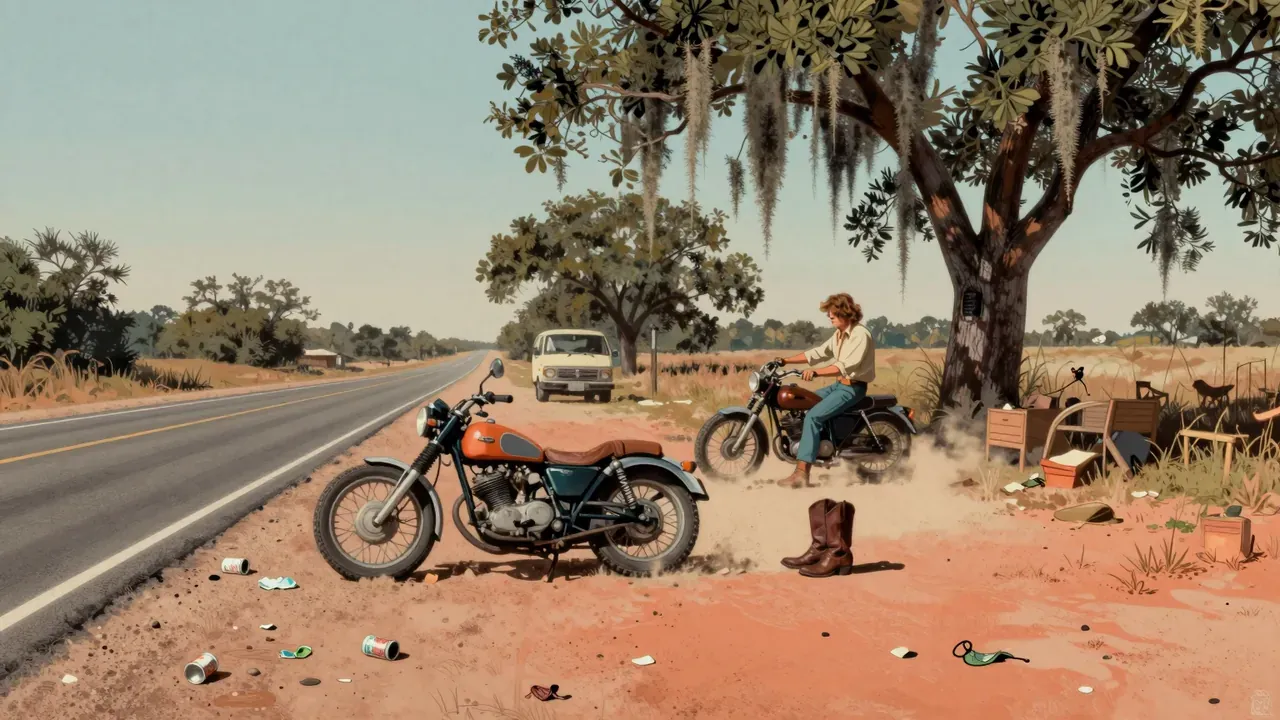
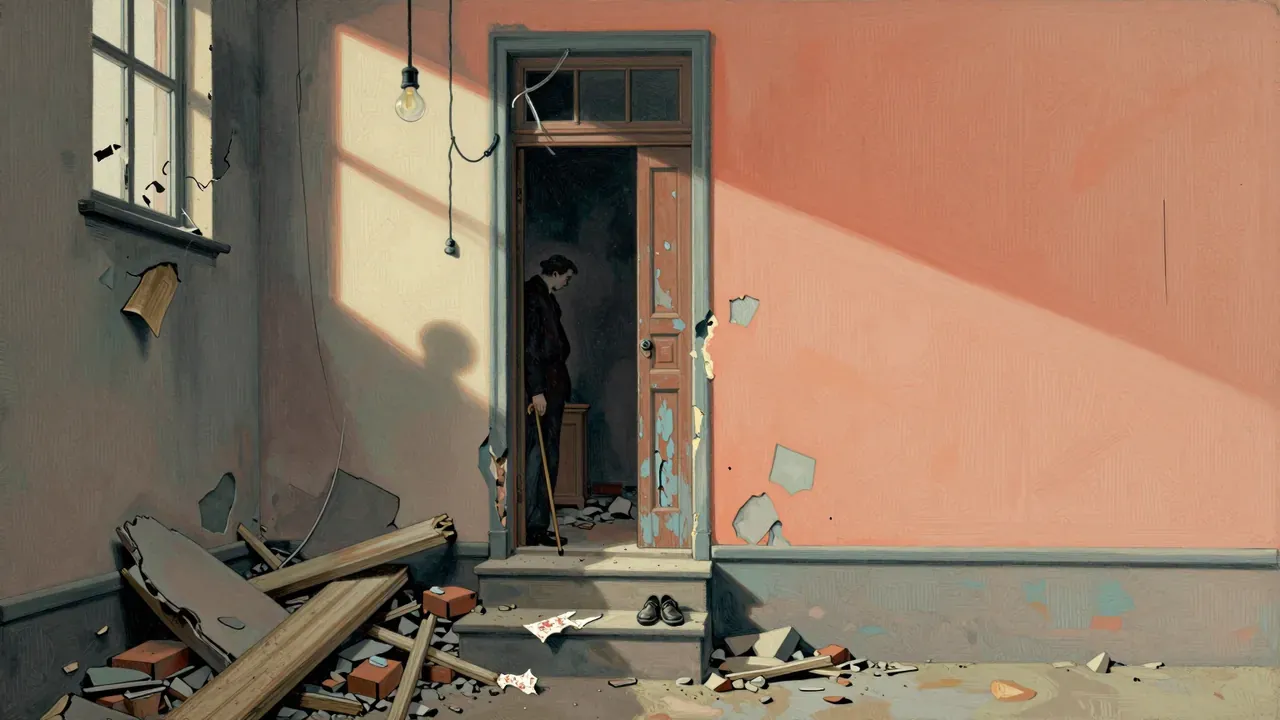
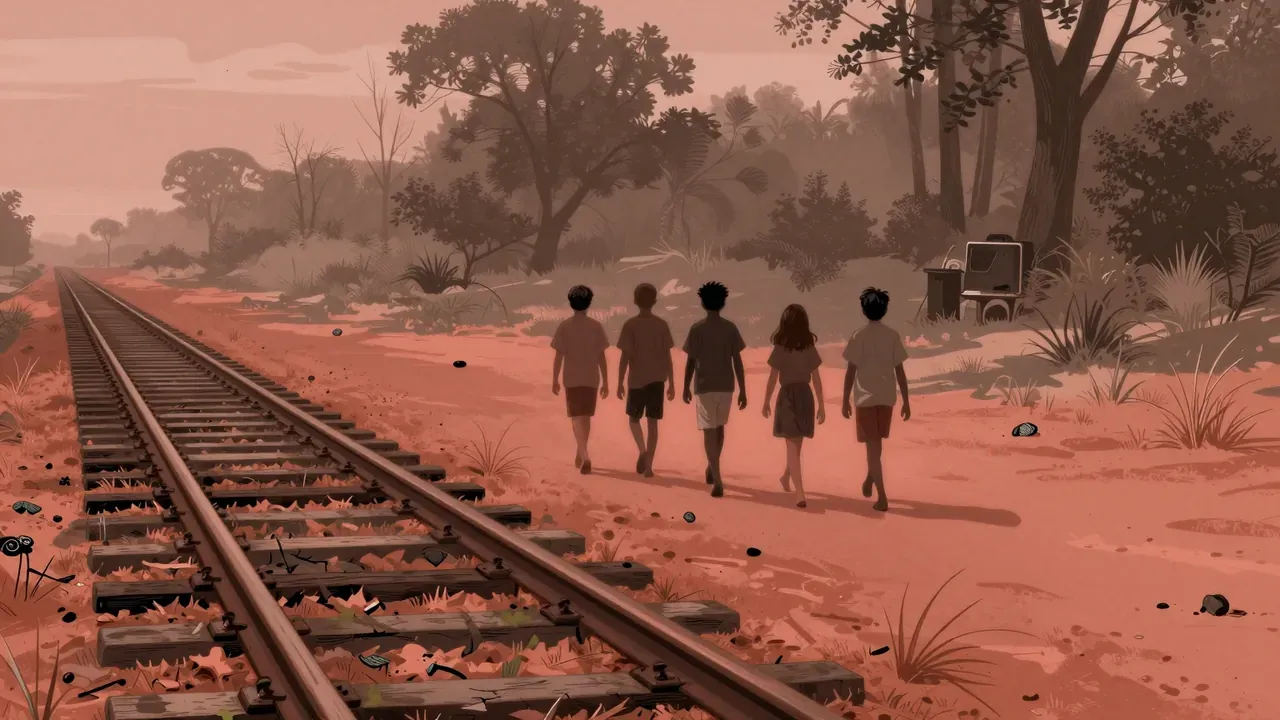
What lands is the film’s tactile authenticity: the stickiness of sweat on skin, the way light falls across peeling paint on a porch step, the hesitant intimacy between children who have not yet learned to perform affection. The portrayal of George Richardson’s condition — never medicalised, never pitied, simply lived with — avoids sentimentality while carrying deep emotional gravity. The ensemble’s collective stillness feels earned, not studied: these are not children acting out roles, but presences calibrated to a shared tempo. The film’s most resonant moments are those without incident — Nasia watching rain gather on a windowpane, Vernon tracing cracks in asphalt, the group walking single-file along railroad ties at dusk. These scenes land because they resist interpretation; they exist as sensory facts. The decision to shoot in Winston-Salem with local non-actors pays off in texture, not novelty: accents, gestures and spatial habits feel rooted, not curated. Even the budgetary constraint — $42,000 — becomes an aesthetic virtue: the film’s modesty is inseparable from its honesty. It does not ask to be admired, only witnessed.
The children in it
What does not land is the film’s resistance to narrative cohesion when it crosses into opacity. Some sequences — particularly those involving the adults — drift without sufficient grounding, leaving motivation and consequence unclear. The railroad workers’ subplot remains atmospheric but underdeveloped, their relationship to the children’s tragedy never quite cohering beyond mood. A few transitions feel arbitrary, as if editing choices prioritise rhythm over continuity, and the film’s deliberate pace risks alienating viewers who expect causal clarity or psychological exposition. The absence of music — or even diegetic source cues — intensifies realism but also flattens emotional contour in places where tonal variation might deepen impact. One or two performances falter in their restraint, lapsing into vacancy rather than interiority. And while the film’s refusal to explain George’s condition is ethically sound, it occasionally leaves his agency ambiguous — not as mystery, but as omission. These are not failures of intent, but of balance: the film’s discipline sometimes shades into withholding.
The adults beside it
The themes that matter are memory as physical sensation, responsibility as something carried silently rather than declared, and community as a web of unspoken obligations rather than shared belief. Poverty here is not a backdrop but a grammar — shaping how people move, speak, wait, look away. Disability is presented as bodily fact, not metaphor: George’s skull is neither tragic nor heroic, just part of how he holds himself in space. Race operates quietly, structurally: the children’s multi-racial friendships are unremarkable within their world, yet their environment bears the imprint of segregation’s afterlife — in housing stock, infrastructure neglect, adult resignation. Time is treated as thick and viscous, not linear: the summer does not progress, it accumulates. Regret is not retrospective but immediate — felt in the pause before a lie, the hesitation before a touch. The film’s deepest concern is with what children absorb before they can name it: the weight of adult failure, the fragility of belonging, the way grief settles into routine. These are not ideas argued, but atmospheres sustained.
The weight it carries
This film is for viewers who value atmosphere over exposition, who find emotional resonance in stillness, and who accept that some stories refuse resolution because life does. It rewards patience, attention to texture, and comfort with ambiguity. It is not for those who require clear cause-and-effect, character arcs with defined turning points, or narrative momentum that builds toward catharsis. Viewers expecting social realism with explanatory dialogue or coming-of-age films structured around decisive choices will find it elusive. Those who associate ‘Southern Gothic’ with overt grotesquerie or melodrama may misread its restraint as emptiness. The film assumes a willingness to sit with discomfort without demanding it be named — a stance that some will find generous, others frustrating. Its appeal narrows with familiarity: repeated viewings reveal subtleties, but first-time viewers may mistake its slowness for slackness. That said, its power is not contingent on prior knowledge — only on openness to a different contract between film and viewer.
The time it takes
Yes, it is worth your evening — provided you watch it on your terms, not the film’s. It demands nothing but attention, and repays it with a rare kind of immersion: not in story, but in sensation and implication. Its 89 minutes pass without hurry, yet leave a residue that lingers longer than many two-and-a-half-hour epics. You do not need to love slow cinema to feel its weight — only to tolerate silence, trust understatement, and accept that some truths are held in posture, not speech. Those who dismiss it as ‘undistinguished’ (as one Variety critic did) are not wrong about its surface calm; they simply value different kinds of intensity. What would change the verdict? A different viewing context — say, a rushed screening on a small screen with distractions — would blunt its effect. But seen attentively, in the right frame, it is not merely worth an evening. It reorients how an evening can be spent.