The premise as liturgy
The Ballad of Narayama is a 1958 Japanese historical drama, adapted by Keisuke Kinoshita from Shichirō Fukazawa’s 1956 story. It depicts a fictionalised mountain village in late Edo-period Japan where the custom of ubasute — abandoning elders on Mount Narayama at age seventy — is observed as communal law. Kinoshita does not treat this as ethnographic reportage but as a ritualised parable: the film seeks to stage moral inevitability through stylisation, not realism. Its aim is not to explain why ubasute existed, but to ask what kind of world sustains such a practice without rupture — one where duty and dignity are inseparable, and where compassion wears the face of austerity. The film avoids psychological exposition or social critique in favour of formal rigour: every gesture, line of dialogue, and compositional choice serves the weight of collective obligation. It is less about ageing than about the architecture of acceptance — how a society constructs meaning around sacrifice so absolute it requires no justification. This is not folklore retold; it is folklore re-enacted as liturgy. (142 words)
The look of it
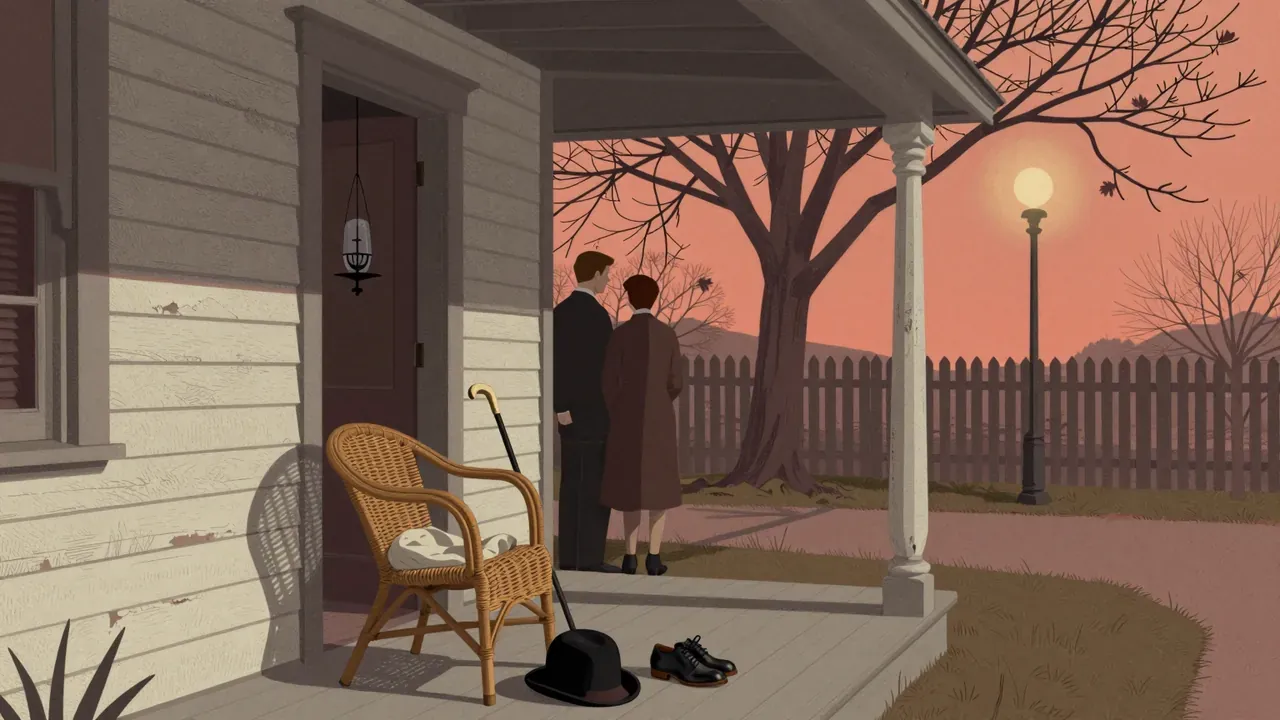
Kinoshita structures the narrative around Orin’s final month before her ascent, compressing time and flattening cause-and-effect into a sequence of ceremonial acts. Kinuyo Tanaka’s performance is restrained, precise, uninflected — she neither pleads nor resists, embodying resignation as discipline. Seiji Miyaguchi and Teiji Takahashi deliver similarly measured turns, their characters’ emotions held in check by social grammar rather than suppressed. Gordon Willis is not involved; the cinematography is by Tatsuo Suzuki, who uses high-contrast black-and-white, shallow focus, and static tableaux modelled on kabuki staging — painted backdrops, deliberate blocking, frontal framing. The score by Ichirō Saitō employs shamisen and koto with sparse, percussive punctuation. Editing is rhythmic rather than narrative-driven: cuts align with breath or gesture, not plot logic. There are no establishing shots of the village; geography is implied through repetition and costume. Dialogue is terse, often chanted or sung in folk-song cadence. The film’s craft is unified: every element reinforces its theatricality, treating the village not as a place but as a stage set for ethical rehearsal. (157 words)
The weight of stillness
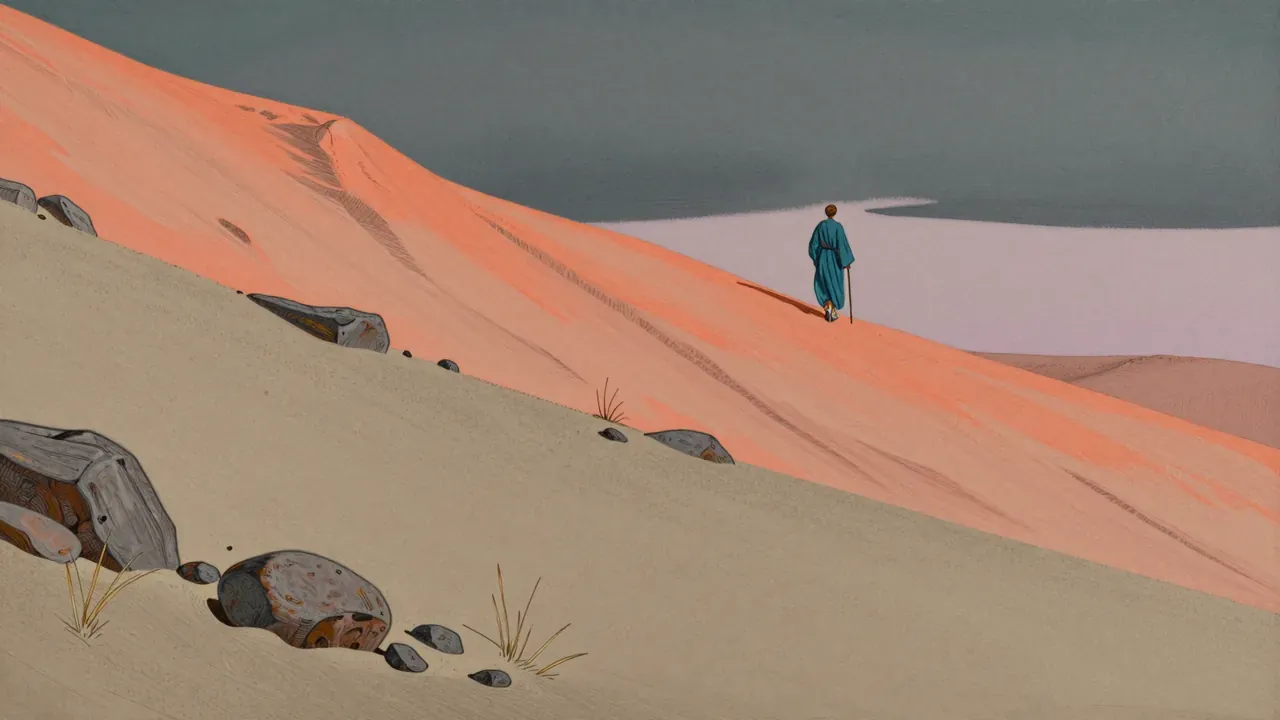
What lands is the cumulative force of its restraint. Orin’s quiet preparations — pulling her own teeth, arranging her funeral shawl, blessing her grandson — gain gravity because nothing else in the film distracts from them. The stylisation does not distance; it clarifies. When Orin climbs the mountain alone, the camera holds her small figure against an immense, bare slope, and the absence of music or close-up makes the act feel inevitable, not tragic. The kabuki-inflected staging works precisely because it refuses naturalism: it asks the viewer to read gesture as meaning, silence as argument. Tanaka’s stillness reads as agency, not passivity — her choices are made long before the journey begins. The film’s moral weight comes not from outrage at ubasute, but from witnessing a life lived entirely within its terms, without irony or evasion. That coherence — between form, theme, and performance — gives the film its rare authority. It does not persuade; it presents. And in that presentation, it achieves something few period dramas manage: it makes custom feel as tangible as weather. (148 words)
Where the form holds firm
What does not land is the film’s occasional rigidity when it mistakes austerity for depth. Some scenes — particularly those involving secondary characters like Tamayan or Kesakichi — feel schematic, their functions too neatly assigned to moral allegory. The village operates as a single moral organism, which flattens individual contradiction and leaves little room for ambiguity beyond Orin’s stoicism. A subplot about grain shortages dissolves without consequence, suggesting narrative discipline was sacrificed for symbolic economy. The kabuki stylisation, while coherent, can also deaden emotional variation: grief, anger, doubt are all rendered in the same tonal register, making moments meant to unsettle feel merely formal. Western viewers unfamiliar with jidaigeki conventions may find the pacing impenetrable not because it is slow, but because its rhythms do not signal emotional shifts in ways they recognise. Kinoshita’s refusal to dramatise internal conflict means the film has no pivot — only procession — and that risks monotony for those expecting psychological progression. (149 words)
The ethics of routine
The themes that matter are not ageing or mortality in the abstract, but the social choreography of decline: how communities codify care, obligation, and disposal. The film treats inheritance not as property but as burden — not just material scarcity, but the weight of memory, precedent, and precedent’s cost. It interrogates interdependence as coercion disguised as harmony: Orin’s sacrifice is voluntary only insofar as refusal would unravel the village’s self-understanding. Kinoshita avoids judging the practice, but insists on its logic — a logic rooted in finite resources, fixed seasons, and the belief that dignity lies in timing, not duration. There is no nostalgia here, no lament for lost tradition; instead, a cold-eyed account of how ethics calcify into ritual. The film’s most persistent motif is substitution: one generation replaces another, one body replaces another’s labour, one story replaces another’s voice. What endures is not the person, but the pattern. That pattern is neither condemned nor endorsed — it is simply shown, in full, unblinking detail. (145 words)
Who it meets halfway
This film is for viewers who value formal precision over narrative propulsion, and who approach cinema as a medium of embodied philosophy rather than storytelling. It suits those familiar with kabuki aesthetics or Japanese postwar jidaigeki, and those willing to sit with silence and repetition as expressive tools. It is not for viewers who require psychological motivation, causal plotting, or emotional escalation — those who expect character arcs or moral resolution will find it withholding. It is also poorly served by distracted viewing: its power depends on sustained attention to rhythm and composition, not isolated ‘moments’. Someone who values Roger Ebert’s four-star assessment may still find it alienating if they expect the warmth or intimacy of his usual canon. A change in pacing, or even a single inserted flashback revealing Orin’s past, would shift the verdict — but Kinoshita’s commitment to austerity is total, and the film’s integrity rests on that refusal. (142 words)
The measure of its demand
Yes, it is worth your evening — but only if you meet it on its own terms. It demands ninety minutes of undivided attention, not as background or mood, but as active participation in its formal logic. Its value lies not in entertainment or catharsis, but in the clarity of its vision: a world where ethics are structural, not personal, and where dignity is measured in composure, not survival. Those who watch it expecting drama in the Western sense may leave unsatisfied; those who watch it as a study in cinematic discipline will find it unforgettable. It is not a film to be liked, but one to be reckoned with — and reckoning takes time. Its endurance in critical esteem — from Venice 1958 to Criterion 2013 — reflects not consensus, but the persistence of its challenge. To dismiss it as ‘strange’ or ‘stylised’ is to miss its point: strangeness is the condition of its honesty. (144 words)