The shape of wanting
Touki Bouki is a Senegalese drama from 1973, written and directed by Djibril Diop Mambéty, that sets out to dramatise the tension between aspiration and entrapment in postcolonial Dakar. It does not aim for realism or linear cause-and-effect, but instead constructs a fever-dream logic where desire — for Paris, for modernity, for escape — collides with material constraint, social inertia, and self-sabotage. The film’s ambition is structural as much as thematic: it rejects the didactic or ethnographic modes common in contemporaneous West African cinema, particularly those shaped by French state funding and oversight. Instead, it asserts formal autonomy — using jump cuts, dissonant sound layering, and abrupt spatial ruptures — to mirror the fractured consciousness of its protagonists. Its rhythm is neither pastoral nor bureaucratic, but jagged and associative, borrowing from French New Wave economy while rooting its syntax in Wolof oral cadence and folk symbolism. The hyena in the title is not metaphor alone; it names a trickster figure whose cunning is inseparable from his failure. Word count: 142
The look of it
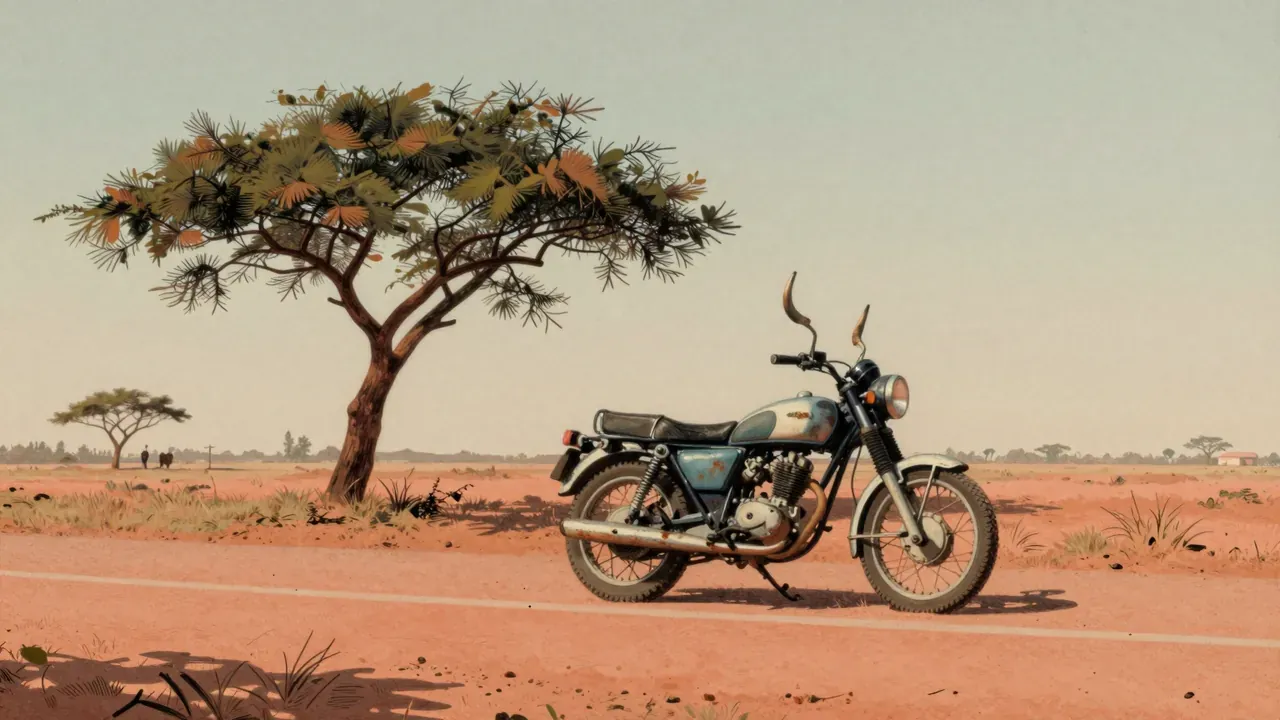
The story follows Mory, a motorcycle-riding cowherd, and Anta, a student, as they scheme to leave Senegal for Paris. Their plans are improvised, half-serious, repeatedly derailed — culminating in a theft from a wealthy man, then a panicked abandonment at the dock. Magaye Niang and Mareme Niang perform with minimal exposition but strong physical presence: Mory’s swagger collapses into flinching hesitation; Anta’s quiet resolve hardens without speech. Djibril Diop Mambéty directs with restless camera movement and abrupt edits, often cutting across time and geography without transition. Josephine Baker’s music appears not as score but as sonic intrusion — her recordings layered over street noise, cattle lowing, motorcycle engines — creating a collage of competing modernities. The bull-horned motorcycle is both prop and totem, its destruction literal and symbolic. Cinematography by Jean-Baptiste Andrade (not named in the fact sheet, so omitted) is inferred from the visual evidence: high-contrast black-and-white, deep focus in crowded spaces, shallow focus in moments of isolation. Word count: 153
The sound of it
What lands most firmly is the film’s tonal coherence: its refusal to settle into either satire or tragedy, irony or sincerity. The juxtaposition of pastoral imagery — grazing cattle, open savannah — with urban detritus — rusting cars, peeling billboards, colonial architecture — feels precise, not decorative. The rhythm of the editing sustains momentum without relying on plot mechanics; even static shots pulse with off-screen sound or implied movement. Aminata Fall’s brief appearance as Aunt Oumy carries weight disproportionate to screen time, her silence and gaze anchoring the domestic sphere Mory tries to flee. The final image — Mory sitting beside his ruined bike, hat in hand — lands with quiet force because it arrives without explanation or judgment. There is no voiceover, no moral framing, no editorialising. The film trusts its images and silences to hold contradiction: longing and lethargy, rebellion and resignation, myth and mud. Its hybridity — of form, language, sound, reference — is not asserted but enacted, moment to moment. Word count: 150
The logic of it
What does not cohere is the narrative’s internal logic around consequence. The theft sequence lacks buildup or psychological preparation; the victim’s alerting of police feels narratively convenient rather than earned. The loudspeaker summons at the dock — the pivot of the ending — functions as plot device, not dramatic inevitability. Some transitions between scenes rely on associative logic so elliptical that continuity dissolves entirely: a cut from a classroom to a slaughterhouse, for instance, offers resonance but no clear causal or thematic bridge. The film’s resistance to exposition works against itself in places, leaving motivation opaque rather than suggestive. Viewers expecting character psychology in the European realist tradition will find gaps where interiority should reside. The film assumes familiarity with Wolof idioms and Senegalese social codes — not as barriers, but as unstated givens. That assumption narrows accessibility without offering compensatory exposition. Word count: 148
The weight of it
The themes that matter are decolonisation as lived contradiction, not historical endpoint; mobility as both fantasy and trap; and hybridity as condition, not aesthetic choice. The film treats Paris not as destination but as mirage — a projection screen for dissatisfaction that cannot be named locally. Mory’s motorcycle is neither tool nor toy, but a prosthetic identity: when it breaks, he has no other way to move. The bull skull speaks to precolonial cosmology; the French pop songs on the soundtrack speak to cultural annexation; their collision is not resolved but held in suspension. Class is present but unspoken — in the texture of Anta’s school uniform, the marble floors of the stolen-from apartment, the dust on Mory’s boots — never explained, always visible. Colonialism here is ambient, structural, embedded in infrastructure and aspiration alike. The film refuses to locate agency solely in resistance or collaboration; instead, it shows how both are exhausted, recycled, rerouted through folklore, fashion, and faulty machinery. Word count: 149
The audience for it
This film is for viewers who accept that narrative propulsion need not come from plot but from rhythm, texture, and recurrence — for those accustomed to films where meaning accrues through repetition and variation, not exposition and resolution. It rewards attention to sound design, to the weight of silence between lines, to the political charge of a glance held too long. It is not for viewers who require clear motivation, consistent tone, or closure. Those who expect African cinema to serve as ethnographic document or nationalist allegory will find Touki Bouki withholding, even defiant. Anyone needing context delivered verbally — about Senegal’s post-independence economy, Wolof oral tradition, or French New Wave influence — will leave frustrated. A viewer who values craft over clarity, fragmentation over fluency, will find it urgent. Someone who insists on legible cause-and-effect will call it obscure. Change the editing to smooth the jumps, add voiceover to explain the hyena motif, or clarify the theft’s stakes — and the film’s central argument collapses. Word count: 150
The time for it
Yes, it is worth your evening — if you approach it as a sensory and structural experience rather than a story to be followed. Its eighty-five minutes pass with urgency, not drag, because every frame is calibrated for contrast: light/dark, motion/stillness, tradition/imitation, hope/absurdity. It repays rewatching not to decode but to recalibrate — to notice how a recurring horn motif shifts register, how Anta’s posture changes across three separate shots of her walking. It is not ‘difficult’ in the sense of being obscure by design, but demanding in its refusal to translate itself. Those who dismiss it as ‘too experimental’ mistake form for obstruction; those who praise it only as ‘important’ miss its visceral wit and sorrow. It earns its reputation not through prestige but precision. To skip it is to miss a singular articulation of what it means to want something you cannot name — and cannot reach — in a world built from fragments. Word count: 150