The title is coincidental
Sunrise (1985) is a Chinese drama film directed by Yu Benzheng and produced by Shanghai Film Park. It does not adapt or reference the 1927 American silent film of the same name — no shared title, cast, crew, source material, or thematic intent links the two beyond coincidence. The film belongs to the post-Mao domestic realist tradition in Chinese cinema: grounded in provincial life, attentive to moral ambiguity, and shaped by socialist humanist concerns rather than expressionist abstraction or mythic allegory. Its aim is neither formal experiment nor political polemic, but psychological fidelity — to trace how economic pressure, generational expectation, and quiet resentment corrode intimacy within a working-class household. The script, by Wan Fang, treats its characters as socially situated individuals, not symbols; their conflicts arise from rent arrears, factory layoffs, and unspoken compromises, not metaphysical dualities or erotic temptation. There is no stylistic rupture, no voiceover, no non-diegetic music listed in the fact sheet — the film’s method is observational, its tone restrained, its emphasis on duration and silence over revelation.
The look of it
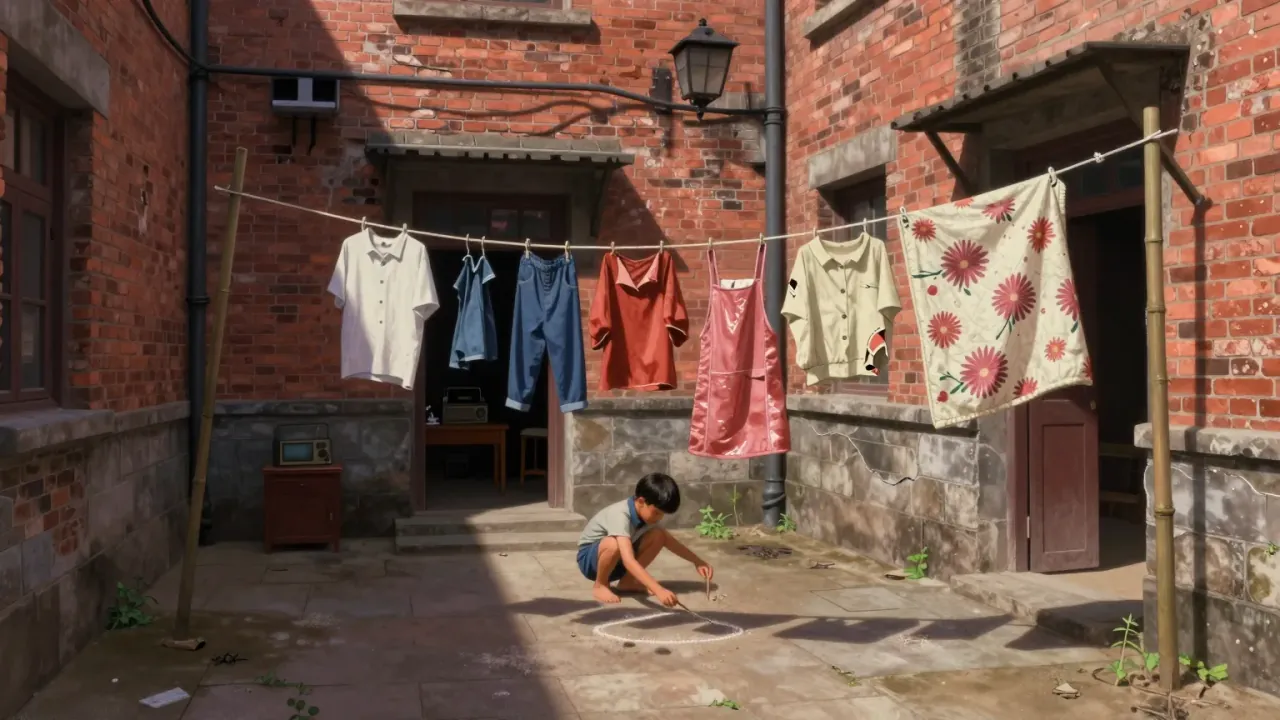
The story follows a married couple — played by Fang Shu and Wang Shihuai — whose relationship frays under the weight of unemployment and housing insecurity. A younger woman, portrayed by Wang Fuli, enters their orbit not as a seductress but as a former neighbour now working in a textile co-op; her presence reopens old tensions rather than inciting new ones. Zhu Yongde’s cinematography avoids flourish: interiors are lit with naturalistic flatness, street scenes use shallow focus only where depth of field would obscure social detail, and long takes hold on hands, doorways, and unmade beds rather than faces. Performances are muted and physically economical — Wang Shihuai’s character rarely raises his voice, and Fang Shu conveys withdrawal through posture and pauses, not monologue. Editing is functional, favouring continuity over rhythm; no montage sequences, no symbolic dissolves. The film’s craft serves verisimilitude: costumes match 1980s Shanghai municipal workwear, dialogue is delivered in unadorned Mandarin without regional affectation, and the 149-minute runtime reflects the cumulative weight of small decisions, not narrative urgency.
The weight of it
What lands is the accumulation of lived texture: the way steam rises from a shared bowl of noodles at dawn, the sound of a bicycle bell echoing down a narrow lane before cutting to silence, the hesitation before a knock on a neighbour’s door when asking to borrow rice. These moments do not build to catharsis but to recognition — of how dignity persists in routine, how love contracts without vanishing, and how economic precarity reshapes even the grammar of apology. The film’s restraint becomes its authority: it refuses to moralise the husband’s brief affair with Wang Fuli’s character, nor does it sentimentalise the wife’s stoicism. Instead, it holds both as equally plausible responses to structural strain. The Hundred Flowers and Huabiao Awards signal official acknowledgment of this balance — not as propaganda, but as socially responsible storytelling. The performances gain resonance precisely because they avoid theatricality: Wang Futang’s supporting turn as a retired cadre who mediates disputes with dry humour lands because it feels drawn from memory, not rehearsal. The film earns its length by making time itself a character — not as metaphor, but as measurable, unspooling duration.
The drag of it
What does not land is any sense of forward propulsion in the second hour. The film’s commitment to realism begins to read as inertia: repeated shots of rain on windowpanes, extended silences that lack subtextual charge, and three separate scenes of characters sorting laundry do not deepen character or advance tension — they dilute it. The absence of a clear dramatic spine beyond ‘marriage under stress’ leaves certain passages feeling like documentation rather than dramatisation. Wang Fuli’s character, though well-acted, remains underwritten — her motivations shift without sufficient cause, and her exit from the central triangle arrives without emotional preparation. The score, if present, is not credited and therefore cannot be assessed; the fact sheet lists no composer, suggesting diegetic sound only, which limits tonal variation. Some viewers may find the pacing incompatible with sustained attention — not because it is slow by design, but because the slowness lacks rhythmic intention. A tighter edit, perhaps trimming fifteen minutes from the middle act, would sharpen its impact without sacrificing its ethos.
The ethics of it
The themes that matter are endurance without reward, care as labour, and the quiet violence of normalised scarcity. The film treats poverty not as crisis but as condition — something absorbed into posture, speech patterns, and the spacing between people on a bus. Class is shown through access: who has a spare room for guests, who borrows soy sauce, who reads the newspaper aloud to an illiterate parent. Gender is rendered through division of unpaid work: the wife mends clothes while the husband reads technical manuals, yet both are equally exhausted — their fatigue is identical in weight, different in register. Memory functions not as nostalgia but as liability: flashbacks to the couple’s wedding are shot in the same flat light as present-day scenes, denying them warmth or distance. There is no redemption arc, no sudden windfall, no ideological resolution — only incremental recalibration. The film’s moral centre lies in its refusal to assign blame: the factory manager who cuts shifts is not villainous, the landlord who demands rent is not cruel, and the wife’s eventual decision to stay is not forgiveness but calculation — a choice made with eyes open, not heart closed.
The audience for it
This film is for viewers who value psychological granularity over plot mechanics, and who accept that realism need not be urgent to be urgent in its implications. It suits those familiar with mid-1980s Chinese social history — the dismantling of danwei welfare, the rise of informal markets, the generational gap between revolution-era cadres and post-Cultural Revolution youth — but does not require that knowledge to follow its emotional logic. It is not for viewers seeking narrative momentum, stylistic distinction, or moral clarity. Those who expect drama to resolve conflict will find its open-endedness frustrating; those who associate Chinese cinema with either revolutionary pageantry or Fifth Generation visual boldness may mistake its plainness for absence. A viewer who values editing as punctuation, or music as emotional cue, will feel adrift — the film offers neither. What would change the verdict? A stronger antagonist — not a person, but a system — given sharper definition; or a more distinctive sonic signature, even if diegetic only. Without either, its power remains local, not cumulative.
The worth of it
Yes, it is worth your evening — but only if you approach it as a study in persistence, not as entertainment. Its 149 minutes ask for patience, not surrender; its rewards are cumulative, not climactic. You will not leave exhilarated, but you may leave altered — noticing how your own silences carry weight, how your own routines encode compromise. It is not for the impatient, the allegorically inclined, or those who require closure. Critics who rate it highly tend to foreground its sociological precision; those who find it inert often cite its resistance to conventional dramaturgy. Its value lies in what it refuses: to simplify, to judge, to elevate suffering into spectacle. That refusal is deliberate, and it is the film’s most consistent achievement. To watch it is to sit with discomfort that has no name — and to recognise that discomfort as shared, ordinary, and quietly consequential. That is not minor. It is exacting. And it takes time.