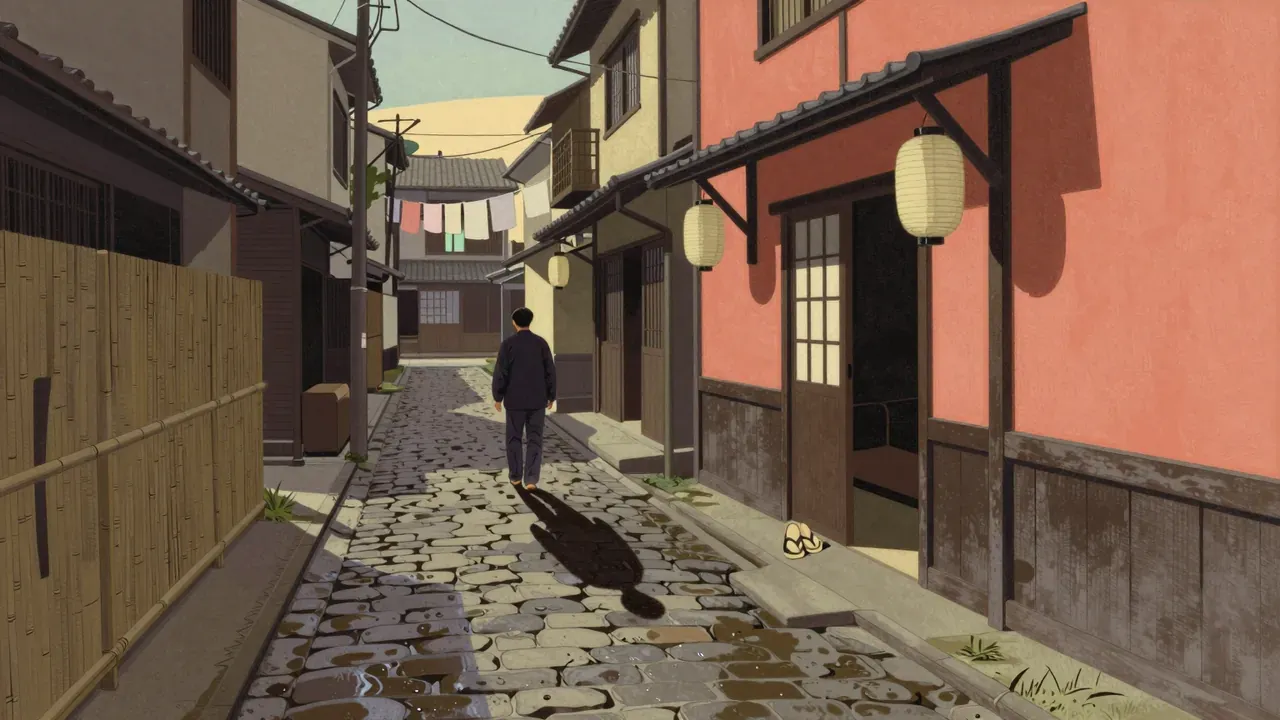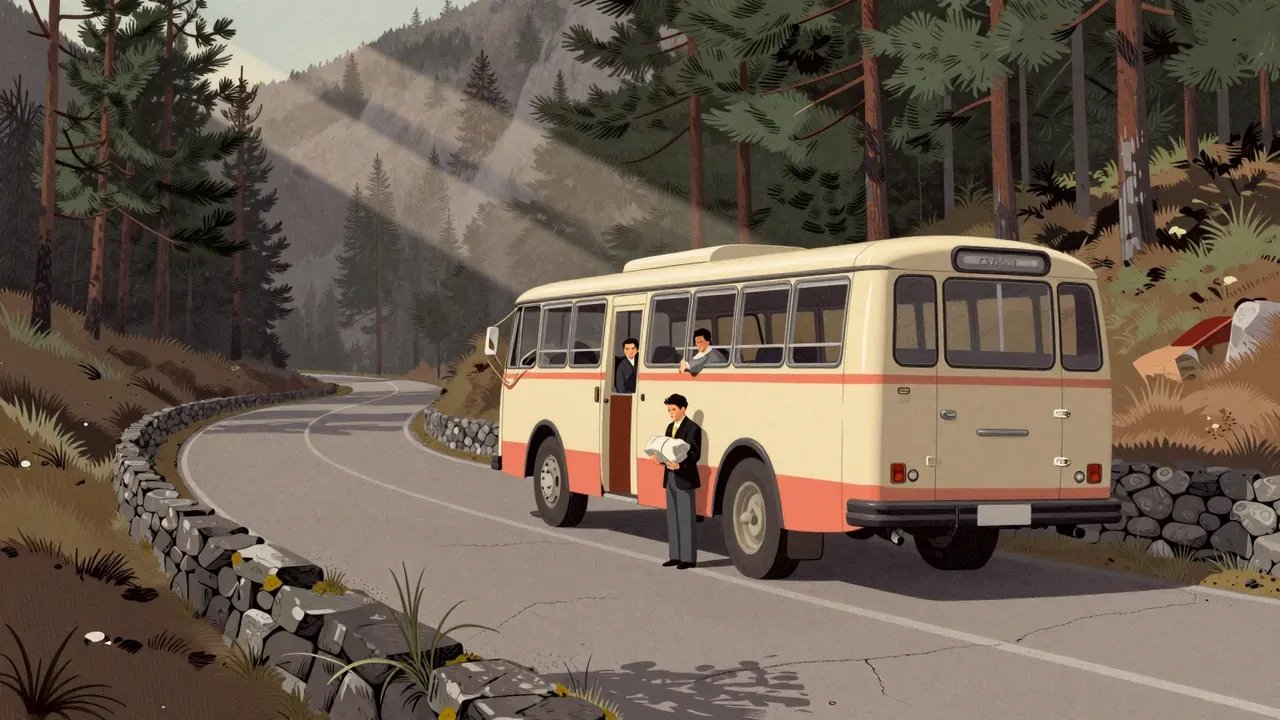
The path down the mountain
The Masseurs and a Woman is a 66-minute Japanese drama made by Shochiku in 1938, written and directed by Hiroshi Shimizu. It belongs to a cluster of his films — including Mr. Thank You and Ornamental Hairpin — that observe transient groups in motion: people passing through spa towns, mountain paths, or railway stations, bound not by family or duty but by brief proximity. Shimizu does not aim for narrative resolution or moral clarity. Instead, he attends to the quiet accumulation of gesture, hesitation, and sensory detail — the weight of a pause, the way light falls on a tatami mat, the sound of footsteps on gravel. The film’s purpose is not to explain its characters but to hold them in gentle, unsentimental focus: blind masseurs, a woman fleeing an unseen arrangement, a man with a nephew in tow. Its ambition lies in restraint: in showing how feeling persists even when speech fails, and how dignity resides in small, unremarked acts of attention. It is a domestic drama without domesticity — set in rented rooms and shared corridors, where intimacy is tactile rather than verbal, and where social hierarchy is felt more than stated.
The hands that know
The story unfolds across three days at a rural hot-spring inn, structured less by cause-and-effect than by recurrence and contrast: Toku and Fuku arrive as outsiders; the woman appears, then withdraws; thefts unsettle the surface calm; a carriage departs. Shin Saburi plays Shintarō with minimal inflection — a man whose concern for the woman is neither romantic nor paternal, but quietly observational. The blind masseurs move with precise physicality; their blindness is rendered not as limitation but as recalibration — their hands and ears doing the work sight usually does. Gordon Willis is not involved; the cinematography is by Kōzō Okazaki, who keeps compositions shallow and grounded, favouring medium shots and lateral movement along corridors and verandas. Lighting is soft, often diffused by shoji screens. Editing avoids emphasis: cuts land without punctuation, scenes end before they resolve. There are no musical cues to guide emotion; silence and ambient sound — wind, water, distant voices — carry the rhythm. The craft serves duration over drama: time passes, people linger, nothing is forced.
The silence between words
What lands is the film’s fidelity to minor emotional weather. Toku’s recognition of the woman by her ‘Tokyo smell’ is not whimsy but a plausible anchor for memory — a detail rooted in embodied experience rather than exposition. The scene where he misreads her guilt, then revises his understanding without fanfare, works because it mirrors how people actually adjust perception: slowly, privately, without declaration. The final image — Toku and Shintarō watching the carriage recede — lands not as closure but as quiet acknowledgment: some departures leave no residue, only the faint echo of a choice made elsewhere. The film’s patience allows space for this kind of understated resonance. It trusts the viewer to notice how a character’s posture shifts when someone enters the room, or how a servant’s glance holds just a beat too long. These moments do not build to a point, but they accumulate into something like empathy — not as identification, but as sustained, unflinching regard.
Theft and absence
What does not land is any attempt to read the woman’s interior life beyond what the film shows. Her motivations remain opaque, not by design but by omission: there is no dialogue that clarifies her history, no flashback, no confiding aside. This may be intentional — Shimizu’s style avoids psychological exposition — but it risks flattening her into a cipher, a catalyst for others’ feelings rather than a subject in her own right. Similarly, the theft subplot dissolves without consequence or explanation, leaving a structural gap where tension might have cohered. Some viewers will find the pacing indistinguishable from stasis: scenes linger without apparent shift in tone or direction, and the lack of narrative propulsion may feel like drift rather than discipline. The film assumes familiarity with Shochiku’s Ōfuna aesthetic — low-key, domestic, anti-sensational — and those unfamiliar with that tradition may mistake its stillness for emptiness, its reserve for indifference.
The weight of service
The themes that matter are transience, perception, and the quiet politics of dependence. The spa town is a microcosm of temporary society: guests rotate, staff stay, services are rendered and paid for, relationships form and dissolve without ceremony. Blindness here is not metaphorical but functional — it reorders hierarchy, making touch and listening primary modes of knowing. The film treats care as labour, not sentiment: the masseurs’ hands are instruments, not symbols. Class is present but unspoken — in the deference shown to guests, the way servants move through doorways, the fact that the woman’s patron is never seen but always implied. There is no critique of this order, only its steady observation. What emerges is not a thesis but a texture: how people navigate constraint, how dignity persists in service, how freedom can look like departure — and how little we ever truly know about the person sitting across from us at breakfast.
The carriage at the gate
This film is for viewers who value sustained attention over narrative payoff, who find interest in the interval between gestures, and who accept that character may be revealed more clearly in how someone pours tea than in what they say about themselves. It suits those familiar with interwar Japanese cinema or with directors like Ozu and Naruse, whose work shares this economy of means. It is not for viewers who require clear motivation, plot momentum, or psychological exposition — those expecting a conventional drama about love or injustice will find it elusive. A viewer who values thematic clarity over atmospheric precision may leave frustrated. The film’s refusal to name its woman’s situation — or to condemn her patron — is not evasion but alignment with its own ethics: some things remain outside the frame, and that is part of the truth it holds.
The last walk back
Yes, it is worth your evening — if you approach it as a study in restraint rather than a story to be followed. Its 66 minutes pass without hurry, but not without weight: every shot has been composed to hold attention without demanding it. Those who find pleasure in the grain of film stock, the rhythm of walking pace, or the ambiguity of a glance held too long will feel its quiet authority. It is not for viewers who need resolution, exposition, or emotional signposting — and those who expect drama to clarify rather than complicate will likely disengage. The verdict rests on whether you trust slowness as a mode of seriousness. If you do, this film repays attention with cumulative precision. If you do not, no amount of historical context will make it click. Its value is not in what it says, but in how steadily it looks.