The shape of the story
The Squid and the Whale is a tightly wound, semi-autobiographical drama set in 1986 Brooklyn, tracing the fracture of a literary family through the eyes of two adolescent sons. It aims not for catharsis or resolution but for fidelity—to the awkward syntax of real speech, to the unvarnished self-deception of adults, and to the way children absorb parental conflict as moral instruction. Noah Baumbach strips away exposition, avoids establishing shots, and refuses to pause for reflection; scenes bleed into one another, dialogue overlaps edits, and emotional weight accrues through accumulation rather than emphasis. The film’s structure mirrors its subject: a system under stress, where cause and effect blur, and every gesture carries disproportionate consequence. Shot on Super 16 mm with steady handheld camerawork, it sustains an intimate, slightly grainy immediacy—less like watching memory than being inside it. Its ambition is modest in scope but exacting in execution: to render divorce not as event but as atmosphere, permeating language, posture, music choice, and even the way a boy folds his arms when he lies.
The sound of voices
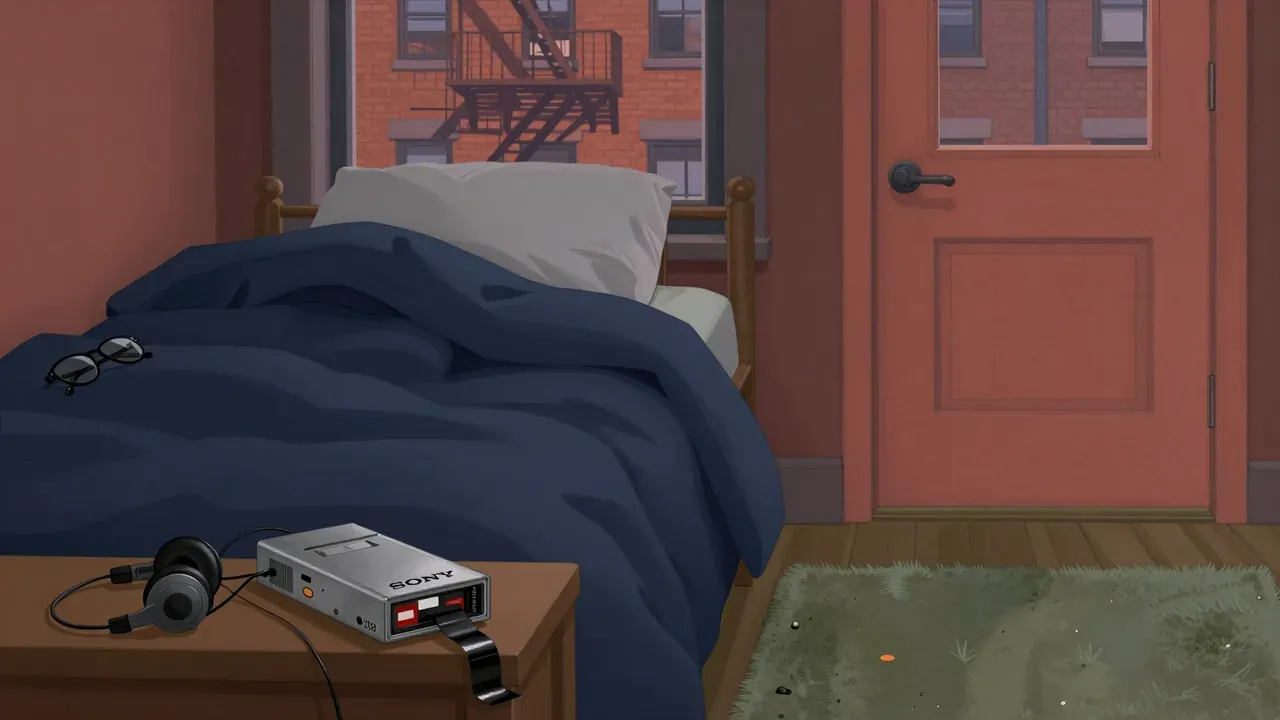
The story unfolds in lean, unsentimental strokes: Bernard Berkman’s professional decline and intellectual arrogance, Joan’s quiet emergence as a writer, Walt’s brittle mimicry of his father’s mannerisms and ethics, Frank’s fumbling attempts at agency through rebellion and imitation. Jeff Daniels gives Bernard a clipped, performative certainty that never quite masks his fragility; Laura Linney holds Joan’s exhaustion and resolve in the same breath, her stillness more charged than any outburst. Jesse Eisenberg and Owen Kline—both non-professionals at the time—deliver performances that feel lived-in, not rehearsed: their line readings are hesitant, sometimes flat, always truthful. Robert Yeoman’s cinematography keeps compositions tight and off-centre, favouring medium two-shots and over-the-shoulder framing that heightens discomfort. Britta Phillips’ score is sparse, mostly diegetic, with Pink Floyd’s ‘Hey You’ functioning less as motif than psychological anchor—heard first as background, then as confession, then as shared vocalisation between brothers. The editing, by Jennifer Lame, sustains Baumbach’s directive: no breathing room, no punctuation, only forward motion.
The weight of detail
What lands most decisively is the film’s tonal precision—the way it balances acid wit and quiet devastation without tipping into either farce or melodrama. Walt’s plagiarism of ‘Hey You’ works because it is neither cartoonish nor excused; it is a logical extension of his father’s worldview, where authorship is performance and influence is theft only when unacknowledged. The museum diorama functions not as metaphor but as structural pivot: its recurrence anchors the film’s emotional arc without stating it outright. Small details land with cumulative force—the way Bernard corrects Frank’s grammar mid-sob, how Joan hums while folding laundry after a shouting match, the precise rhythm of Walt’s lie about Lili’s age. These are not flourishes but evidence: the film trusts the audience to infer motive from gesture, history from silence. Even the soundtrack choices—Loudon Wainwright III’s wry fatalism, The Cars’ hollow yearning—feel earned, not curated. Nothing is underlined. Everything is weighted.
The edges of the frame
What does not land is the film’s occasional reliance on shorthand for emotional complexity—particularly in Ivan, whose caricatured masculinity feels less like satire than narrative convenience. William Baldwin plays him with broad physicality, but the script gives him no interiority beyond function: foil, rival, object of Frank’s mimicry. Similarly, Anna Paquin’s Lili remains underwritten; her relationship with Bernard registers as transactional, yet the film offers no insight into her perspective beyond what serves Walt’s disillusionment. There is also a narrowness in the film’s social world: Park Slope’s insularity is rendered so thoroughly that class operates as backdrop, not pressure point—no sense of economic precarity beyond Bernard’s agent troubles, no reckoning with how privilege cushions the fall. The film’s refusal to explain or contextualise these omissions is deliberate, but it leaves certain characters stranded as types rather than people. That restraint serves the central quartet well—but elsewhere, it reads less like discipline and more like omission.
The grammar of feeling
The themes that matter are inheritance—not of property or name, but of voice, posture, and self-justification. Walt does not just copy Bernard’s opinions; he copies his cadence, his contempt for sentiment, his habit of turning vulnerability into intellectual critique. The film treats language as both weapon and wound: Bernard’s essays on Dostoevsky double as defences against his own failure; Joan’s published stories quietly dismantle his authority; Walt’s plagiarism is less about laziness than about believing authorship is mimicry perfected. Another theme is the asymmetry of parental presence: Bernard demands attention even in collapse; Joan’s care is quieter, dispersed across domestic labour and emotional containment. The squid-and-whale diorama becomes a silent third theme—predation as natural law, scale as terror, observation as safety. The film suggests children do not learn from what parents say, but from how they hold space, how they listen (or don’t), and what they permit themselves to feel in front of others.
The terms of engagement
This film is for viewers who value precision over comfort—those willing to sit with unresolved tension, unlikable protagonists, and endings that offer clarity without solace. It suits readers of Chekhov or Alice Munro, fans of Cassavetes’ domestic realism, or anyone who finds emotional honesty more compelling than uplift. It is not for those needing narrative closure, moral reassurance, or characters who grow in easily legible ways. Some will find its tone too dry, its characters too withholding, its pacing too relentless. Parents expecting a ‘divorce film’ with guidance may be unsettled by its refusal to assign blame or offer models. Others may reject its New York literary milieu as alienating or elitist. A viewer who values explicit thematic signposting or empathetic scaffolding will likely leave cold. The film assumes competence—not just in parsing subtext, but in tolerating ambiguity as a condition of being human.
The light in the museum
Yes, it is worth your evening—not as relief, but as recalibration. Its eighty-one minutes pass with the quiet urgency of a conversation you cannot step away from, even when it makes you wince. It rewards attention not with spectacle but with accumulation: a line repeated, a glance withheld, a song heard three times in different keys. It is worth it for the way it reorients how you hear dialogue, how you read posture, how you understand the weight of a silence held too long. It is not for casual viewing; it asks for presence, not distraction. Those who prefer plot-driven momentum or emotional hand-holding will find it thin. But for anyone who has ever mistaken mimicry for maturity, or politeness for peace, or a shared meal for connection—it lands with the quiet force of recognition. Its value lies not in what it resolves, but in how precisely it names what it refuses to resolve.