Five years in disused stables
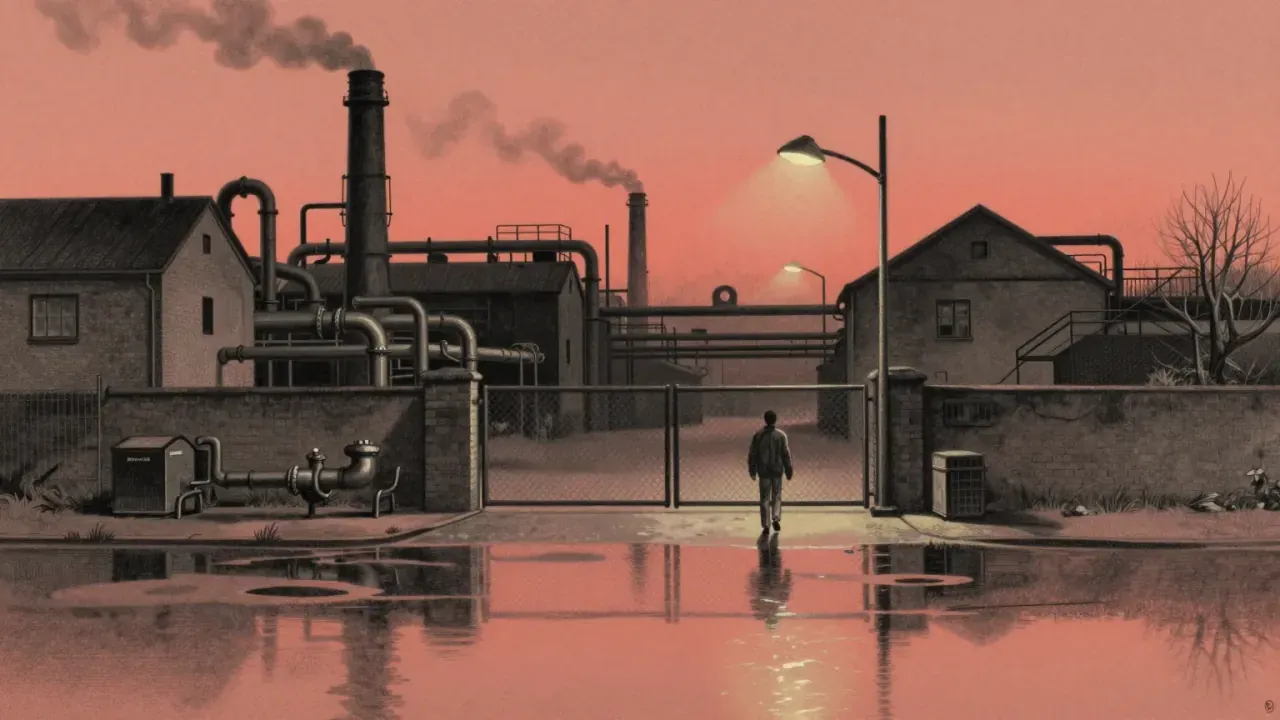
Eraserhead was David Lynch’s feature debut, written, directed, edited and scored by him while he was a student at the American Film Institute’s Center for Advanced Film Studies. He had proposed a different, longer script first, but the school judged it too unwieldy and green-lit Eraserhead instead, on the mistaken assumption that its twenty-one page script would run to roughly twenty minutes at the industry’s usual rate of a minute per page. It did not, and shooting stretched across several years as funding repeatedly ran out. The film follows Henry Spencer, left alone to care for an infant so deformed it barely resembles a human child, in a blighted industrial setting Lynch built to resemble the neighbourhood he had lived in in Philadelphia.
Henry and the child
Jack Nance plays Henry with a fixed, startled expression and the upswept hairstyle he kept for the entire multi-year shoot rather than risk continuity problems. The plot follows him through an unplanned pregnancy, marriage to Mary, and abandonment when she leaves him alone with their child, whose constant wailing and unexplained fragility structure the film’s second half. Charlotte Stewart plays Mary, and Jeanne Bates and Allen Joseph play her parents in a dinner scene that turns physically wrong in ways the script does not explain, including a chicken that appears to move on the plate. Herbert Cardwell shot the film initially before leaving over money, and Frederick Elmes, later Lynch’s regular cinematographer, took over and finished it in stark, high-contrast black and white.
A year on sound alone
The film’s most striking work happens on the soundtrack. Lynch and sound designer Alan Splet spent nearly a year in a studio they had soundproofed themselves, building a mix that layers as many as fifteen tracks of industrial hum, hiss and mechanical noise at once, so that the world outside Henry’s apartment feels permanently, oppressively present even when nothing on screen explains it. One effect, meant to suggest a bed dissolving into liquid, was made by floating a bottle with a microphone inside it in a bathtub and recording air passing through the neck. The infant itself, built with independently operating eyes, mouth and neck, was kept secret enough that the technician developing dailies was blindfolded, and its construction has never been officially confirmed.
The prop nobody explains
The film’s glacial pace and refusal to explain its own premises will frustrate viewers looking for narrative logic; entire scenes, including one where a full year passed on set between Henry opening a door and being filmed walking through it, exist for mood rather than plot progression, and the film does not apologise for the gap between the two. The Lady in the Radiator sequence, in which a woman with swollen cheeks sings while stepping on creatures that resemble the infant, is thematically legible but staged so slowly it risks losing viewers rather than unsettling them further. Some of the film’s shock value, too, depends on not knowing how the infant prop worked; audiences now aware it was a constructed object rather than something stranger may find the effect diminished.
Kafka, Gogol and a claimed Bible verse
Lynch has connected the film to his own fear of fatherhood; his daughter Jennifer, born with severe clubbed feet requiring corrective surgery, has said her own unplanned birth and disability shaped the story directly. The film treats parenthood not as a milestone but as an imposition that arrives before anyone involved is ready for it, and Henry’s inability to either care for or abandon the child gives the body horror a domestic, rather than supernatural, source. The industrial wasteland around the apartment, inspired by Lynch’s years in a violent, poverty-stricken Philadelphia neighbourhood, functions as an extension of that dread rather than a separate setting, suggesting the child’s deformity and the blighted landscape come from the same unexamined source.
Who it rewards
This suits anyone tracing Lynch’s development from the start, or interested in how much a film’s sense of dread can be built through sound rather than image or plot; it rewards close, patient attention more than almost anything else in his catalogue. It is also a reasonable entry point for viewers curious about body horror that works without gore, relying instead on ambiguity about what exactly the infant is. It is a poor choice for anyone who needs a story to move forward at a normal pace, since long stretches deliberately hold on static, wordless scenes, and it will not suit viewers who find sustained visual and aural discomfort, rather than shock, hard to sit through for an hour and a half.
A short film that asks for full attention
At 89 minutes, trimmed down after a poorly received test screening convinced Lynch to cut twenty minutes, it does not overstay its welcome, and its journey from ignored midnight-movie curiosity to Library of Congress preservation in 2004 says something about how durable the unease it generates has proven. Made for around a hundred thousand dollars and eventually grossing seven million, a return few debut features from film-school students ever approach, it remains the clearest demonstration of how far sound design and a fixed visual idea can carry a film with almost no budget. The scores published elsewhere, an 87 on Metacritic and an 89 percent Tomatometer, back up what has become consensus: this is a film worth the discomfort of sitting through it once, carefully.