The look of it
Contempt is a French-Italian co-production, shot in Italy in 1963, that adapts Alberto Moravia’s 1954 novel Il disprezzo as a self-reflexive drama about artistic compromise, marital erosion, and the collision of European humanism with American commercial logic. Godard frames it as a film within a film: a screenwriter rewrites Homer’s Odyssey for an American producer and a German director, while his marriage collapses over the same few days. The project was commissioned by Carlo Ponti and Joseph E. Levine, who insisted on Brigitte Bardot’s casting to secure box-office appeal — a demand Godard accommodated with irony, opening the film with a long, static, frontal nude portrait of her that functions less as seduction than as audit of the industry’s transactional gaze. Godard does not attempt psychological realism; instead, he uses the scaffolding of narrative to stage philosophical propositions about authorship, fidelity, translation, and the material conditions of cinema itself. The film’s ambition lies not in resolving its tensions but in holding them in sustained, uncomfortable suspension.
The sound of it
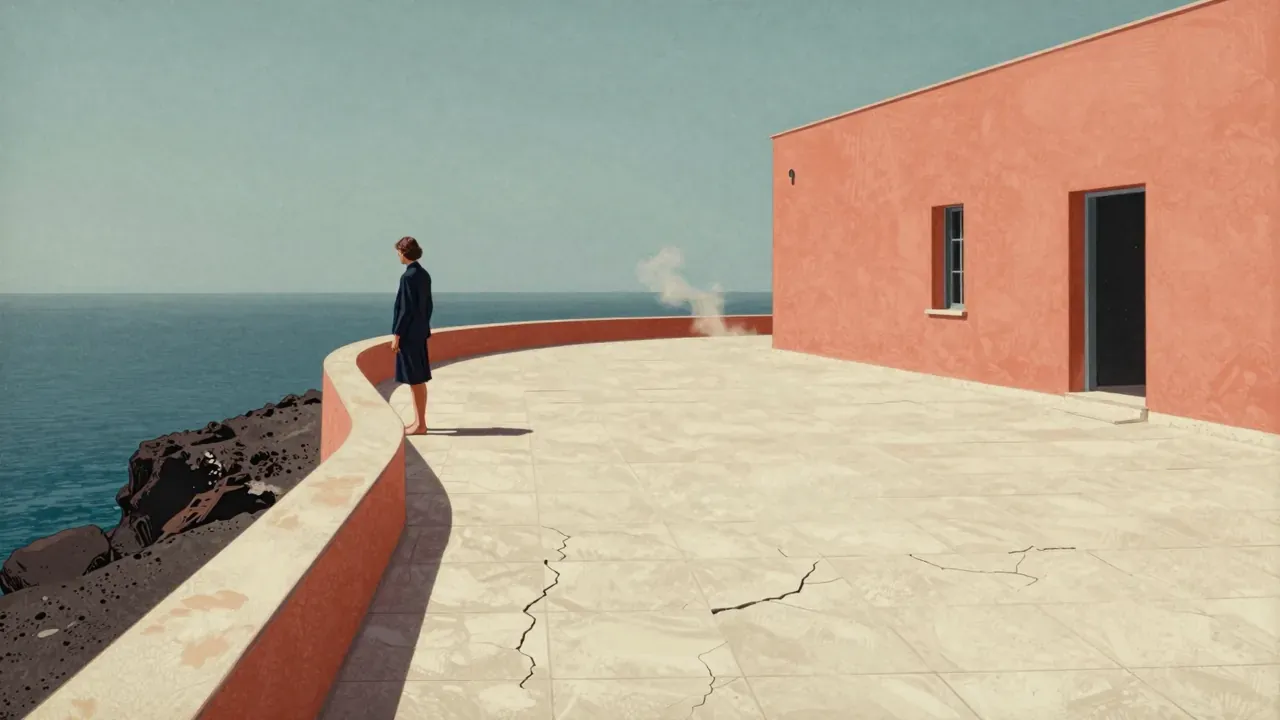
The story unfolds across three primary locations — Cinecittà studios, a Roman apartment, and the Casa Malaparte on Capri — each serving distinct formal purposes. Raoul Coutard’s cinematography favours natural light, deep-focus compositions, and extended tracking shots, most notably in the apartment sequence where Piccoli and Bardot move through rooms in near real-time, their dialogue overlapping, trailing off, or falling silent without scoring or cutaways. Bardot’s performance avoids mannerism; she registers Camille’s withdrawal through posture, glance, and duration of stillness rather than exposition. Piccoli plays Paul as affectively muted, his passivity less weakness than a kind of moral atrophy. Fritz Lang appears as himself, delivering lines that double as Godard’s own manifestos on montage, narrative economy, and the death of classical cinema. Editing by Agnès Guillemot avoids Godard’s earlier jump-cut radicalism but sustains rhythmic disjunction through asymmetrical shot lengths and abrupt shifts in scale — close-ups held too long, wide shots that withhold context. Georges Delerue’s score is sparse, recurring only the ‘Thème de Camille’ motif, which recurs like a question left unanswered.
The space of it
What lands is the film’s structural honesty about its own contradictions. The opening nude scene works not as provocation but as diagnosis: it names the terms of Bardot’s presence before the plot begins, exposing how her body is both commodity and cipher. The apartment argument sequence remains one of the most formally precise depictions of emotional drift in cinema — no music, no close-ups on tears, just bodies moving in shared space while language fails. The staircase confrontation between Camille and Paul at the Casa Malaparte gains force from its refusal of resolution: neither character yields, and the silence after Camille’s final line hangs without commentary. Godard’s insertion of himself as Lang’s assistant — a silent, watchful figure — lands as quiet satire of the auteur myth, especially when contrasted with Lang’s authoritative, weary presence. The film’s colour palette — saturated reds, cool greys, the blinding white of Capri’s stone — is never decorative; it maps emotional temperature and institutional hierarchy. These choices do not flatter the viewer but invite scrutiny of how meaning accrues in image, rhythm, and omission.
The voice of it
What does not land is the film’s treatment of Camille as a vessel for Paul’s crisis rather than an autonomous subject. Her contempt arises from suspicion, not evidence, and her motivations remain opaque beyond reaction — a limitation Godard acknowledged when he said he made Paul ‘more American’, but did not extend the same revisionist agency to Camille. The character of Jerry Prokosch, played by Jack Palance with theatrical bluntness, tips into caricature: his vulgarity serves Godard’s thesis about Hollywood imperialism but lacks interiority, making his function allegorical rather than dramatic. The Odyssean framing feels intermittently ornamental; Lang’s debates with Prokosch about Homer’s intent are intellectually charged but narratively inert, and the film never convincingly ties Odysseus’s departure to Paul’s failure. Some viewers find the pacing deliberately enervating; others read it as slackness — a gap between intention and execution that Godard himself later diagnosed as the film’s central flaw. The reliance on ambient sound and silence, while formally coherent, can register as austerity rather than precision for those unaccustomed to its rhythms.
The structure of it
The themes that matter are not abstracted but embedded in production fact and narrative friction: the commodification of art and the artist, the gendered asymmetry of creative labour, the violence of translation — linguistic, cultural, and cinematic — and the impossibility of fidelity when power relations govern interpretation. Contempt treats the Odyssey not as source text but as contested terrain: Prokosch wants spectacle, Lang demands mythic gravity, Paul supplies compromise, and Camille becomes the untranslated term — her silence, her body, her departure all resisting assimilation into any of their frameworks. The film’s title refers less to personal disdain than to a systemic condition: contempt as the default stance of capital toward craft, of producer toward director, of husband toward wife when both are reduced to contractual roles. Even the villa’s architecture — modernist, isolated, perched on rock — functions thematically: a site of aesthetic aspiration severed from social continuity. Godard does not argue these points; he arranges them spatially, temporally, and tonally, so that theme emerges from where the camera lingers, whom it excludes from frame, and what sounds are permitted to fill the gaps.
The silence of it
This film is for viewers who value formal rigour over narrative propulsion, who attend to how light falls on skin or how silence stretches between sentences, and who accept that ambiguity may be the film’s final statement rather than a failure of clarity. It rewards patience with structural intelligence, not emotional payoff. It is not for those who require psychological coherence in characters, who expect resolution in relationships, or who find deliberate pacing indistinguishable from inertia. Some admirers of Godard’s later, more fragmented work — such as Week-end or Sympathy for the Devil — may find Contempt too anchored in classical composition; others who prize Moravia’s novel for its social critique may object to Godard’s narrowing of scope and interiority. A viewer who values adaptation as fidelity would reject this version outright. What would change the verdict is not better acting or tighter editing, but a willingness to meet the film on its own terms: as a diagnostic instrument, not a story.
The story of it
Yes, it is worth your evening — provided you set aside expectations of conventional engagement and allow its repetitions, silences, and unresolved tensions to accumulate their own weight. It is not a film to be consumed but inhabited, like a room whose proportions shift slowly as you move through it. Its 102 minutes pass without hurry, yet none feel wasted: every shot contributes to the film’s central inquiry into how meaning is assigned, withheld, or bartered. Those who leave impatient have likely mistaken slowness for emptiness; those who stay discover how much can be said without speech, how much tension can reside in a glance held half a second too long, how much history lives in the grain of film stock shot on Capri in autumn 1962. It does not offer solace or catharsis, but it does offer clarity — about the cost of compromise, the fragility of mutual understanding, and the quiet violence of being seen only as asset. That clarity remains urgent, and rare.