The shape of the ghost
Empire of Passion is a French-Japanese co-production, directed and written by Nagisa Ōshima in 1978, adapting Itoko Nakamura’s novel. It is his only kaidan — a Japanese ghost story — and treats the genre not as supernatural spectacle but as psychological and moral pressure vessel. The film sets itself against the grain of both Western gothic tradition and conventional jidaigeki: it refuses period pageantry, avoids stylised violence, and declines to resolve its central horror through ritual or revelation. Instead, it tightens around Seki and Toyoji like a noose, using the ghost not as a plot device but as an index of conscience, memory, and social exposure. Ōshima aims for austerity, not atmosphere; accountability, not catharsis. The film does not ask whether the ghost is real, but what kind of reality emerges when guilt becomes visible, audible, and inescapable in a tightly bound rural community. Its ambition is structural and ethical: to make dread inseparable from consequence, and silence inseparable from confession.
The weight of the lie
The story follows a linear, almost forensic arc: seduction, murder, concealment, erosion, exposure. Ōshima and screenwriter Ōshima keep exposition minimal and dialogue sparse; much is conveyed through duration — long takes on faces, pauses between gestures, the weight of unspoken assumptions. Kazuko Yoshiyuki’s Seki moves with contained volatility: her eyes narrow before her voice rises, her posture stiffens before she lies. Takahiro Tamura’s Gisaburo appears only in memory and haunting — a presence defined by absence. Yoshio Miyajima’s cinematography favours shallow focus and muted earth tones; interiors are lit as if seen through smoke, exteriors drained of warmth. Tōru Takemitsu’s score uses silence as punctuation, deploying biwa and shakuhachi not for ornament but for dissonant counterpoint to human action. The pacing is deliberate, never rushed — scenes hold until their emotional charge curdles into something else: fatigue, suspicion, inevitability.
The look of it
What lands most firmly is the film’s refusal to flinch. The murder scene is brief but physically unambiguous: hands tightening, breath failing, a body dragged without ceremony. The ghost’s appearances are understated — a shadow at the edge of frame, a shift in light, a pause in sound — yet they accumulate with unbearable precision. Seki’s unraveling feels earned, not theatrical: her increasing rigidity, her compulsive tidying, her sudden laughter at inappropriate moments. The village’s collective gaze is rendered not through dialogue but through composition — characters often framed in doorways or behind lattice, watching, waiting, withholding judgment until it becomes unavoidable. Takuzo Kawatani’s Inspector Hotta does not interrogate so much as observe; his authority lies in stillness, not force. The film’s moral gravity lands because it insists on continuity: the crime does not end when the body disappears, nor does the ghost arrive only after the truth is known. It begins earlier — in the first lie, the first glance held too long, the first time Seki looks away from her husband’s face.
The sound and the light
What does not land is the film’s occasional drift into abstraction that lacks grounding in character or context. A sequence where Seki dances alone in a barn — lit in near-total darkness, accompanied only by a single biwa note repeated — feels conceptually bold but emotionally inert: it signals inner turmoil without clarifying its source or shape. Some supporting performances verge on schematic: the villagers speak in proverbs or mutter in chorus, which reinforces theme but flattens individuality. The narrative’s rigour occasionally becomes rigidity — the three-year gap between murder and investigation passes without texture, leaving Seki and Toyoji’s relationship underdeveloped in its later stages. There is little sense of how desire curdles into resentment, or how habit replaces passion. The film assumes we will read exhaustion in a glance or betrayal in a hesitation, but not all viewers will meet that assumption with equal certainty. Those expecting psychological nuance in the affair’s deterioration may find its progression too elliptical, its motivations too implied.
The village as witness
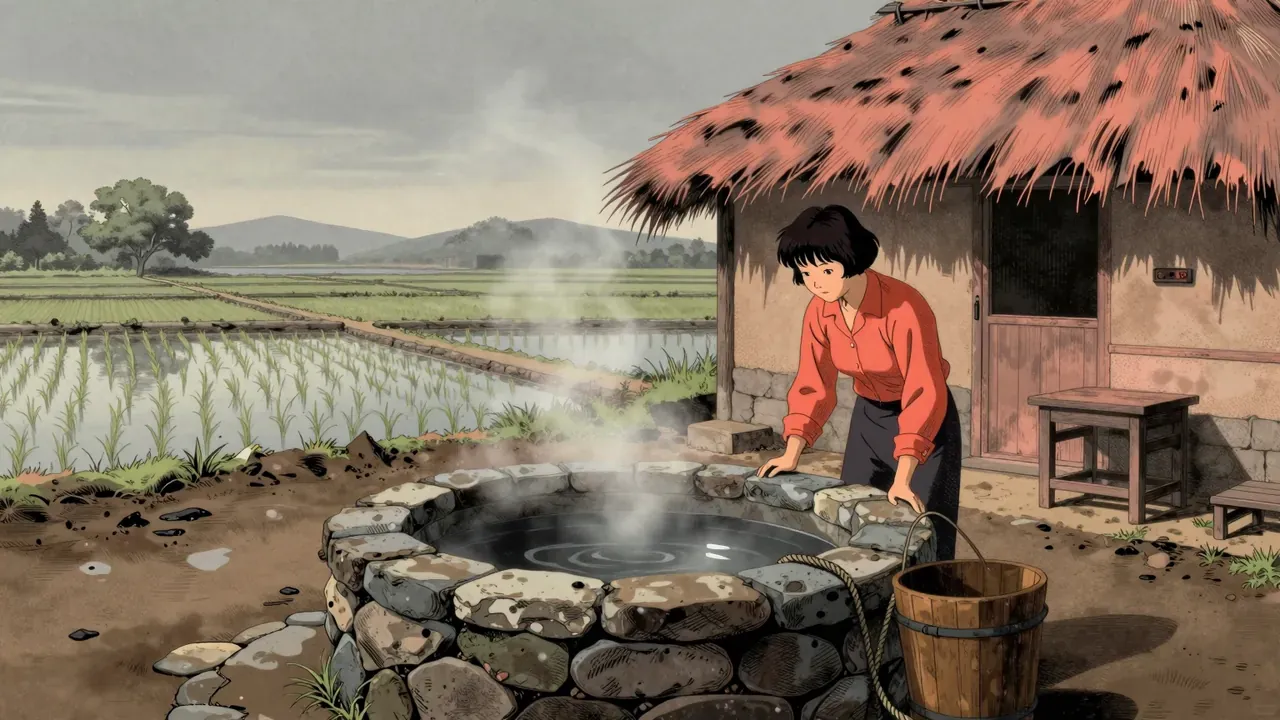
The themes that matter are not those of possession or vengeance, but of containment and complicity. The well into which Gisaburo’s body is dumped is both literal and metaphorical: a site of disposal, yes, but also of persistent resonance — voices echo upward, water stirs without cause. The film treats the village not as a chorus but as a membrane: porous enough to let rumour seep in, impermeable enough to trap shame inside. Class is present but muted — Seki is married to a rickshaw runner, Toyoji is younger, less settled, but neither is explicitly poor nor privileged; their transgression is social, not economic. More urgent is the theme of time as accusation: the past does not recede, it accumulates weight, and every day of silence adds mass to the ghost. Justice here is not delivered by law but by duration — by the sheer, grinding persistence of memory in a place where nothing is truly buried. The ghost is not a spirit returning; it is the past refusing to stay past.
The weight of time
This film is for viewers who value formal discipline over exposition, who find tension in restraint rather than escalation, and who accept ambiguity as part of moral reckoning. It suits those accustomed to arthouse pacing and comfortable with silence as narrative material — fans of early Mizoguchi or late Bresson, for instance. It is not for viewers who require clear motivation, psychological scaffolding, or narrative payoff in the conventional sense. Those who expect the ghost to be explained, the killer punished, or the lovers’ psychology unpacked will leave frustrated. Some critics have called it ‘savage’; others find it cold. The difference lies not in the film’s execution but in the viewer’s willingness to sit with unease without resolution. A change in verdict would follow a shift in expectation: if one watches not for answers but for the shape of the question, the film holds firm.
What the well remembers
Yes, it is worth your evening — provided you set aside the expectation of entertainment and approach it as a sustained act of attention. Its 104 minutes pass without hurry but also without waste: every shot serves the architecture of dread, every silence deepens the sense of enclosure. It rewards patience not with reward but with clarity — a slow, unblinking look at how guilt inhabits the body, how secrecy reshapes speech, how a community polices itself without raising its voice. Those who dislike it tend to cite its austerity as alienation; those who admire it see that austerity as honesty. It is not a film to be enjoyed, but one to be endured — and in that endurance, understood. Its value lies not in what it gives, but in what it refuses to give: comfort, closure, or absolution. That refusal is precise, deliberate, and entirely justified by what the film sets out to do.