The look of it
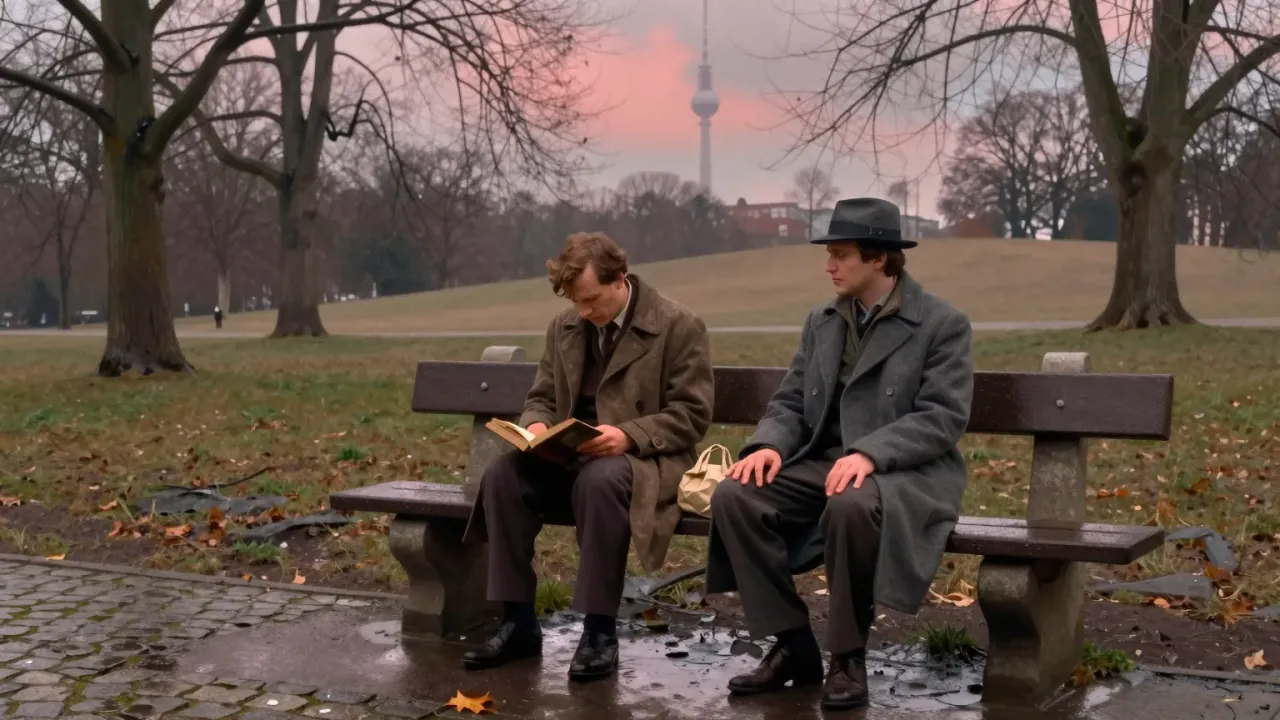
Faraway, So Close! is a German fantasy film set in Berlin shortly after reunification, conceived as a sequel to Wings of Desire but driven less by narrative continuity than by Wim Wenders’ desire to observe the city’s moral and physical transformation. It follows Cassiel, an angel who chooses embodiment not out of longing but in response to a child’s fall — a moment that triggers his abrupt, unprepared entry into human sensation, language, law, and vulnerability. The film attempts to stage a metaphysical reckoning with post-Wall reality: not just the lifting of barriers, but the emergence of new forms of exploitation, surveillance, and spiritual disorientation. Its ambition is theological and civic at once — to ask what kind of being a person becomes when divine perspective collapses into the immediacy of traffic, debt, alcohol, and betrayal. It treats Berlin not as backdrop but as protagonist: a city where angels walk subway platforms and former Soviet leaders appear without explanation, where the sacred and the profane share the same pavement and the same silence.
The shape of descent
The story unfolds episodically, anchored by Otto Sander’s Cassiel as he stumbles through human systems — police stations, gambling dens, arms dealers’ offices — while Bruno Ganz, Nastassja Kinski, and Peter Falk reprise their roles with quiet consistency. Jürgen Jürges’ cinematography avoids the monochrome reverence of the first film; instead, it uses natural light and shallow focus to render Berlin’s newly porous streets with a grounded, sometimes weary realism. Laurent Petitgand’s score leans on ambient textures and sparse piano motifs, avoiding uplift or resolution. Editing by Peter Przygodda sustains a deliberate, almost hesitant rhythm — long takes punctuated by sudden cuts, as if resisting narrative momentum. Performances are restrained: Sander conveys bewilderment without caricature; Willem Dafoe’s Emit Flesti moves with unnerving stillness; Mikhail Gorbachev appears not as symbol but as presence — a man whose face carries history without commentary. There is no exposition about his role; he simply sits, listens, and leaves.
The city as witness
What lands most firmly is the film’s tactile sense of transition — the weight of a passport application, the shock of a car horn, the exhaustion of learning how to speak without hearing every thought around you. Cassiel’s early scenes in the subway and police station carry a rare authenticity in depicting disorientation: not as metaphor, but as procedural confusion — missing documents, misheard instructions, the sheer physical effort of staying upright in crowds. The Brandenburg Gate sequences retain the solemnity of the first film’s aerial views, now complicated by scaffolding and construction cranes. Rüdiger Vogler’s brief appearance as a disillusioned journalist grounds the film’s critique of media complicity without sermonising. And Heinz Rühmann’s final performance, as a frail but lucid elder observing the city from a window, registers as both elegy and witness — not because of his biography, but because the character’s gaze holds time without nostalgia. These moments do not argue; they accumulate.
The turn into shadow
What does not land is the film’s pivot into crime plot mechanics — the arms dealing, the poker cheating, the barge hijack — which arrive without sufficient psychological or spatial preparation. The shift from metaphysical observation to thriller pacing feels unearned, as though the screenplay abandons its own logic to service genre expectations. Emit Flesti’s function as ‘Time’ remains underdeveloped: his interventions lack internal consistency, and his forehead inscription is introduced too late to resonate. The subplot involving Raissa Becker and her mother dissolves midway, leaving emotional threads untethered. Some performances suffer from this drift: Nastassja Kinski’s Marion is given little to do beyond reacting, and Solveig Dommartin’s role is reduced to a single, muted scene. The U2 soundtrack inserts — though licensed and thematically adjacent — sit uneasily within the film’s acoustic world, their anthemic tone clashing with the prevailing hush. The finale’s boat lift sequence, meant to be transcendent, reads instead as logistical rather than lyrical.
The weight of the sacred
The themes that matter are those rooted in embodied contradiction: the tension between divine witness and human limitation, between Berlin’s physical reunification and its unresolved moral fractures. The film treats addiction not as moral failing but as sensory dependency — Cassiel’s first drink is less temptation than neurological recalibration. His theft is not greed but a failed attempt at agency in a system that offers no entry points. The recurring motif of names — Karl Engel, Casa dell’Angelo, Emit Flesti — insists on language as both veil and vessel. Christianity enters not through doctrine but through structure: the angels’ stated purpose to connect humans with ‘Him’, the scriptural echoes in framing and composition, the emphasis on grace as interruption rather than reward. But the film’s deepest concern is secular: how identity persists — or frays — when geography, ideology, and even time itself become unstable. It asks whether belonging is possible in a city that has just stopped being two places at once.
The rhythm of waiting
This film is for viewers who value sustained atmosphere over propulsion, who find meaning in hesitation, and who are willing to sit with ambiguity longer than most contemporary cinema permits. It rewards attention to texture — the grain of a brick wall, the echo in an abandoned factory, the way light falls on a tram ticket. It is not for those who require clear cause-and-effect, tightly wound plotting, or emotional payoffs calibrated to act breaks. Some critics have argued its formlessness reflects the historical moment — Roger Bromley called it fitting for ‘incomplete modernity’ — but others, like Martin Jesinghausen, found the absence of structural division (like the Wall) left the film without its essential counterweight. A tighter edit, or a more rigorous commitment to either allegory or realism, would change the verdict significantly. As it stands, it demands patience as a condition of engagement, not a virtue to be rewarded.
The sound of return
Yes, it is worth your evening — but only if you approach it as a mood piece, not a story. Its 144 minutes unfold like a slow exposure: details accrue, impressions deepen, and the city’s contradictions settle into the bones. It is not a film to watch while distracted, nor one that yields much on first viewing — its power lies in accumulation, not revelation. Those expecting the poetic clarity of Wings of Desire may feel adrift; those open to its quieter, more fragmented register will find moments of startling resonance. The Grand Prix at Cannes was not misplaced: it honours a film that risks coherence for honesty about dislocation. It does not offer answers, but it frames questions — about responsibility, memory, and what it means to stand on solid ground in a world remade overnight — with rare gravity. To dismiss it as lesser sequel is to miss its real subject: the awkward, necessary labour of becoming present in a place that has just become itself again.