The shape of it
Simon of the Desert is a forty-five-minute Mexican film, written and directed by Luis Buñuel in 1965, that uses the legend of Simeon Stylites — a fifth-century Syrian ascetic who lived atop a pillar — as a scaffold for sustained theological and moral satire. It does not aim to dramatise sanctity, nor to reconstruct history, but to test the coherence of spiritual ambition when stripped of ritual, audience, and consequence. The film’s brevity is structural, not incidental: it refuses the sprawl of biblical epics, compressing decades of endurance into precise, repeating gestures — prayer, refusal, temptation, misrecognition — until each act reveals its own absurdity. Buñuel treats orthodoxy not as doctrine to be affirmed or denied, but as a system whose internal logic collapses under scrutiny, especially when confronted with hunger, boredom, or a woman in a miniskirt. The satire is dry, unemphatic, and anchored in physical detail: the grit in Simón’s eyes, the weight of his robe, the way light falls on Gabriel Figueroa’s desert dunes. It is less about belief than about what happens when belief becomes performance without witnesses — and then, suddenly, has an audience again.
The look of it
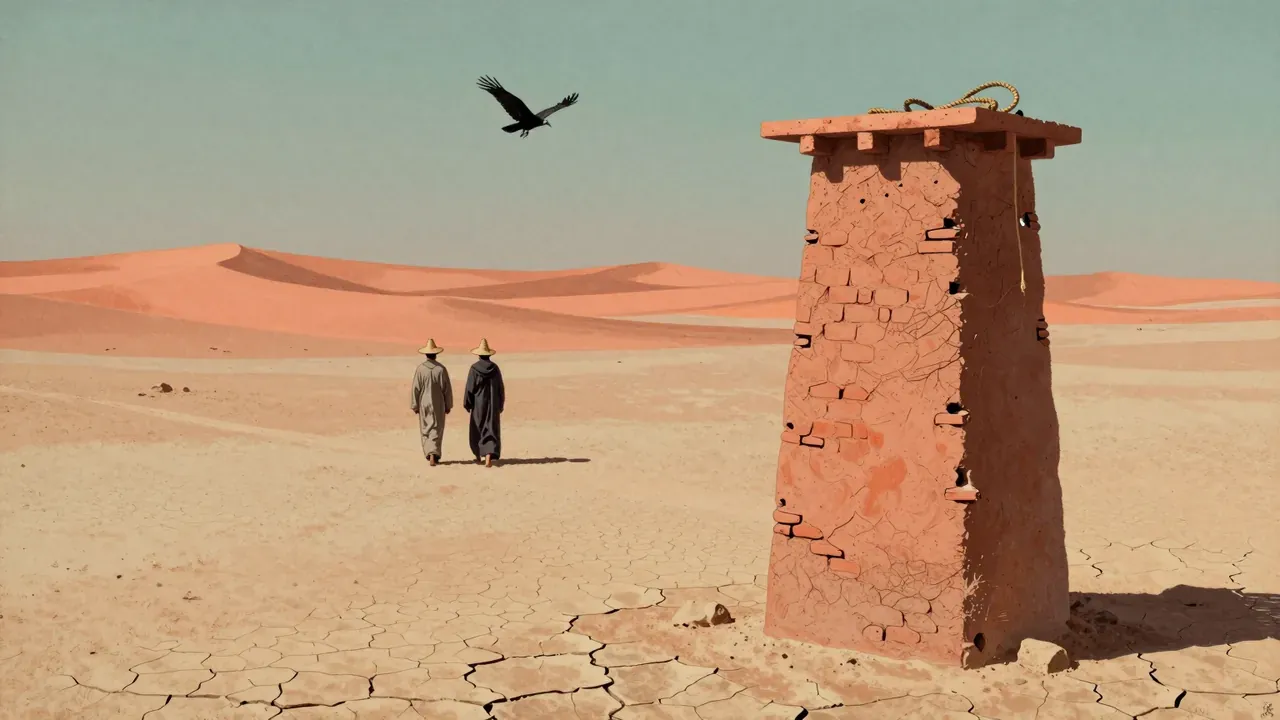
The story follows Simón across eight years, eight months, and eight days on a pillar, punctuated by visits from monks, peasants, his mother, and Satan — who appears first as a woman with a jug, then as a teenage girl, then as God. Claudio Brook plays Simón with stillness and slight impatience, never martyred, rarely inspired; his piety reads as habit, not revelation. Glauber Rocha appears briefly but decisively as Satan, delivering her lines with the flat affect of someone reciting a grocery list. Figueroa’s cinematography keeps the desert vast and indifferent: low angles make the pillar look precarious, not heroic; wide shots show how small Simón is against the dunes. Raúl Lavista’s score is sparse, mostly absent — silence dominates, broken only by wind or the clink of a water jug. Carlos Savage’s editing avoids rhythm or emphasis: cuts land where they must, not where they please. There is no build, no release, no climax — only recurrence, interruption, and a final, jarring cut to a New York nightclub. The craft serves restraint: nothing is heightened, nothing is explained, nothing is forgiven.
The weight of it
What lands is the cumulative weariness of virtue performed in isolation. Simón’s refusal of holy orders, his irritation at Brother Matías’s lettuce, his momentary confusion when Satan impersonates God — these register not as plot points but as quiet fractures in the façade of certainty. The film’s humour arises from mismatch: between theological gravity and bodily need, between sacred time and calendar time, between Simón’s self-image and how others see him — as healer, fraud, curiosity, or nuisance. The nightclub ending lands because it is neither ironic nor explanatory; it simply places Simón in a world he cannot parse, surrounded by people who do not recognise him as anything but another man at a table. That dislocation feels earned, not clever. The satire works because it refuses caricature: the monks are earnest, the peasants pragmatic, Satan bored. Even the miracle of the reappearing hands is treated as mildly inconvenient — no one applauds, no one converts. The film trusts the viewer to notice what is unsaid: that holiness, when severed from community, begins to resemble stubbornness.
The gaps in it
What does not land is the sense of stakes. Simón’s penance of standing on one leg — announced after mistaking Satan for God — arrives without weight, because the film has already shown that his theology is unmoored from consequence. His earlier refusal to acknowledge his mother, his dismissal of the monks’ prayers, his indifference to the peasant’s stolen hands: none of these carry moral residue beyond the immediate scene. The film’s brevity works against it here — there is no time for doubt to accumulate, no space for Simón to question himself beyond a single frustrated sigh. The final New York sequence, while striking, lacks grounding: we do not know how he got there, why Satan chose that place, or whether the nightclub is real, hallucination, or allegory. Buñuel offers no key, but the absence of even a framing device — a cut from pillar to stage, a dissolve, a sound bridge — leaves the transition feeling abrupt rather than inevitable. Some viewers will find this precision; others will find it evasion.
The idea in it
The themes that matter are endurance as habit, not virtue; the instability of divine authority when tested by desire; and the impossibility of purity in a world that insists on touching you. The film treats asceticism not as transcendence but as withdrawal so total it becomes indistinguishable from irrelevance. Simón’s isolation is not spiritual discipline but logistical failure: he cannot get down, and no one can reach him. His encounters with Satan expose not temptation but misrecognition — he mistakes her for God not because he is weak, but because both figures speak in flattery and offer the same thing: relief from effort. The film also probes the social function of sainthood: the monks want to ordain him, the peasants want miracles, his mother wants proximity — all treat him as resource, not person. When he finally arrives in New York, he is not corrupted but rendered obsolete: the crowd dances ‘Radioactive Flesh’, a phrase that names a condition — exposure, contamination, energy without direction — that his pillar-world could never name, let alone contain.
The audience for it
This film is for viewers who value precision over exposition, who find dryness more unsettling than melodrama, and who do not require narrative closure to feel satisfied. It suits those familiar with Buñuel’s Mexican period — particularly Viridiana and The Exterminating Angel — and those who read theology as language game rather than dogma. It is not for viewers who need emotional arcs, character development, or explanation of symbolism. Those who expect satire to clarify rather than complicate will leave frustrated. Anyone requiring context — historical, religious, or biographical — will find the film withholding. A viewer who values craftsmanship over message may admire Figueroa’s lighting but miss the point of Simón’s silence. Someone who finds absurdism exhausting rather than clarifying will not last the forty-five minutes. The film assumes patience, not knowledge — but it does assume willingness to sit with ambiguity until it yields, not answers, but sharper questions.
The time it takes
Yes, it is worth your evening — provided you watch it whole, in one sitting, without pause or distraction. Its brevity is not convenience but necessity: the rhythm depends on accumulation, not escalation. To skip it because it is short is to mistake economy for emptiness. To watch it expecting resolution is to misunderstand Buñuel’s method. Those who dislike it tend to cite its coldness or opacity — fair, but not flaws in themselves. What would change the verdict? A longer version might dilute its force; a subtitled print with inaccurate timing would blur its deadpan delivery. Its value lies in how tightly it holds its contradictions: Simón is both ridiculous and reverent, Satan both banal and terrifying, the desert both empty and full of meaning. It does not ask you to choose sides. It asks you to notice what happens when you stop choosing — and what remains when the pillar ends, and the music starts.