The shape of her days
I Knew Her Well is a 1965 Italian comedy-drama that observes Adriana Astarelli — a young woman from the provinces — as she navigates Rome’s margins of celebrity, seeking validation through proximity to fame rather than achievement. It does not satirise ambition so much as hold it under steady, unsentimental light: her efforts are neither mocked nor romanticised, but tracked with forensic patience across a series of encounters — with directors, writers, actors, lovers, hangers-on — each transaction revealing another layer of what is asked, offered, and withheld. The film avoids narrative propulsion in favour of cumulative portraiture; its aim is not to resolve Adriana’s situation but to register its texture, rhythm, and quiet exhaustion. It treats stardom not as a destination but as a condition of perpetual audition, where attention is currency and intimacy is barter. Armando Nannuzzi’s cinematography keeps the frame loose and observational, often holding on Sandrelli’s face just long enough for the viewer to notice how often she is looking away — not at the camera, but past the person she is with. (158 words)
The look of it
The story unfolds episodically, without flashback or voiceover, anchored entirely to Adriana’s movement through Rome’s mid-1960s social topography: film sets, apartments, nightclubs, seaside villas, caravans. Stefania Sandrelli carries every scene with minimal inflection — her performance is calibrated to suggest effort without declaring it, weariness without surrender. Supporting roles are precisely etched: Ugo Tognazzi’s Gigi Baggini is all practiced charm and unspoken calculation; Nino Manfredi’s Cianfanna offers weary pragmatism; Karin Dor’s Barbara moves between solidarity and condescension. Nannuzzi’s camera stays at medium distance, favouring natural light and shallow focus that blur backgrounds without softening faces. Benedetto Ghiglia’s score is sparse, mostly absent during dialogue — the soundtrack instead leans on contemporaneous pop songs, played diegetically or over transitions, lending period texture without emotional cueing. Editing by Roberto Perpignani avoids emphasis: cuts land on silence more often than on reaction, trusting the weight of what has just passed rather than what follows. (159 words)
The weight of repetition
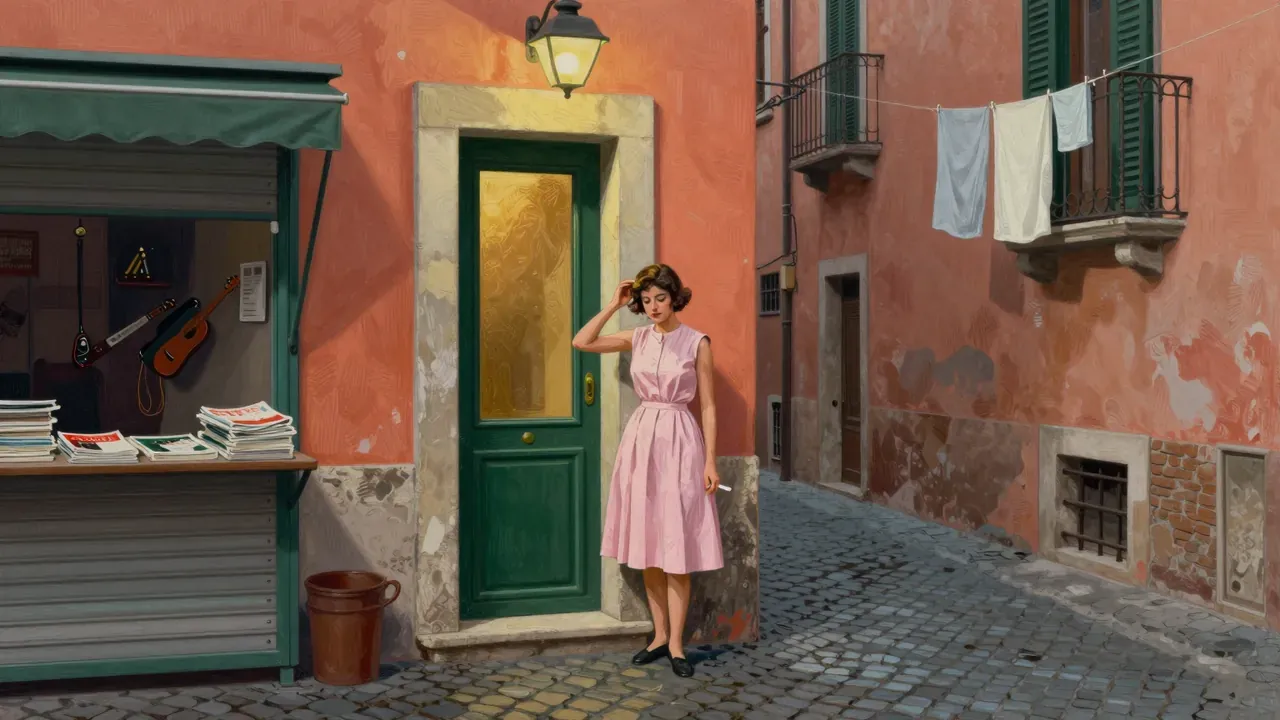
What lands is the film’s refusal to moralise or mythologise. Adriana remains opaque not because she is unknowable, but because the film declines to interpret her — it watches, records, lets her gestures accumulate meaning slowly. The repeated motifs — the recurring shot of her adjusting her hair before entering a room, the way she holds cigarettes just below her lip without smoking them, the slight pause before she laughs at a joke she hasn’t heard — gain resonance through repetition, not exposition. The casting of real-life figures like Jean-Claude Brialy and Franco Nero as versions of themselves blurs the line between fiction and documentary without breaking character. The film’s structure, built around discrete vignettes rather than plot turns, works because each encounter reveals something structural about Adriana’s position: she is never central to any scene’s purpose, only peripheral to others’ ambitions. This asymmetry is sustained with discipline — no scene overextends, no performance swells beyond its function. The result is a portrait that feels less constructed than uncovered, like a series of photographs taken at consistent intervals over several months. (157 words)
The edges of the frame
What does not land is the film’s occasional drift into anecdote without consequence. A few episodes — particularly those involving minor characters like the writer played by Joachim Fuchsberger or the caravan man — feel like sketches rather than scenes, their presence justified more by atmosphere than by narrative or thematic return. The film’s resistance to explanation can also tip into ambiguity without payoff: Adriana’s motivations remain deliberately vague, but at times the lack of even implied interiority makes her seem passive rather than strategic, which weakens the critique of systemic exploitation. Some viewers may find the pacing indistinguishable from inertia — the 115-minute runtime contains no conventional climax, no reversal, no catharsis, and the final sequence offers no resolution beyond Adriana walking alone down a beach, a gesture that reads as resignation to some, as endurance to others. Those expecting irony or satire may be disappointed by the film’s flat tonal register; it does not wink, nor does it condemn. Its restraint risks being mistaken for neutrality, though it is closer to withholding judgment until the evidence is complete — and the evidence, here, is always Adriana’s face, her posture, her silences. (159 words)
The architecture of attention
The themes that matter are not celebrity per se, but the infrastructure of attention: how it is allocated, deferred, commodified, and withdrawn. The film treats Rome not as a city but as a set — one where everyone is performing a role they believe will be noticed, yet few are cast. Class operates silently but decisively: Adriana’s provincial accent, her clothes, her hesitation before speaking mark her as perpetually auditioning, never arriving. Gender structures every interaction — men speak over her, assign her roles, interrupt her sentences, then forget her name — but the film does not present this as exceptional cruelty, only as ambient condition. Ambition is shown not as folly but as rational response to limited options; her desire for fame is less vanity than a bid for agency in a world that grants it selectively. Memory and erasure recur formally: characters reappear without introduction, locations shift without explanation, suggesting a reality where Adriana’s presence is provisional, easily overwritten. The film’s enduring power lies in how it frames visibility as labour — exhausting, uncredited, and ultimately insufficient. (156 words)
The terms of watching
This film is for viewers who value precision over propulsion, observation over exposition, and cumulative effect over climax. It rewards patience, attention to gesture, and tolerance for unresolved tension. It suits those familiar with mid-century Italian cinema’s tendency to treat social realism as a form of quiet activism — films that do not shout injustice but show its architecture. It is not for those who require narrative momentum, psychological revelation, or moral clarity. Viewers expecting satire or feminist polemic may find its tone too detached; those who need closure or character arcs will leave unsatisfied. Some critics have argued the film’s restraint borders on complicity — that its refusal to judge Adriana’s choices risks normalising her exploitation. That reading would change if the film offered more interior access or clearer structural critique, but it does not. Its power lies in its refusal to choose between empathy and analysis — a stance that demands the viewer do both. (158 words)
The measure of time
Yes, it is worth your evening — provided you watch it as a study in duration and disposition, not as a story with stakes. Its 115 minutes unfold with the weight of lived time, not plotted time, and that demands adjustment: this is not a film to consume, but to inhabit alongside Adriana. It repays close viewing — not for hidden meanings, but for the accumulation of small, telling details: how light falls on a staircase, how a cigarette burns down while no one speaks, how a door closes behind someone who will not return. Those who dismiss it as slow or inconclusive are not wrong, but they mistake its method for its message. Its value lies in how thoroughly it resists comfort — no uplift, no indictment, no easy irony. To watch it is to accept its terms: that some lives are documented not to be explained, but to be remembered. That makes it demanding, yes — but also rare, and quietly urgent. (159 words)