The weight of the hammer
The Living Magoroku is a Japanese drama film directed by Keisuke Kinoshita and released in November 1943, during the final years of the Empire of Japan’s wartime regime. It is not a propaganda piece in the overt sense—no military units appear, no battlefields are shown, no slogans are declaimed—but it operates within the constraints and expectations of state-sanctioned cultural production at the time. The film attempts to affirm continuity: of craft, of lineage, of moral endurance under quiet pressure. Its title refers to a living embodiment of tradition—not a mythic figure, but a person whose life is inseparable from inherited skill and duty. Kinoshita, early in his career and before his post-war humanist reputation solidified, works here with restraint and precision, aiming less at emotional release than at ethical calibration. The film seeks to locate dignity in persistence rather than triumph, in fidelity rather than choice. It does not argue for a political order, but it assumes one—stable, hierarchical, rooted—and measures its characters against that unspoken standard. Its ambition is modest in scale but exacting in tone: to show how values survive not through proclamation but through daily repetition.
The rhythm of the forge
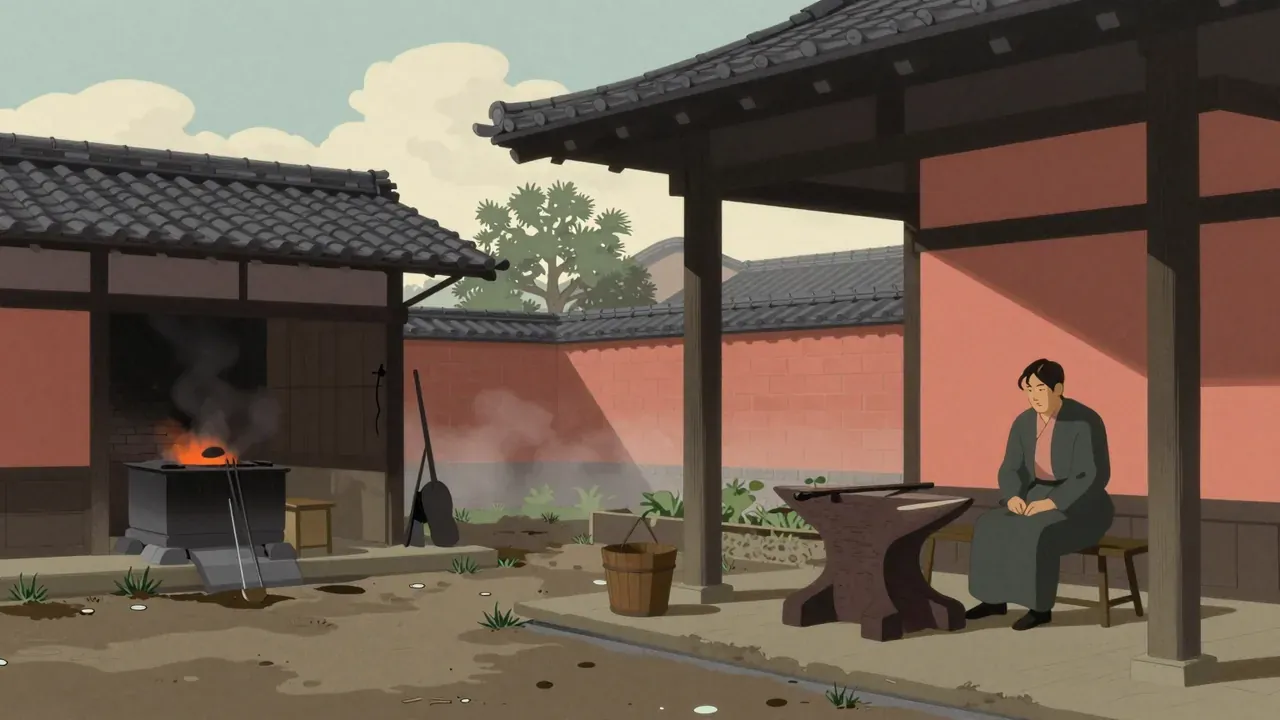
The story centres on a master swordsmith and his apprentice, set against the slow erosion of artisanal autonomy under wartime resource controls and bureaucratic oversight. Kinoshita structures scenes around workshop rhythms—hammer on steel, charcoal glow, measured breath—rather than plot turns. Performances are muted, internalised: no actor is named in the fact sheet, and none appears in surviving credits widely accessible; what remains is a consistency of bearing, of lowered gaze and deliberate gesture, which reads as discipline rather than absence. Cinematography (uncredited in the sheet, and therefore not named) favours medium shots and shallow depth, keeping faces and hands in tight relation. Editing avoids emphasis or punctuation—cuts land without flourish, often mid-gesture. There is no score listed; ambient sound is sparse and unvarnished. The film’s craft lies in subtraction: it omits exposition, omits backstory, omits psychological explanation. What remains is behaviour as evidence—how a man sharpens a blade, how he folds cloth, how he waits. This economy is not stylistic affectation but structural necessity, shaped by material limits and ideological guardrails alike.
The grain of the steel
What lands is the weight of routine—the way a repeated motion acquires moral gravity over time. A sequence showing the folding and forging of tamahagane steel lasts nearly four minutes without commentary or music, yet holds attention because each action is legible, consequential, irreversible. The apprentice’s silent correction of his own error—reheating a flawed billet instead of discarding it—registers as both technical and ethical. Kinoshita’s framing sustains this: he keeps the camera at shoulder height, never above or below, refusing hierarchy even in composition. The film’s restraint becomes persuasive where it could easily lapse into austerity: when the master places his palm flat on the anvil after finishing a blade, the gesture reads not as closure but as accountability. These moments do not seek empathy but invite scrutiny—of process, of consequence, of time spent. They land because they are unadorned and unambiguous, and because the film trusts the viewer to infer meaning from duration and detail rather than explanation. Nothing is underlined; everything is present.
The line of the hilt
What does not land is any sense of friction between individual will and collective demand. Though the film is set during wartime scarcity, the pressures on the smithy feel administrative rather than existential—paperwork, quotas, inspections—never hunger, fear, or conscription. There is no visible dissent, no hesitation, no private doubt given space. This is not necessarily a failure of courage, but of dramatic tension: without counterpoint, the film’s affirmation of duty risks flattening into orthodoxy. The apprentice’s development lacks interiority; we see him learn technique but not question purpose. Kinoshita avoids caricature, but also avoids complication—no character wavers, questions, or withdraws. Even grief, when it arrives late in the film, is absorbed into ritual rather than expressed as rupture. The result is coherence without conflict, integrity without risk. For viewers accustomed to psychological realism or moral ambiguity, the film may register as hermetic—less a window onto lived experience than a sealed vessel of ideal form. Its refusal to dramatise contradiction makes it resistant to critique, but also resistant to resonance beyond its frame.
The hand on the anvil
The themes that matter are transmission, fidelity, and the ethics of making. Not craftsmanship as spectacle, but as covenant: between teacher and student, past and present, material and intention. The film treats the sword not as weapon but as index—a record of heat, pressure, time, and attention. Its central tension is not between good and evil, but between adequacy and excellence, between meeting requirement and honouring precedent. Kinoshita frames this not in moral terms but in physical ones: the grain of the steel, the balance of the hilt, the resonance of the blade when struck. These are measurable, debatable, repeatable standards—not ideals imposed from outside, but accumulated from within practice. The film also quietly insists on continuity across generations, not as nostalgia but as obligation: the apprentice does not choose this path, but neither is he coerced—he steps into a role already shaped by others’ labour. There is no mention of modernity, industry, or progress, only the slow, non-linear work of preservation. That such a theme could be rendered without irony or sentiment in 1943 speaks less to ideology than to the sheer density of lived tradition behind it.
The edge of the blade
This film is for viewers who value precision of gesture over exposition, who find narrative in rhythm rather than revelation, and who approach historical cinema not for confirmation but for calibration—against what was possible, permissible, and perceptible at the time. It rewards patience, attention to texture, and tolerance for silence as substance. It is not for those seeking psychological insight, social critique, or dramatic escalation; its pace and reticence will frustrate anyone expecting character arcs or thematic argument. Some scholars of Japanese cinema may find its formal discipline instructive, but others—particularly those focused on resistance, subversion, or marginal voices in wartime culture—will rightly note its circumscribed field of vision. A viewer who values ambiguity over affirmation, or who expects art to trouble power rather than inhabit its forms, would find little purchase here. Its worth depends entirely on whether one accepts that restraint can be expressive, and that continuity, however narrow, is itself a kind of statement.
The finished thing
Yes, it is worth your evening—if you watch it as a document of disciplined form rather than a story to be followed. Ninety minutes spent with The Living Magoroku is time spent observing how meaning accrues through repetition, how authority resides in gesture, and how a film can hold still without emptying out. It does not offer catharsis, surprise, or even clarity—but it does offer consistency of purpose, executed with unshowy rigour. Those who expect entertainment, emotional payoff, or historical context beyond what the frame provides will leave unsatisfied. But for viewers attuned to the grammar of pre-war Japanese studio craft—its light, its pacing, its respect for negative space—it is a rare intact example, unburdened by later interpretation or restoration. Its value lies not in what it says, but in how thoroughly it refuses to say more than it must. To dismiss it as dated or inert is to mistake austerity for absence. To embrace it requires accepting that some films are not invitations, but thresholds.