The silence of it
A Story of Floating Weeds is a silent Japanese drama from 1934, directed and written by Yasujirō Ozu for Shochiku. It tells of Kihachi Ichikawa, an ageing kabuki actor who returns to a provincial town where he once fathered a son, now a university student who believes his father is dead. The film attempts to trace the quiet erosion of dignity, the weight of unspoken responsibility, and the fragile persistence of connection across generations and social roles. It does so without recourse to sound or psychological exposition, relying instead on composition, gesture, and rhythm — a formal discipline that treats emotion not as eruption but as sediment. Its ambition is modest in scale but precise in aim: to hold still long enough for the viewer to see how much is carried in a glance, a pause, a departure. It is not interested in explaining why people act, only in showing how they do — and what remains after they leave. This is not storytelling as revelation, but as accumulation.
The look of it
The story unfolds in measured episodes: arrival, concealment, exposure, betrayal, rupture, reconciliation, and departure. Chishū Ryū does not appear in the cast list provided, though he is widely associated with Ozu’s later work; here, Takeshi Sakamoto plays Kihachi with restrained physicality — shoulders slightly rounded, movements economical, face often half-shadowed by his hat. Hideo Shigehara’s cinematography avoids dramatic angles or close-ups; frames are level, interiors shallow, backgrounds uncluttered. Editing follows Ozu’s emerging signature: cuts between shots of objects — a riverbank, a teacup, a railway platform — that function as punctuation rather than transition. Performances are muted by design: no grand speeches, no tears on cue. Even violence — the slaps, the beating — is brief, unemphatic, absorbed into the flow. The absence of intertitles for internal monologue forces attention onto posture, timing, spatial relation. What registers is not what characters say, but where they stand in relation to each other and to the doorways, windows, and tatami lines that structure every scene.
The weight of it
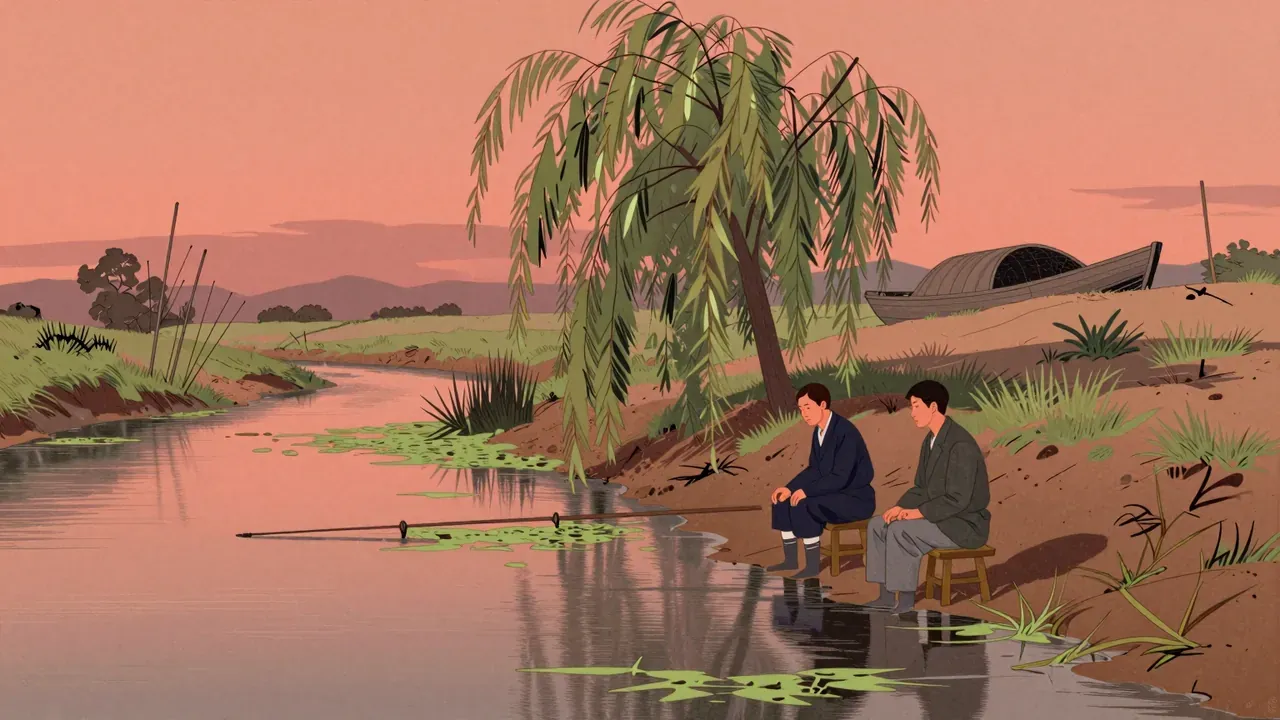
What lands is the cumulative pressure of small betrayals and withheld truths. The scene where Kihachi walks Otaka out of Otsune’s restaurant — not shouting, but gripping her wrist, stepping just ahead, then releasing her at the gate — carries more tension than any confrontation later in the film. The fishing trip with Shinkichi works because it is unremarkable: two men sitting side by side, nets idle, silence held without strain. The final train sequence lands not through sentiment but through contrast: the shared snack, the sleeping boy, the match offered without comment — all feel earned because nothing earlier has been overstated. The film’s restraint makes its few emotional releases — Otsune’s quiet admission that Kihachi paid for Shinkichi’s schooling, Shinkichi’s choked exit from the room — land with physical weight. There is no music to cue response, no camera push-in to underline significance. The effect is not distance, but proximity: the viewer leans in, not because something is happening, but because something is being withheld — and then, just once or twice, allowed to surface.
The gaps in it
What does not land is the subplot involving Otoki’s seduction of Shinkichi. It functions narratively as catalyst, but emotionally it feels schematic — a device to provoke Kihachi’s crisis rather than a fully inhabited relationship. Yoshiko Tsubouchi’s performance is capable, yet the script gives Otoki little interior logic beyond obedience to Otaka and then sudden, unexplained devotion to Shinkichi. Her declaration that she is ‘merely a traveling actress’ arrives without sufficient groundwork in gesture or prior exchange. Similarly, Otaka’s pivot from jealousy to reconciliation lacks texture: her final offer to join Kihachi’s new troupe feels less like character resolution and more like narrative convenience. The film’s commitment to silence works against psychological exposition, but here it leaves motivation underdeveloped. A viewer familiar with Ozu’s later films may sense the scaffolding of themes — duty, transience, filial distance — but this version does not yet possess the tonal certainty to make those abstractions resonate as lived experience. The mechanics are clear; the human friction is sometimes thin.
The drift of it
The themes that matter are those embedded in motion and stillness: the itinerancy of actors versus the rootedness of townspeople; the gap between biological and social fatherhood; the cost of maintaining appearances in a society governed by unspoken rules. The floating weeds of the title are not metaphorical flourish — they recur literally, drifting on the river where Kihachi and Shinkichi fish, then again near the station at the end. They signify both impermanence and quiet continuity: things that move without direction but do not vanish. Class is present but unspoken — Kihachi’s troupe lives in rented rooms, eats standing up, rehearses in dusty halls; Shinkichi wears Western-style academic dress, studies in a library, speaks formally to elders. Yet neither man judges the other’s life — only the consequences of their choices. Ageing is treated without pathos: Kihachi is past his prime, but not pitiable; his authority persists in how others defer, even as his body slows. The film’s deepest concern is not with right or wrong, but with what endures when roles dissolve — a look, a debt acknowledged, a match lit and passed without words.
The terms of it
This film is for viewers who value compositional discipline over narrative urgency, who find meaning in duration rather than development, and who are comfortable with ambiguity that is structural, not evasive. It rewards patience, familiarity with silent-film grammar, and tolerance for pacing that resists acceleration. It is not for those who require clear moral positioning, psychological explanation, or emotional payoff timed to narrative beats. A viewer expecting the emotional clarity of Ozu’s 1959 remake — or the expressive range of contemporary Japanese cinema — will likely find this version austere to the point of opacity. Those who dislike silent films on principle, or who rely on dialogue to orient themselves in character relationships, will struggle. The film assumes its audience knows how to read a glance, how to wait for a cut, how to hold two contradictory feelings — disappointment and tenderness, resentment and duty — without resolution. That assumption is its condition of entry.
The leaving of it
Yes, it is worth your evening — but only if you arrive prepared to meet it on its own terms. It is not a film to be consumed, but one to be inhabited for its duration: eighty-six minutes of deliberate slowness, of repeated framings, of rain falling on unpaved streets and steam rising from station platforms. Its value lies not in what it reveals, but in how steadily it refuses to hurry. Someone who finds Ozu’s later work too mannered may find this version refreshingly unpolished; someone who values narrative propulsion will find it withholding. Its verdict rests on whether you accept that meaning can reside in repetition — the same doorway, the same riverbank, the same train — and whether you trust a filmmaker who believes that what is left unsaid, and what is held in frame for three seconds longer than expected, is where truth gathers. It is not for everyone, but for those it is for, it stays.