A Different Kind of Adaptation
Sorcerer is a 1977 American thriller adapted from Georges Arnaud’s 1950 novel The Wages of Fear, not a remake of Henri-Georges Clouzot’s 1953 film. William Friedkin conceived it as a standalone reimagining — grittier, more documentary in texture, and anchored in the physical reality of four fugitives bound by circumstance rather than shared history. He sought to strip away mythic framing and foreground endurance as brute fact: men hauling unstable nitroglycerin across 351 kilometres of jungle road in two decaying trucks. The film rejects psychological exposition in favour of cumulative pressure — heat, vibration, rust, sweat, silence broken only by engine strain or a misfiring spark plug. Friedkin intended it as his most personal work, one that would test both technical control and moral stamina, using Latin America not as backdrop but as an active, indifferent force. Its ambition lies in sustained tension without relief, in refusing catharsis even at the finish line. It asks the viewer to sit inside consequence, not plot. (142 words)
The Look of It
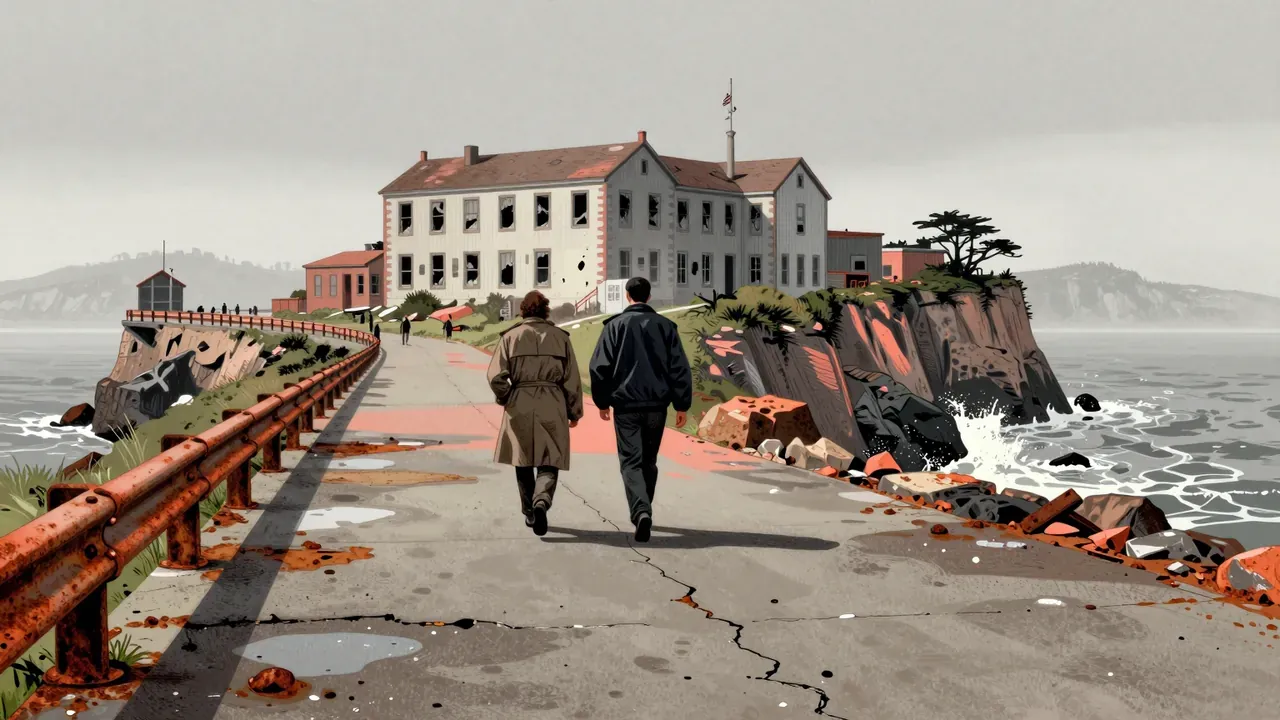
The story unfolds in five episodic prologues — each establishing a man’s flight from ruin — before converging on a nameless South American port town. Roy Scheider, Bruno Cremer, Francisco Rabal and Amidou play men whose pasts are rendered with cinéma vérité rigour: handheld shots, natural light, unvarnished locations, no score during these sequences. Dick Bush and John M. Stephens’ cinematography favours tight frames and shallow focus, keeping faces half-obscured, environments oppressive and humid. Michel Colombier’s electronic score — sparse, pulsing, low in register — enters only after the mission begins, reinforcing mechanical dread over human drama. Bud S. Smith’s editing avoids rhythm for its own sake; cuts land like gear shifts, abrupt and functional. Performances are internalised: Scheider’s Jackie Scanlon rarely speaks beyond necessity; Cremer’s Nilo moves with weary precision; Rabal’s Chico carries grief like ballast; Amidou’s Kassem watches, waits, calculates. There is no heroism here — only calibration, hesitation, and the slow erosion of choice. (156 words)
What Holds the Frame
What lands is the weight of the journey itself. The trucks — their creaking chassis, patched radiators, groaning differentials — become characters with agency, their fragility palpable in every shot held just long enough to make the viewer flinch. Friedkin sustains a single, unbroken tone: procedural realism edged with fatalism. The jungle is not exotic but exhausting — mud sucks at tyres, rain blurs vision, insects swarm the cab. The dynamite’s volatility is never dramatised; it is simply present, a condition, like gravity. This refusal to heighten or explain pays off in the final stretch: when the bridge collapses, it does so without music, without slow motion, without a close-up on a face — just a lurch, a silence, then the sound of falling timber and water. The film’s restraint makes its few eruptions — a fistfight in a bar, a sudden explosion in the prologue — feel earned, not theatrical. Its power accumulates not through incident but through duration: 121 minutes of near-continuous unease, calibrated to the pace of a failing machine. (158 words)
Where It Lets Go
What does not land is the emotional architecture between the men. Their bond remains transactional, which is intentional, but the film offers no counterpoint — no memory, no shared glance, no gesture that suggests anything beyond mutual dependence. The episodic prologues, while vivid, do not cohere into a larger pattern of cause or contrast; they feel like separate short films stitched together, not movements in a symphony. Some performances suffer from underwritten motivation: Amidou’s Kassem, for instance, reads as opaque rather than enigmatic, his silence unmoored from context. The film’s commitment to austerity occasionally tips into detachment — the camera observes suffering but rarely invites identification. A late-night argument in the truck cab lacks heat because the script gives no subtext, no buried history to animate it. Friedkin’s documentary impulse works against intimacy, and where Clouzot’s version found pathos in desperation, Sorcerer finds only physics. That is a valid choice, but it leaves little room for resonance beyond the visceral. (152 words)
The Weight of Time
The themes that matter are endurance as labour, failure as inevitability, and dignity as persistence without reward. Sorcerer treats survival not as triumph but as delay — a series of micro-decisions that postpone collapse. Colonial infrastructure appears only as ruin: a defunct oil company’s abandoned compound, a railway line swallowed by vines, a bridge built for extraction now barely holding traffic. The men are not rebels or victims of empire but its residue — displaced, unmoored, operating in the cracks left by systems that have moved on. Money is never the point; it is merely the condition of temporary reprieve. The film’s quietest theme is time: not narrative time, but geological time — the slow decay of rubber, metal, flesh, trust. Nitroglycerin sweats because chemistry cannot be bargained with. The jungle reclaims because biology does not pause for plot. Friedkin refuses allegory, yet the film becomes an unstated parable about late capitalism’s diminishing returns: effort compounds, risk escalates, payoff recedes. There is no revolution here, only recalibration — and even that fails. (147 words)
Who It Is For
This film is for viewers who value sustained atmosphere over exposition, who find tension in stillness and meaning in mechanics. It suits those accustomed to arthouse pacing, to films where silence carries weight and where character is revealed through posture, not monologue. It rewards patience, attention to texture, and tolerance for ambiguity. It is not for viewers who require narrative propulsion, emotional pay-off, or moral clarity — those who expect redemption arcs, thematic resolution, or even consistent tonal logic will find it withholding. Fans of Clouzot’s Wages of Fear may resist its colder register; admirers of Friedkin’s The French Connection or The Exorcist may miss the kinetic urgency of his earlier work. Anyone needing catharsis, levity, or even a clear sense of place — the country is unnamed, the language Spanish but the setting deliberately generic — will leave unsatisfied. Its appeal is narrow but deep: it is a film for people who believe cinema can be a form of applied physics. (154 words)
Why It Endures
Yes, it is worth your evening — but only if you arrive prepared to receive it on its own terms. It is not entertainment in the conventional sense; it is immersion in a state of calibrated peril. Its 121 minutes pass slowly, deliberately, without concession — and that slowness is the point. To call it ‘unrewarding’ mistakes its purpose: it does not seek to please, only to persist. Those who dismiss it as dull have likely expected a thriller that thrills, not one that embodies tension as a physical condition. A viewer who values craft over comfort, who finds beauty in decay and meaning in restraint, will find it unforgettable. Its restoration in 2013 and Criterion release in 2025 confirm its stature not as a curiosity but as a benchmark of formal discipline. It is not for everyone — but for those it is for, it occupies space no other film does. (149 words)