The shape of Mortville
Desperate Living is John Waters’ third and most structurally ambitious film in his self-named ‘Trash Trilogy’, made without Divine for the first time and built around a deliberate, sustained parody of political allegory. It tries to transpose the logic of Baltimore’s underground into a fully invented dystopia — Mortville — where social exclusion is literalised as exile, and power operates through absurd, ritualised cruelty. Unlike Pink Flamingos or Female Trouble, which escalate personal transgression into spectacle, this film constructs a world with internal rules: a queen, a lottery, a hospital, a garbage-collecting nudist class. The intent is not just provocation but worldbuilding — a shantytown governed by warped versions of real institutions, filmed on plywood sets scavenged from Baltimore streets. Waters wrote, produced, and shot it himself; the film’s coherence depends less on narrative continuity than on tonal consistency — a flat, deadpan commitment to its own logic. It is satire that refuses the comfort of moral clarity, preferring instead to stage oppression as farce, and liberation as cannibalistic feast.
The pace of it
The story follows Peggy Gravel and Grizelda Brown as they flee murder charges only to be exiled to Mortville, a ramshackle fiefdom ruled by Queen Carlotta. Its structure is episodic but tightly wound: each character’s arc — Mole’s surgery, Coo-Coo’s elopement, Carlotta’s fatigue — serves the central conceit of systemic rot. Performances are uniformly uninflected, leaning into caricature without winking: Liz Renay’s Muffy St. Jacques holds the screen with brittle glamour, while Edith Massey’s Grizelda anchors the film in weary physicality. Cinematography is functional — grainy, low-contrast, often lit by practical sources — and the editing, done over ten weeks in a basement, favours abrupt cuts and static frames. The score, composed by Chris Lobingier and Allen Yanus, mimics romantic orchestral clichés with ironic solemnity. Production design dominates: Vincent Peranio’s sets are deliberately flimsy, their decay part of the aesthetic. Sound is sparse, dialogue dry, pacing unhurried — all choices that reinforce the film’s air of grim, bureaucratic absurdity rather than anarchic chaos.
The weight of it
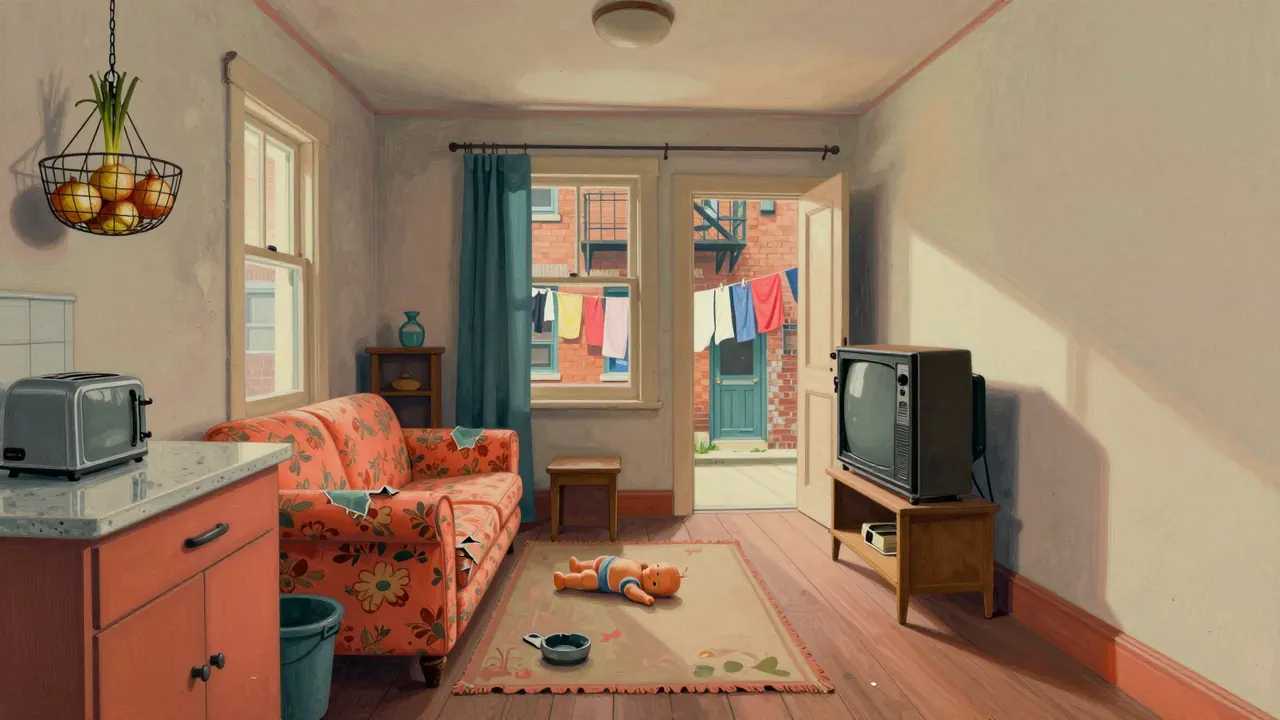
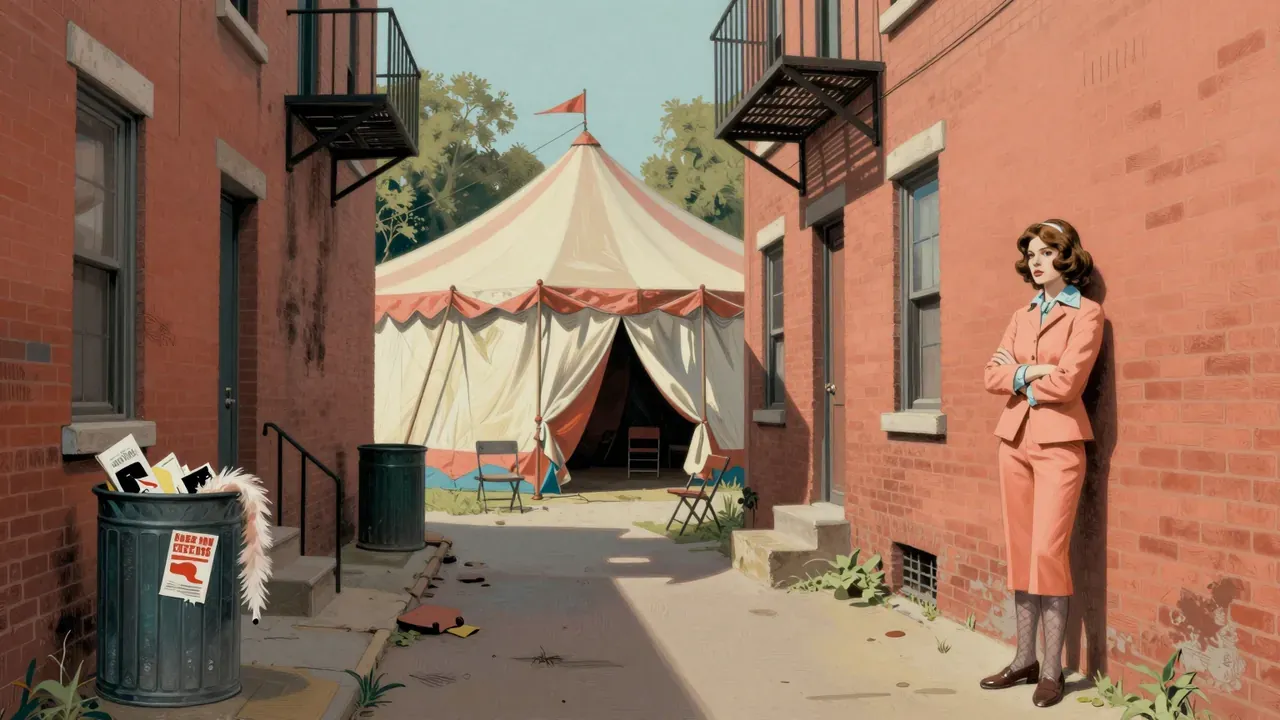
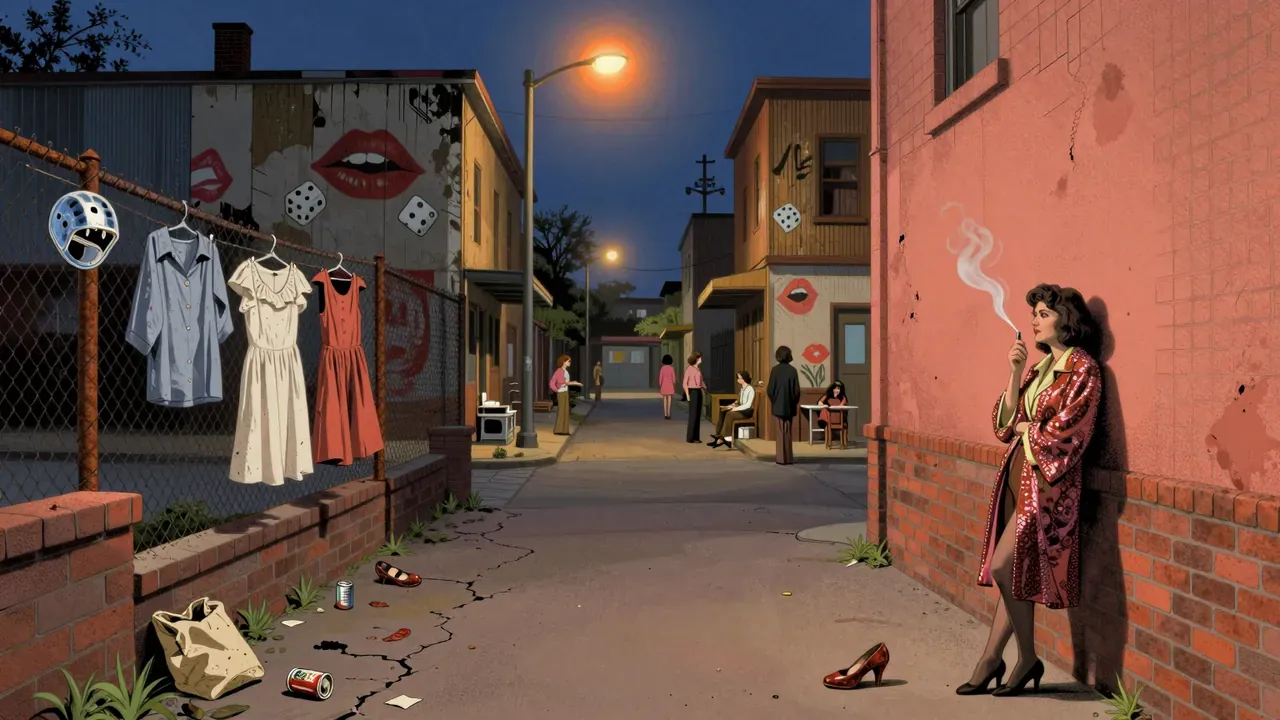
What lands is the film’s sustained tone: a bleak, unsmiling parody of authoritarianism disguised as camp. The mortuary stillness of Mortville — its residents moving like sleepwalkers through decrepit rooms and rain-slicked plywood alleys — gives the satire weight. The sequence where Carlotta’s guards collapse Peggy and Grizelda’s house feels less like slapstick than structural inevitability, a physical manifestation of how systems crush dissent without drama. Mole’s penectomy, though grotesque, lands because it follows logically from the film’s internal logic: if gender transition is transactional, then reversal is equally plausible. The final image — Carlotta roasted and served — works not as shock but as grim punchline, the only coherent resolution to a society that treats bodies as interchangeable commodities. Even the film’s technical limitations — the unheated loft, the muddy Maryland rain — become expressive: Mortville feels lived-in not because it is convincing, but because it is stubbornly, exhaustingly present.
The gaps in it
What does not land is the attempt at emotional pivot. The subplot involving Princess Coo-Coo and the nudist garbage collector lacks the same grounded absurdity; their romance feels tacked-on, its tragedy underwritten by both script and performance. The film never earns the pathos it gestures toward — Coo-Coo’s grief, Grizelda’s death, even Peggy’s moral collapse — because it denies them interiority. There is no character development, only role-swapping: Peggy moves from neurotic housewife to genocidal collaborator without psychological scaffolding. The satire suffers when it strains for symbolic resonance beyond its own terms — the rabies plot, for instance, reads as arbitrary rather than inevitable. And while the absence of Divine is formally interesting, it leaves a vacuum in charisma and timing; several scenes stall where Divine would have accelerated them through sheer force of presence. The film’s refusal to explain itself becomes a liability when its metaphors grow opaque rather than sharpened.
The logic of it
The themes that matter are not transgression for its own sake, but the banality of tyranny and the infrastructure of exclusion. Mortville is not an otherworldly hell but a logical extension of American suburban alienation — a place where people are sorted, discarded, and rebranded according to arbitrary hierarchies. Class is visible in costume and posture: Muffy’s sequins versus Carlotta’s military drag, Mole’s surgical transformation versus Grizelda’s worn housedress. Gender is treated as mutable but never liberatory — every change is transactional, medical, or punitive. The film interrogates consent not through intimacy but through bureaucracy: exile is offered as choice; surgery is paid for with stolen lottery money; rabies is administered as public health policy. There is no utopian counterpoint — even the revolution ends in ritual cannibalism — suggesting that systems do not collapse into freedom but into new forms of consumption. It is a film about how power sustains itself not through violence alone, but through the dull, daily work of administration, architecture, and weather.
The audience for it
This film is for viewers who already know Waters’ grammar — those who recognise deadpan delivery as emotional strategy, who read plywood sets as political statements, who find humour in the gap between bureaucratic language and bodily horror. It rewards patience with texture, not payoff. It is not for those who require narrative momentum, psychological realism, or moral orientation — the film offers none. Anyone expecting the visceral propulsion of Pink Flamingos or the glittering nihilism of Female Trouble will find Desperate Living slow, dry, and structurally withholding. Those who dislike long takes of characters silently eating or staring at walls will leave before Mortville’s second rainstorm. A viewer who values thematic density over entertainment will stay; one who needs catharsis, closure, or even consistent rhythm will not. The film assumes familiarity with its own rules — and makes no effort to teach them.
The time it takes
Yes, it is worth your evening — but only if you accept its terms. It demands attention to composition, to silence, to the weight of a single glance across a cluttered room. Its ninety-one minutes unfold like a document rather than a story: observed, not narrated. You will not laugh often, but you may feel the slow creep of recognition — how easily hierarchy hardens into dogma, how quickly safety becomes surveillance. Those who dismiss it as ‘just shock’ miss its rigour: every prop, line, and edit serves the world’s internal logic. Critics who walked out after ten minutes mistook restraint for emptiness. The film’s value lies in its consistency, not its accessibility. It is not for everyone — but for those who meet it on its own ground, it repays close watching with quiet, unsettling returns. To find it tedious is reasonable; to call it meaningless is to ignore the care with which every rotten plank was nailed into place.