The look of it
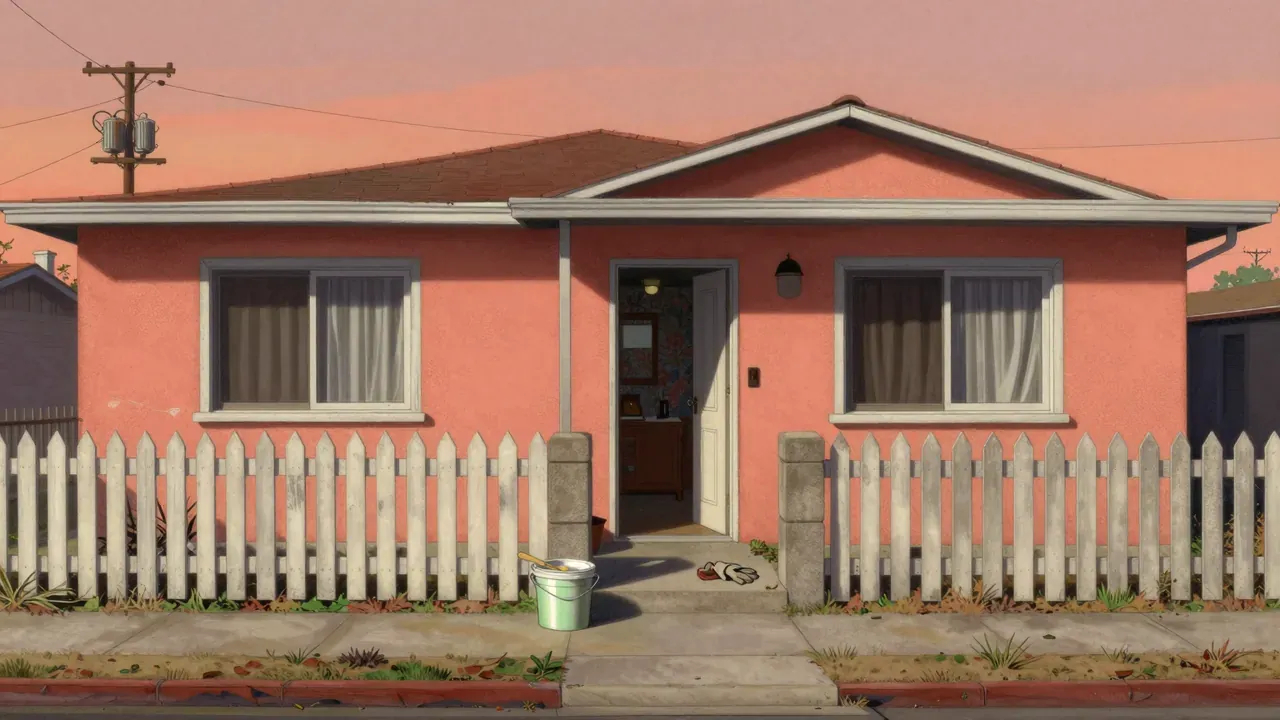
Housekeeping is a quiet, deliberate adaptation of Marilynne Robinson’s 1980 novel, made by Bill Forsyth as his first American feature. It is not an expansion or reinterpretation but a sustained act of fidelity — to the book’s tone, its preoccupations with absence and inheritance, and its refusal of narrative urgency. Forsyth treats the material as something already complete: a vessel for atmosphere, not plot; for implication, not exposition. The film avoids psychological realism in favour of a kind of lyrical restraint, where silence carries weight and domestic detail stands in for emotional history. It does not seek to explain Sylvie’s drift or rationalise the sisters’ choices, nor does it dramatise the town’s disapproval beyond what the script gives — a few glances, one formal visit from church ladies. Its ambition is modest and precise: to hold space for characters who live outside convention without making them symbols, victims, or lessons. That it does so in the language of 1950s small-town America, shot in Canadian locations standing in for Idaho, only deepens its sense of displacement — both geographical and emotional. (158 words)
The pace of it
The story follows Ruth and Lucille through adolescence after their aunt Sylvie arrives to raise them, but it unfolds without cause-and-effect momentum. Christine Lahti plays Sylvie with stillness and unforced eccentricity — no grand gestures, no breakdowns, just a woman whose habits are her grammar. Sara Walker and Andrea Burchill, both non-professionals, carry the film’s emotional centre with unvarnished presence: their shifting allegiance between loyalty and self-preservation feels earned, not scripted. Michael Coulter’s cinematography avoids contrast or flourish; he keeps light even, interiors soft, exteriors washed in overcast greys, matching the film’s resistance to emphasis. Michael Gibbs’ score is sparse, mostly piano and strings, used only where silence would be too heavy. Editing by Michael Ellis moves at the pace of memory — lingering on empty rooms, slow pans across waterlogged floors, long takes that let scenes settle rather than propel. There is no voiceover, no flashbacks, no exposition about the grandfather’s death beyond what the girls know. Every craft choice serves the same end: to make the ordinary feel charged, not dramatic. (159 words)
The weight of it
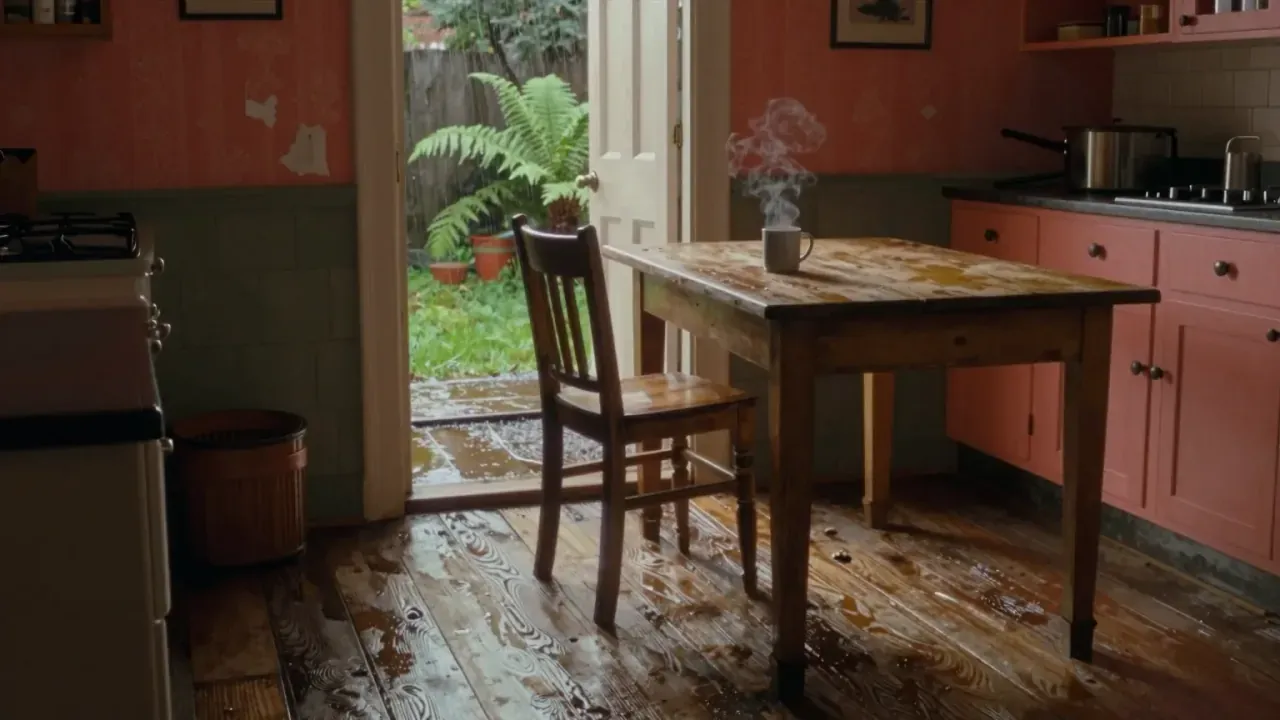
What lands is the cumulative weight of small, unremarkable moments: Sylvie washing tins at dawn after a night of frantic cleaning; Ruth watching Lucille walk away without turning back; the two of them sitting knee-deep in floodwater, eating toast. These are not ‘high points’ but accumulations — the film’s rhythm depends on repetition and slight variation, like the trestle bridge reappearing in different lights, or Sylvie’s repeated walks along train tracks. The performances land because they refuse interpretation: Lahti never cues us how to read Sylvie’s detachment, Walker never signals when Ruth begins to choose her aunt over her sister. The film trusts the audience to sit with ambiguity, and it rewards that patience with emotional precision. Even the production design — the piled newspapers, the damp wallpaper, the way furniture seems slightly out of place — feels less like set-dressing than evidence of lived-in contradiction. There is no irony in how the film treats its characters’ choices, no condescension toward the town’s norms or Sylvie’s refusal of them. That neutrality is rare, and it is what makes the final departure feel inevitable rather than tragic. (157 words)
The gaps in it
What does not land is the attempt to condense the novel’s interiority into visual equivalents. The book’s long passages of reflection — Ruth’s meditations on memory, time, and the porous boundary between life and death — have no direct cinematic counterpart. The film substitutes atmosphere for thought, and while that works much of the time, key transitions feel underwritten: Lucille’s decision to leave lacks the psychic scaffolding the novel provides, and Sylvie’s final act loses some of its metaphysical resonance when stripped of Robinson’s prose. The film also struggles with scale. Its insistence on understatement occasionally flattens stakes — the sheriff’s intervention, the church ladies’ visit, even the flood itself, all register as events rather than crises. This is not a flaw in intent, but in translation: Forsyth’s Scottish sensibility, honed on dry comedy and gentle absurdism, sits uneasily beside Robinson’s American gothic gravity. Some viewers will find the pacing inert rather than contemplative; others may miss the novel’s moral architecture beneath the quiet surfaces. (156 words)
The shape of it
The themes that matter are inheritance and erasure — not of property or name, but of presence. The lake swallows cars, trains, people, and memory alike; the house fills with water and paper, then empties again; Sylvie arrives and departs without explanation, leaving only traces. The film treats family not as a structure but as a series of absences — the mother gone, the grandfather drowned, the great-aunts temporary, the aunt transient. Belonging is shown as conditional and unstable: Lucille seeks it in school, in Miss Royce’s home, in clean rooms; Ruth finds it in motion, in shared silence, in the liminal space beneath the trestle. Conformity is never mocked, only observed — the town’s expectations are real, practical, unyielding, but the film refuses to frame them as villains. Instead, it asks what it costs to remain legible to others, and whether illegibility might be a form of survival. These are not abstract ideas but embodied ones: in the way Sylvie folds laundry while water laps at the floorboards, in the way Ruth watches her sister’s back recede down the road, in the way the camera holds on an empty chair long after someone has left it. (159 words)
The demand of it
This film is for viewers who value mood over momentum, who find emotional clarity in stillness, and who trust that a character’s worth is not measured by their utility to plot. It suits those familiar with Forsyth’s earlier work — the unhurried pacing of Local Hero, the dry observation of Gregory’s Girl — or readers of Robinson’s novel seeking a faithful, tactile echo. It is not for viewers who require narrative resolution, psychological explanation, or moral framing. Those who expect Sylvie’s arc to culminate in revelation or redemption will be frustrated; those who need Lucille’s departure to feel justified, or Ruth’s choice to feel earned in conventional terms, will find the film withholding. A viewer who values tight causality or strong external conflict — say, a fan of 1980s American drama or studio comedies — may mistake its restraint for indifference. Nothing changes the verdict except a willingness to meet the film on its own terms: as a study in duration, not development. (158 words)
The leaving of it
Yes, it is worth your evening — provided you watch it without expectation of payoff, without reaching for meaning before the scene has settled, and without comparing it to other films about grief or adolescence. Its 117 minutes pass slowly, but not emptily: each frame holds texture, each silence contains weight. It repays attention not with twists or revelations but with subtle shifts in light, posture, and proximity — the way Sylvie’s hand rests on Ruth’s shoulder for a fraction longer than necessary, or how the steam rises from two mugs placed side by side on a wet table. Those who dislike it tend to cite its lack of forward drive or emotional catharsis — fair objections, but objections to its design, not its execution. Its value lies precisely in its refusal to perform emotion for the camera. To ask whether it is ‘entertaining’ is to misread its contract. It is absorbing, exact, and quietly devastating — and that is enough. (157 words)