The look of it
In Vanda’s Room is a fixed-camera, digitally shot portrait of daily life in Fontainhas — a Lisbon shantytown then under demolition — centred on Vanda Duarte, a woman living with heroin addiction. It is the second film in Pedro Costa’s Fontainhas trilogy and operates as neither documentary nor fiction but as a sustained act of attention: to place, to duration, to bodies in space, to the rhythms of survival amid neglect. Costa does not seek exposition, diagnosis or narrative resolution. Instead, he constructs a slow, uninflected record — one that refuses to separate Vanda’s personal condition from the material decay of her environment, or from the presence of neighbours, family and friends who share her marginality. The film’s ambition lies in its refusal of hierarchy: no moment is privileged over another; no voice is framed as authoritative; no edit imposes meaning. It treats time not as a vessel for story but as a substance to be held, measured and inhabited. Its project is ethical as much as aesthetic: to make visible what official Lisbon had already begun erasing.
The people in it
The film works through radical formal consistency: every shot is static, composed with deliberate weight and stillness, often holding long after action has ceased. Pedro Costa handles both direction and cinematography, using low-resolution digital video not for convenience but for its grain, its flatness, its resistance to polish. Light falls unevenly — lamps flicker, windows admit weak daylight, interiors stay dim — and sound is captured raw: overlapping Portuguese speech, distant construction, coughs, silences thick enough to hear breath. Performances are non-professional and unperformed: Vanda Duarte, Lena Duarte, Zita Duarte, António ‘Pango’ Semedo and others appear as themselves, speaking in their own voices, moving at their own pace, often doing little more than sitting, waiting, smoking or tending to small domestic tasks. Editing by Dominique Auvray sustains this rhythm: cuts arrive without emphasis, often mid-sentence or mid-gesture, refusing punctuation. There is no score, no narration, no explanatory title cards. The craft is ascetic, precise and entirely devoted to preserving the integrity of the observed moment — not dramatising it.
The time in it
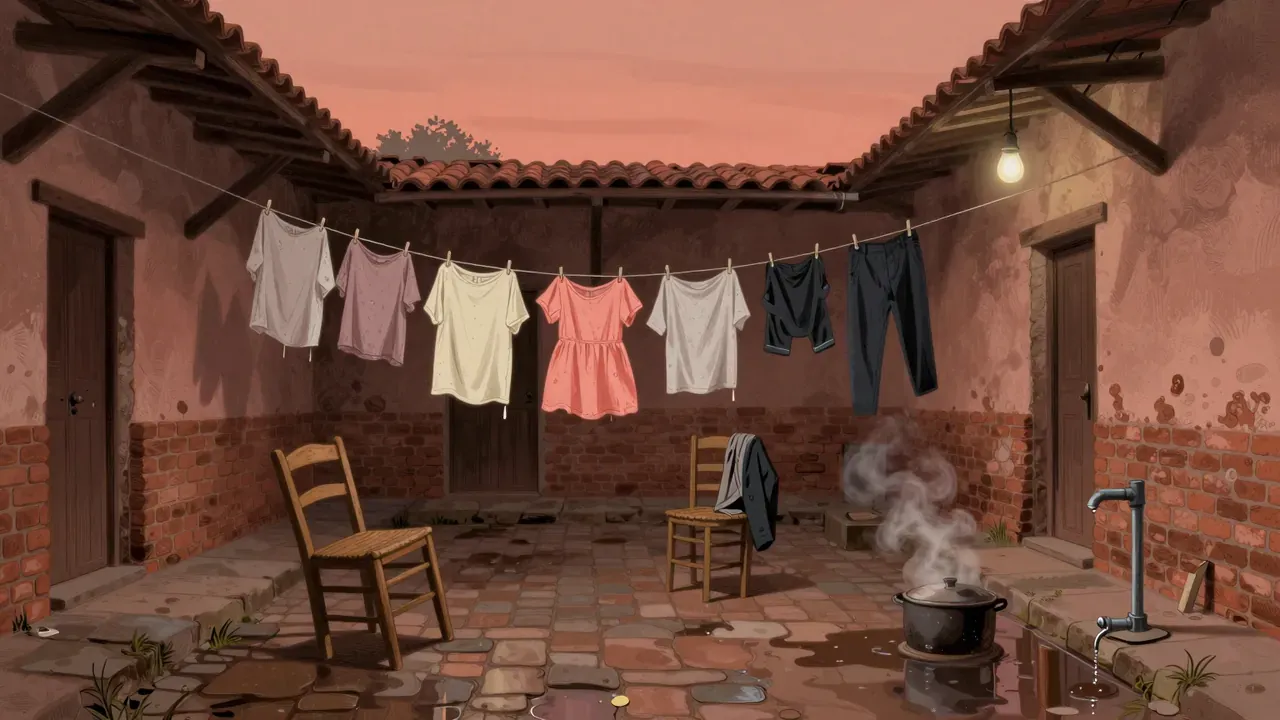
What lands is the cumulative gravity of presence. Over 170 minutes, the film builds a tactile sense of place — the damp plaster, the cracked tiles, the narrow doorways, the way light pools on a bare floor — until the setting becomes a character with its own biography and dignity. Vanda’s quiet endurance, her dry humour, her moments of tenderness toward her sister Lena or her nephew Diogo, register without sentimentality because the camera never flinches or interprets. The demolition of Fontainhas enters the frame not as spectacle but as background fact: a bulldozer appears in a window, dust settles on a table, a neighbour packs a suitcase. These details accrue into something like moral clarity: the film makes visible how structural abandonment operates not through violence but through omission, delay and indifference. The viewer does not learn about poverty — they inhabit its texture, its pauses, its repetitions. That immersion is earned, not imposed, and it lingers long after the final frame.
The place in it
What does not land is any sense of forward motion or relational development. Characters recur but rarely deepen; conversations begin and end without resolution; illness, dependency and displacement remain constant, unvaried conditions rather than arcs. Some viewers will find the film’s refusal of exposition alienating — there is no context given for Cape Verdean migration, no explanation of Portugal’s housing policy, no biographical framing for Vanda beyond what she says in passing. The digital image, while intentional, can feel visually fatiguing over extended stretches: low contrast, muted tones and occasional sensor noise may read as technical limitation rather than aesthetic choice to those unfamiliar with Costa’s method. And while the film’s stillness is disciplined, it risks monotony when viewed outside its intended context — as part of the Fontainhas trilogy, or within a programme of structuralist or ethnographic work — where its rigour reads as necessary rather than self-justifying.
The ending of it
The themes that matter are not abstract but embodied: the weight of time as lived experience, the politics of visibility, the quiet persistence of community amid erasure, and the relationship between architecture and agency. Fontainhas is not backdrop but determinant — its crumbling walls, shared courtyards and lack of sanitation shape every decision, every interaction, every silence. Addiction is presented not as pathology but as one condition among many — coexisting with exhaustion, unemployment, immigration status, ageing, caregiving — all of which are distributed unevenly across bodies in the frame. The film also treats memory as physical: photographs hang crookedly on walls, radios play fado, older residents speak of past neighbourhoods now gone. There is no nostalgia, only continuity — a sense that history is not behind these people but beneath their feet, in the rubble, in the soil. Costa’s interest is not in change but in what persists despite it: resilience without rhetoric, dignity without performance.
The voice of it
This film is for viewers who value sustained attention over narrative payoff, who find meaning in duration and texture rather than plot or character transformation, and who accept that some truths resist dramatisation. It suits those familiar with structural film, ethnographic practice or the work of filmmakers like Jean-Marie Straub, Chantal Akerman or Wang Bing. It is not for viewers seeking exposition, emotional catharsis, psychological insight or social analysis delivered through dialogue or voiceover. Those who require clear cause-and-effect, moral framing or even basic contextualisation will likely disengage. The film assumes patience as a precondition, not a virtue to be rewarded — and it offers no concessions. If you need the film to tell you what to think, or to move faster than real time allows, it will feel inert. But if you trust that watching — truly watching — is itself an ethical act, then it repays that commitment fully.
The point of it
Yes, it is worth your evening — but only if you approach it as an encounter, not entertainment. Its 170 minutes demand surrender to its tempo, its silence, its refusal of emphasis. It does not offer distraction, uplift or intellectual neatness. What it gives instead is rare: a film that treats its subjects with absolute seriousness, without condescension, without extraction, without turning suffering into spectacle. You will not leave informed in the conventional sense, but you may leave recalibrated — attuned to the weight of a glance, the significance of an empty chair, the politics of a doorway left open. Those who dismiss it as ‘too slow’ or ‘unengaging’ are not wrong in their reaction; they are simply outside its contract. For the right viewer — patient, attentive, unafraid of ambiguity — it is not just worth the time. It redefines what time in cinema can do.