The frame around the story
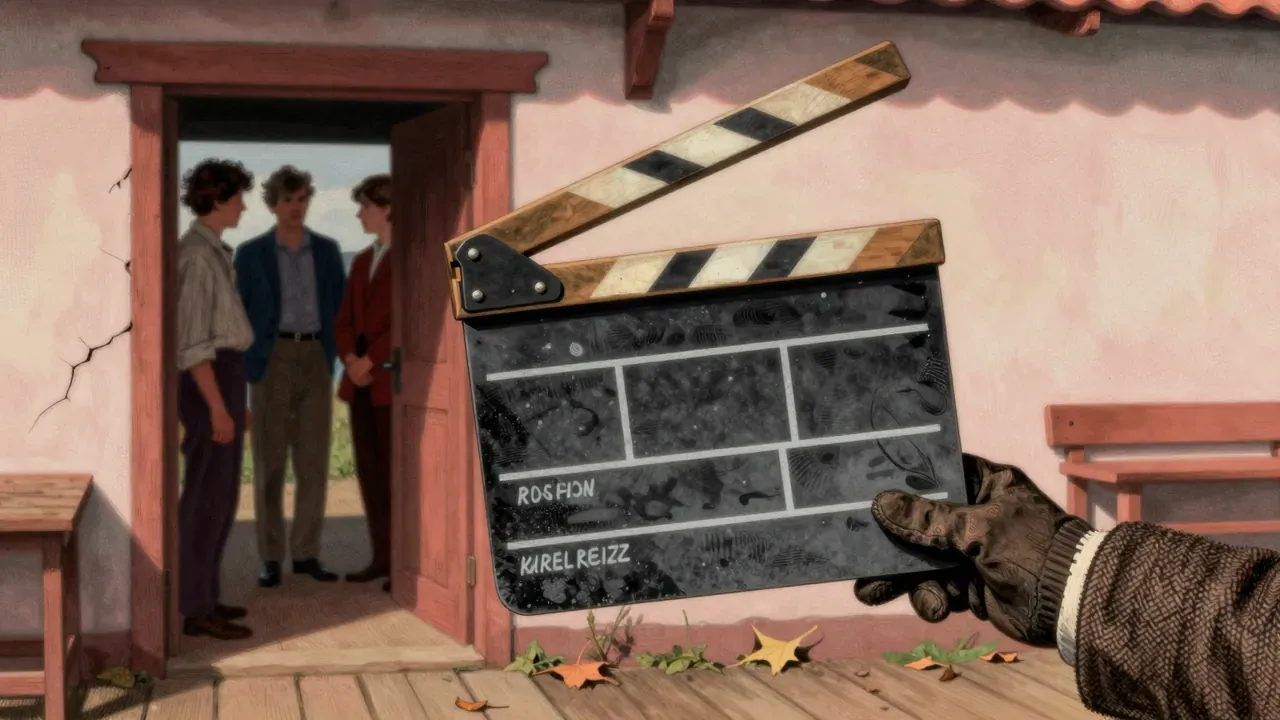
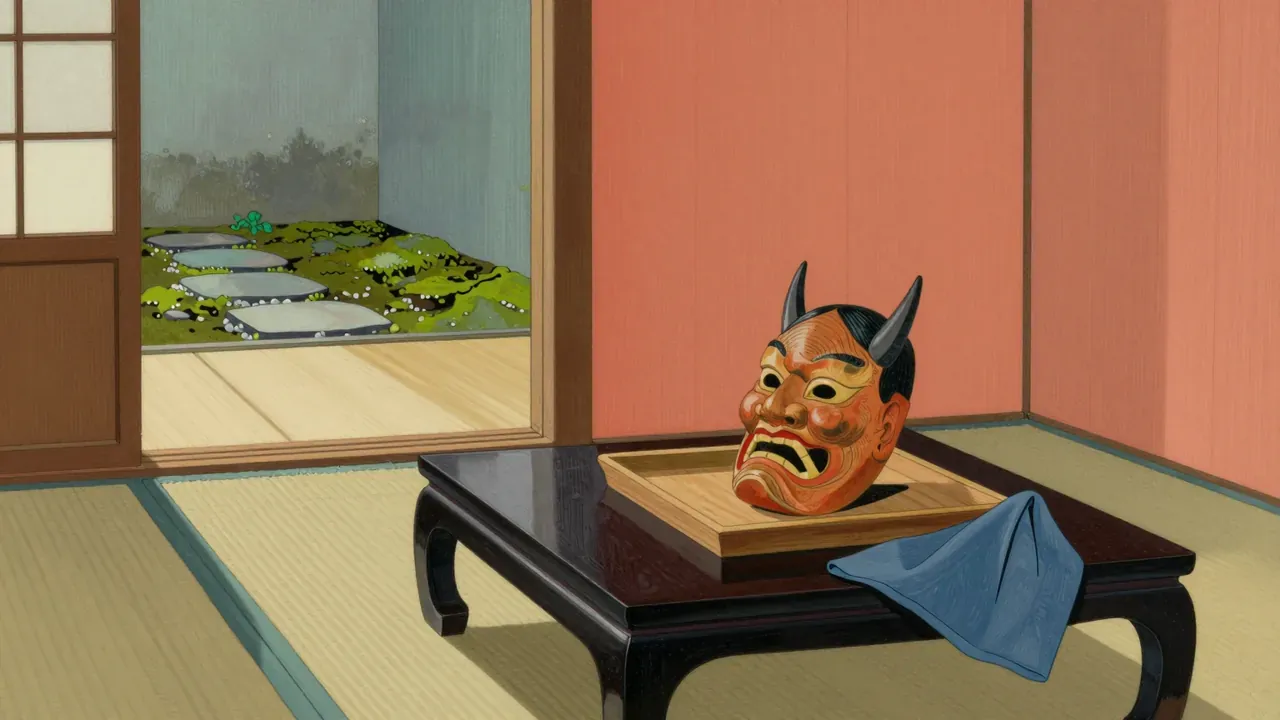
Double Suicide is a 1969 Japanese film adaptation of Chikamatsu Monzaemon’s 1721 bunraku play, transposed from puppet theatre to live action while retaining its theatrical grammar. Masahiro Shinoda does not attempt naturalism; instead, he treats the story as a ritual performed in real time, with kuroko — stagehands in black — moving props, adjusting light, and even assisting Jihei’s suicide. The film opens with preparations for a modern staging: a director on the phone, a set under construction, voices debating location logistics. This framing insists the tragedy is not past but present, not history but rehearsal — a form of collective memory enacted rather than recounted. It is not about fidelity to source, nor psychological realism, but about sustaining the formal tension between human actors and puppet logic: where gesture stands for feeling, silence for anguish, and black-clad figures for fate made visible. The film’s ambition is structural and philosophical: to make the audience feel the weight of tradition not as ornament but as constraint, and the lovers’ choice not as passion but as the only available syntax within that constraint. Word count: 158.
The weight of the gesture
The story follows Jihei, a paper merchant torn between his wife Osan and the courtesan Koharu, both played by Shima Iwashita — a casting decision that anchors the film’s doubling motif in performance, not metaphor. Kamatari Fujiwara’s Tahei is all bluster and social misreading; Nakamura Kichiemon II’s Magoemon carries quiet authority, his revelation as Jihei’s brother landing with moral gravity, not surprise. Tōru Takemitsu’s score avoids period pastiche: sparse, dissonant, percussive — it punctuates rather than underscores, often falling silent at moments of high emotion. Gordon Willis is not involved; the cinematography is by Kazuo Miyagawa, who keeps the palette muted, the compositions rigidly frontal or axial, the lighting flat and stage-like. Sets are deliberately artificial — painted backdrops, visible joists, minimal props — rejecting illusion in favour of emblem. Editing is rhythmic, not narrative: cuts align with kuroko movement or bell tolls, not emotional beats. The camera rarely moves, and when it does, it glides like a puppet master’s hand. Word count: 159.
The black figures in the frame
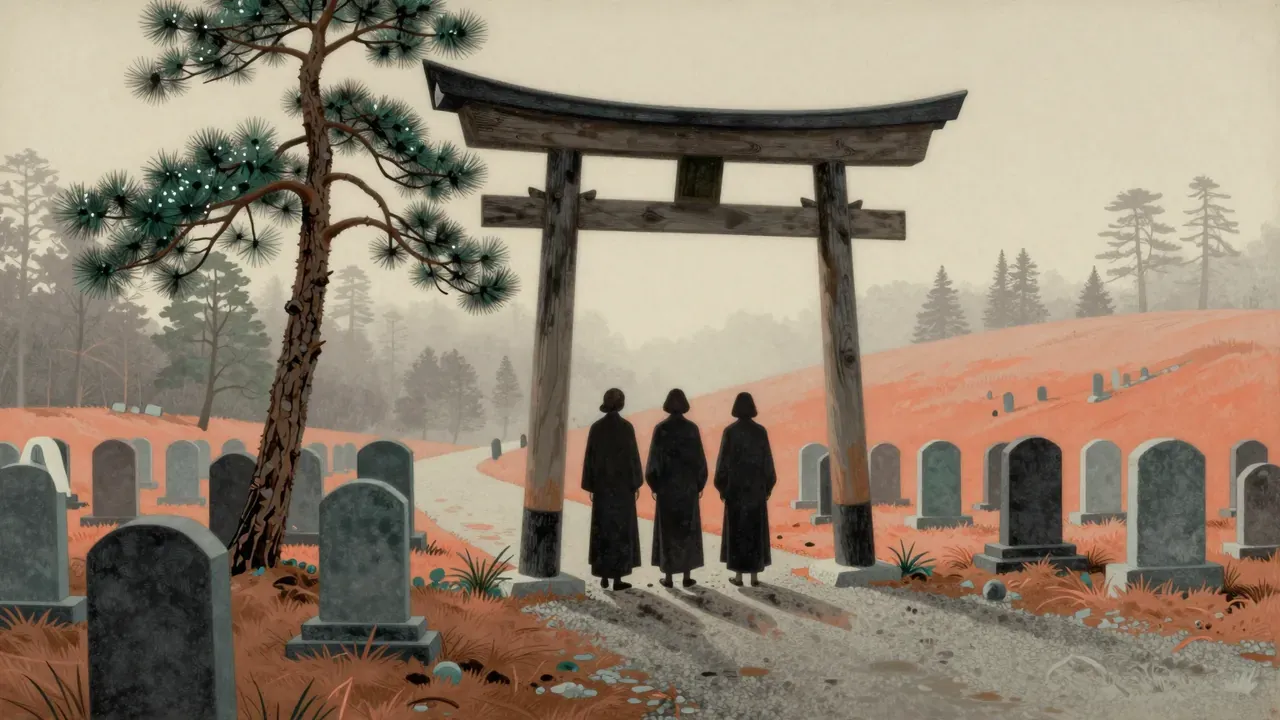
What lands is the film’s unwavering commitment to its own terms. The kuroko do not break immersion; they deepen it — their interventions feel less like theatrical ‘devices’ and more like the physical manifestation of social pressure, debt, and obligation. When Jihei tears apart his shop, the flimsy walls collapsing under his hands register not as poor set design but as the literal crumbling of bourgeois stability. Iwashita’s dual role works because her shifts between Osan and Koharu are not psychological but gestural: posture, gaze, the angle of a wrist. The final sequence — the graveyard coupling, the cutting of the topknot, the hanging from the torii — gains force from its restraint: no music swells, no close-ups linger, the kuroko simply step in and tie the obi. The film’s austerity becomes its eloquence. Its refusal to explain Jihei’s despair, or Osan’s sacrifice, or Koharu’s wavering resolve, leaves space for the weight of the act itself — not why they die, but that they must. Word count: 157.
What the film refuses to say
What does not land is the film’s reliance on prior knowledge of bunraku conventions. Without understanding the kuroko’s symbolic function — or the cultural gravity of shinjū as socially legible protest — their presence risks seeming arch or arbitrary. The telephone call framing device, though conceptually sound, sits uneasily beside the historical setting: the anachronism feels intellectual rather than expressive, a footnote mistaken for architecture. Some scenes — particularly the brothel confrontation with the samurai — suffer from static blocking and protracted dialogue delivery, where rhythm should carry meaning but instead stalls. The film assumes fluency in Japanese theatrical semiotics; viewers unfamiliar with Chikamatsu’s work may read Jihei’s passivity as weakness rather than entrapment, Osan’s letter as manipulation rather than love. The moral economy — where honour, debt, and filial duty operate as immutable physics — remains opaque without context. Word count: 156.
The arithmetic of devotion
The themes that matter are obligation as identity, love as debt, and death as syntax. Jihei is not undone by desire but by his inability to reconcile competing claims: to Osan, to Koharu, to his brother, to his father-in-law, to his trade, to his class. His suicide is not romantic escape but grammatical necessity — the only sentence his world allows him to complete. The film treats marriage, prostitution, and brotherhood not as relationships but as contracts written in silver, blood, and silence. Money is never abstract: ten kan of silver is a wall, 150 ryō is a bridge, 80 ryō hidden in a chest is a lifeline severed before it can be thrown. Gender is codified in costume and posture: Osan’s stillness versus Koharu’s performative mobility, both constrained by the same structure. Even the kuroko embody absence-as-presence: their blackness signifies what cannot be named — shame, poverty, social erasure — yet must be acted upon. The film’s modernity lies not in its 1969 release but in its diagnosis: that systems — economic, familial, theatrical — shape action long before intention forms. Word count: 159.
Who the film is for
This film is for viewers who value formal rigour over emotional exposition, who find clarity in constraint, and who approach cinema as a discipline of attention rather than immersion. It rewards patience with structural intelligence, not plot payoff. Those who expect psychological motivation, narrative momentum, or visual lushness will find it austere, slow, and emotionally withholding. It is not for viewers who rely on exposition, empathetic anchoring, or cinematic ‘guidance’. Someone who values Takemitsu’s score but dislikes Miyagawa’s flat lighting may resist it; someone who admires Ozu’s stillness but finds Mizoguchi’s moral gravity oppressive may find Shinoda’s tone too unrelenting. A change in pacing — tighter editing, fewer static tableaux — would shift the verdict, but not the film’s purpose: this is not a story told, but a form rehearsed. Word count: 154.
The time it takes
Yes, it is worth your evening — provided you watch it as one would attend a Noh performance: with preparation, stillness, and willingness to sit inside its rules. Its 142 minutes unfold with the inevitability of a clockwork mechanism, each scene calibrated to the next like a puppet joint. To call it ‘difficult’ mistakes discipline for obscurity; its difficulty lies in its refusal to translate. Someone who watches it expecting catharsis will leave unsatisfied; someone who watches it as an inquiry into how form shapes feeling will find it exacting and resonant. It is not entertainment, nor therapy, nor instruction — it is a demonstration: of how tradition holds grief, how theatre names shame, how love, stripped of romance, becomes arithmetic. Its value is cumulative, not immediate. Word count: 152.