The look of it
The Third Man is a British film noir set in the ruins of Allied-occupied Vienna in 1948, built around a moral and spatial disorientation. It attempts to render the exhaustion of postwar Europe not as backdrop but as texture: cracked plaster, flooded basements, tilted horizons, voices echoing from sewer grates. Its aim is not to solve a crime but to sustain a state of doubt — about friendship, loyalty, justice, and the very legibility of truth in a city divided into four zones and governed by competing loyalties. Graham Greene’s script treats plot as secondary to atmosphere; the story exists to move Holly Martins through spaces that resist coherence, where light falls at unnatural angles and authority figures speak in riddles or silence. The film does not seek to affirm order after chaos. Instead, it holds open the question of whether any stable moral ground remains — and whether the desire for such ground is itself a kind of naivety. It is less a thriller with philosophical trimmings than a philosophy made visible through thriller grammar: suspense as epistemology, shadow as syntax.
How it moves
The story follows American pulp writer Holly Martins as he arrives in Vienna expecting work from his old friend Harry Lime, only to find Lime dead — then alive — then morally unmoored. Joseph Cotten plays Martins with a quiet, stubborn decency that never quite hardens into conviction; his performance is all hesitation, blink, and delayed reaction. Orson Welles appears late but dominates every frame he occupies, his voice and posture calibrated to suggest charm that curdles on contact. Alida Valli’s Anna Schmidt moves through the film like smoke: present but untouchable, grieving but withholding, loyal but unyielding. Robert Krasker’s cinematography uses deep focus, extreme low angles, and high-contrast lighting to make Vienna’s rubble feel sentient — walls lean, stairwells coil, doorways gape like wounds. Anton Karas’s zither score avoids melody in favour of repetition and dissonance, its plucked strings sounding like footsteps on wet stone. Oswald Hafenrichter’s editing sustains rhythm without resolution: scenes end mid-breath, cuts land just before sense catches up.
What sticks
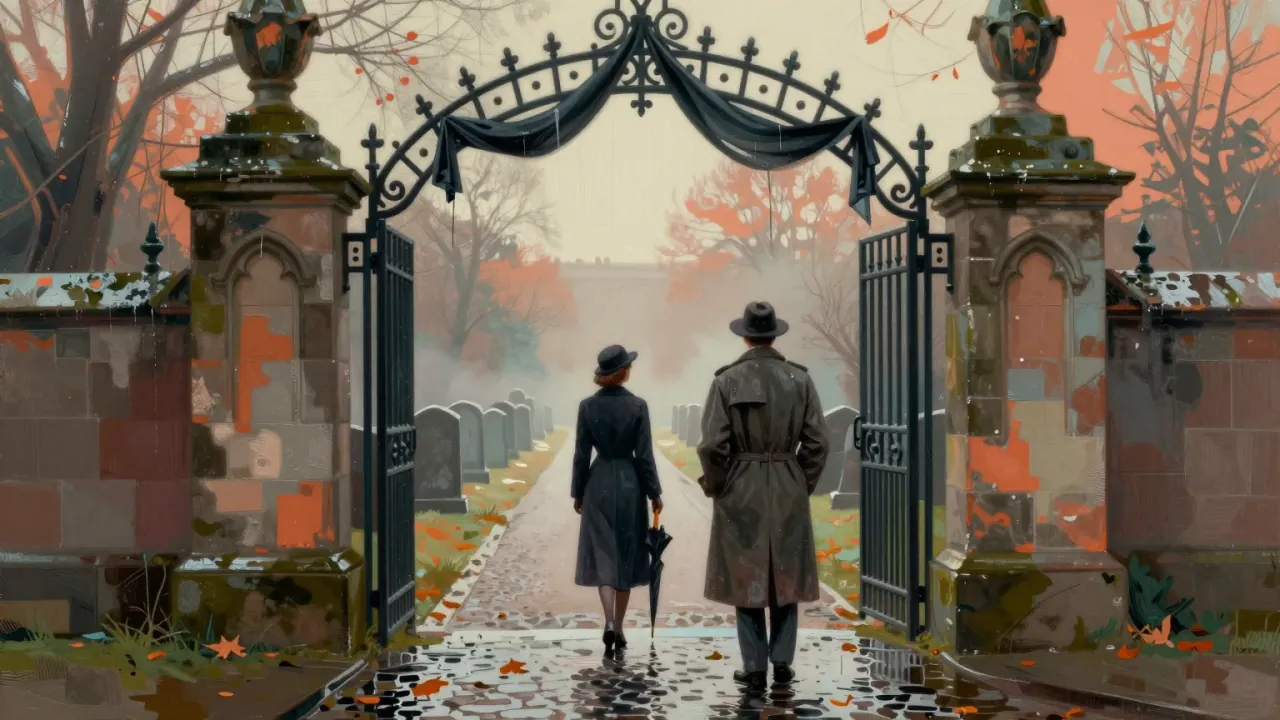
What lands most decisively is the film’s physicality — the weight of its locations, the grain of its surfaces, the way light bleeds across damp brick or pools in a man’s eye socket. The famous Ferris wheel scene works not because of the speech about cuckoo clocks, but because the camera holds on Welles’s face as it tilts downward, then upward again, making perspective itself unstable. The sewer chase is effective not as action but as descent: each ladder rung, each drip of water, each echo off curved concrete accumulates dread without recourse to music or close-ups. The final shot — Valli walking past Martins without acknowledgment — lands with the force of withheld punctuation. There is no catharsis, no explanation, no comfort; just the slow, cold fact of her choice, and his stillness. The film’s refusal to let Martins (or the viewer) settle into certainty is sustained with near-total consistency. Even minor characters — the cynical Major Calloway, the weary porter, the indifferent British officer — occupy their roles with the gravity of people who have stopped believing in explanations but keep working anyway.
Where it slips
What does not land is the framing device: the opening narration, delivered over aerial shots of Vienna, feels detached from the rest of the film’s tactile urgency. It names Holly Martins as the narrator, yet the voice is too polished, too literary, too sure — a mismatch with Cotten’s hesitant, physically grounded performance. The early scenes in Martins’s hotel room also falter: exposition-heavy dialogue about Lime’s death lacks the subtextual tension that later scenes generate effortlessly. Some supporting performances verge on caricature — particularly the Austrian bureaucrats and black-market dealers — though this may be deliberate tonal shorthand rather than failure. The US version, shortened by David O. Selznick, excises key ambiguities and flattens the ending, but even the original UK cut occasionally strains under the weight of its own symbolism: the recurring motif of broken clocks and stalled watches risks becoming illustrative rather than immersive. And while the zither score is distinctive, its repetition can tip from evocative to insistent — a single instrument holding the entire sonic field begins to feel less like austerity and more like limitation.
What it means
The themes that matter are those embedded in architecture and gesture: occupation as both political condition and psychological state; friendship as a contract easily rewritten by circumstance; corruption not as villainy but as infrastructure — something you walk through, breathe, and pay for in cigarettes. The film treats postwar Vienna not as a setting but as a character whose biography is written in rubble, ration books, and overlapping patrol zones. It asks what happens when institutions collapse not all at once, but incrementally — when law is enforced by soldiers who do not speak your language, when justice is negotiated in basements, when grief is measured in permits and paperwork. The ‘cuckoo clock’ speech is less about Swiss neutrality than about the seduction of tidy moral binaries: the film insists that history produces neither Renaissance nor cuckoo clocks, but both, simultaneously, in the same street, the same room, the same person. Its central concern is not evil versus good, but the erosion of the ground where that distinction could ever be drawn with confidence.
Who it’s for
This film is for viewers who tolerate ambiguity as a condition of attention, who find tension in stillness and meaning in unresolved endings. It rewards patience with texture: the way rain steams off hot pavement, the sound of a zither string catching on a fingernail, the pause before a lie is spoken plainly. It is not for those who require narrative propulsion, emotional payoff, or moral clarity — viewers who expect characters to change, villains to be punished, or love to offer redemption will leave unsatisfied. Those accustomed to contemporary pacing may find its 104 minutes long, not because it drags, but because it refuses to compress time for convenience. A viewer who values craft over plot, mood over message, and atmosphere over explanation will find it rich. Someone seeking catharsis, exposition, or even consistent point-of-view will find it withholding — and rightly so, since withholding is its method.
Is it worth your time
Yes, it is worth your evening — not as entertainment but as calibration: a reminder of how much cinema can do with shadow, silence, and withheld information. Its power lies in restraint: no musical swell as Lime reappears, no close-up as Anna walks away, no explanation for why the British officer lets Martins go. That restraint demands active watching, not passive consumption. Some will argue it is overrated — that its influence has ossified into cliché, that its Cold War pessimism feels dated, that its visual style has been imitated into invisibility. But those objections miss how precisely its techniques serve its vision: the Dutch angles are not stylistic flourishes but expressions of vertigo; the zither is not quaint local colour but the sound of a culture picking itself up, one broken string at a time. To watch it today is to encounter a film that still refuses easy answers — and that refusal remains rare, necessary, and deeply unsettling.