The last frame
Street of Shame is Kenji Mizoguchi’s final film, made in 1956 as Japan debated the abolition of licensed prostitution. It follows five women working at Dreamland, a brothel in Tokyo’s Yoshiwara district, under the Tayas’ management. The film does not dramatise resistance or redemption but observes how each woman’s circumstances — debt, family obligation, grief, age, or illusion — bind her to the trade even as legal change looms. It aims not to indict individuals but to map the structural forces that make exit impossible: debt enforced by custom and law, social shame that isolates, and economic precarity that precludes alternatives. The title’s English translation obscures the original Akasen chitai — ‘red-line district’ — a bureaucratic term for zones where prostitution was legally confined, underscoring the film’s focus on regulation over morality. Mizoguchi and co-director Yasuzō Masumura (though the sheet credits both, contemporary accounts confirm Mizoguchi oversaw principal photography before his death; Masumura completed post-production) treat the setting as a social ecosystem, not a stage for catharsis. The film’s ambition is documentary in temper, ethical in posture, and unsparing in its refusal to offer narrative relief. (158 words)
The look of it
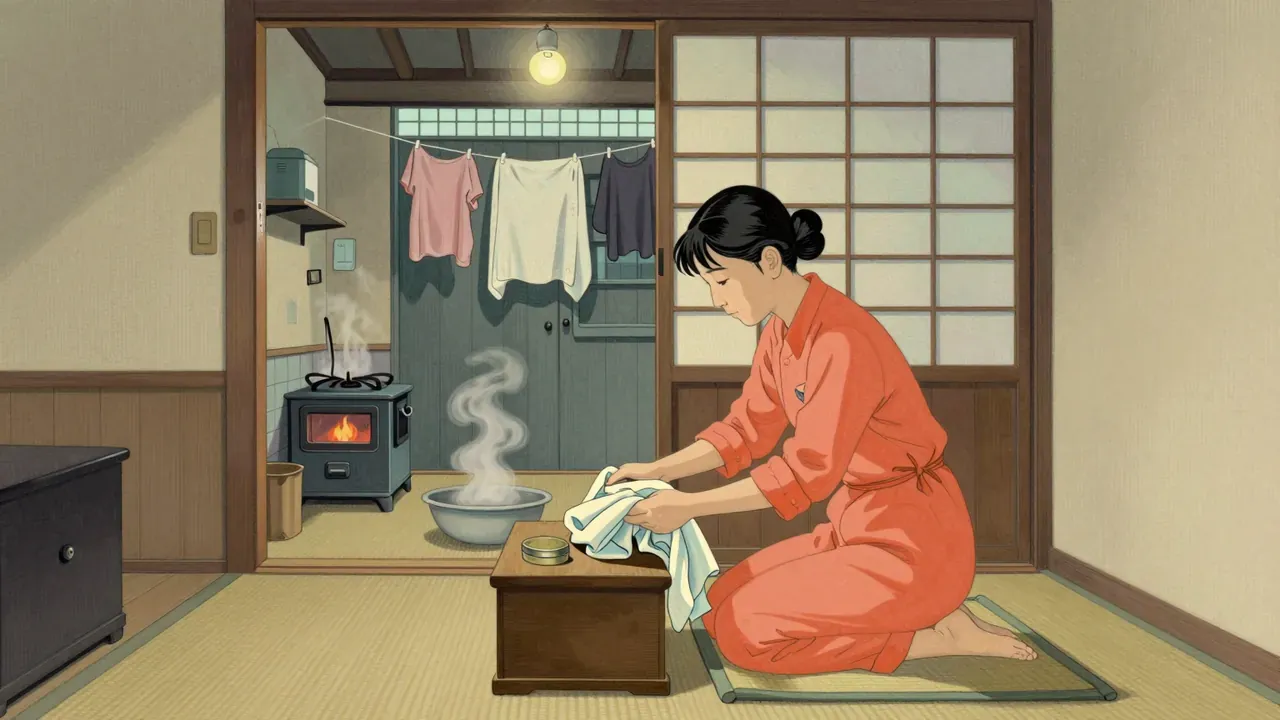
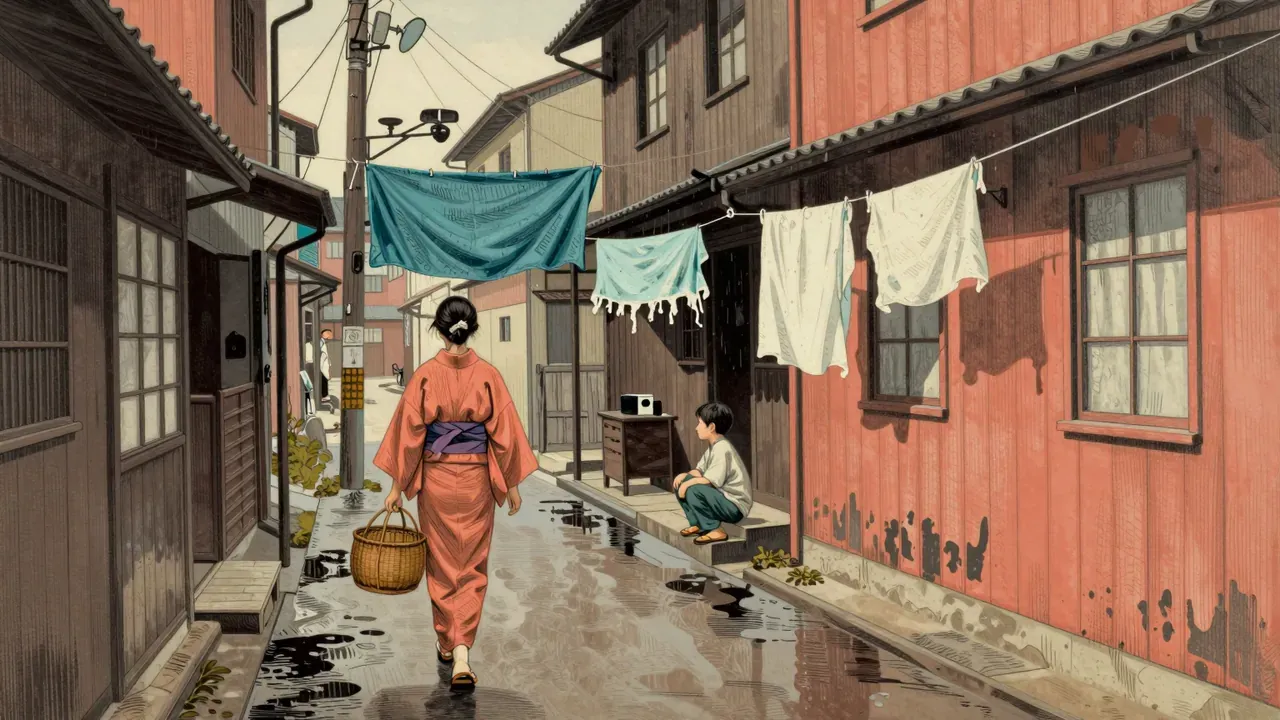
The story unfolds across parallel arcs, each anchored by a woman’s material condition rather than psychological turning points. Machiko Kyō’s Mickey moves with restless physicality, Ayako Wakao’s Yasumi sustains quiet tension through withheld glances, and Aiko Mimasu’s Yumeko carries grief like a weight in her shoulders. Kazuo Miyagawa’s cinematography avoids dramatic lighting: interiors are lit evenly, often from overhead sources, flattening hierarchy between characters and denying visual emphasis to any single face. The camera lingers at medium distance, observing group interactions in long takes, rarely cutting during dialogue. Production designer Hiroshi Mizutani gives the brothel a worn, functional realism — no ornate screens or symbolic props, just tatami, sliding doors, and a narrow street visible through gaps. Toshiro Mayuzumi’s score is sparse, mostly absent during scenes of confrontation or breakdown, returning only in transitional passages with muted koto and shakuhachi. The script by Masashige Narusawa adapts Yoshiko Shibaki’s novel without embellishment, retaining its episodic structure and refusing to resolve contradictions — such as Yorie’s return after marriage, or Yasumi’s pivot to commerce — as irony or failure. (159 words)
The weight of routine
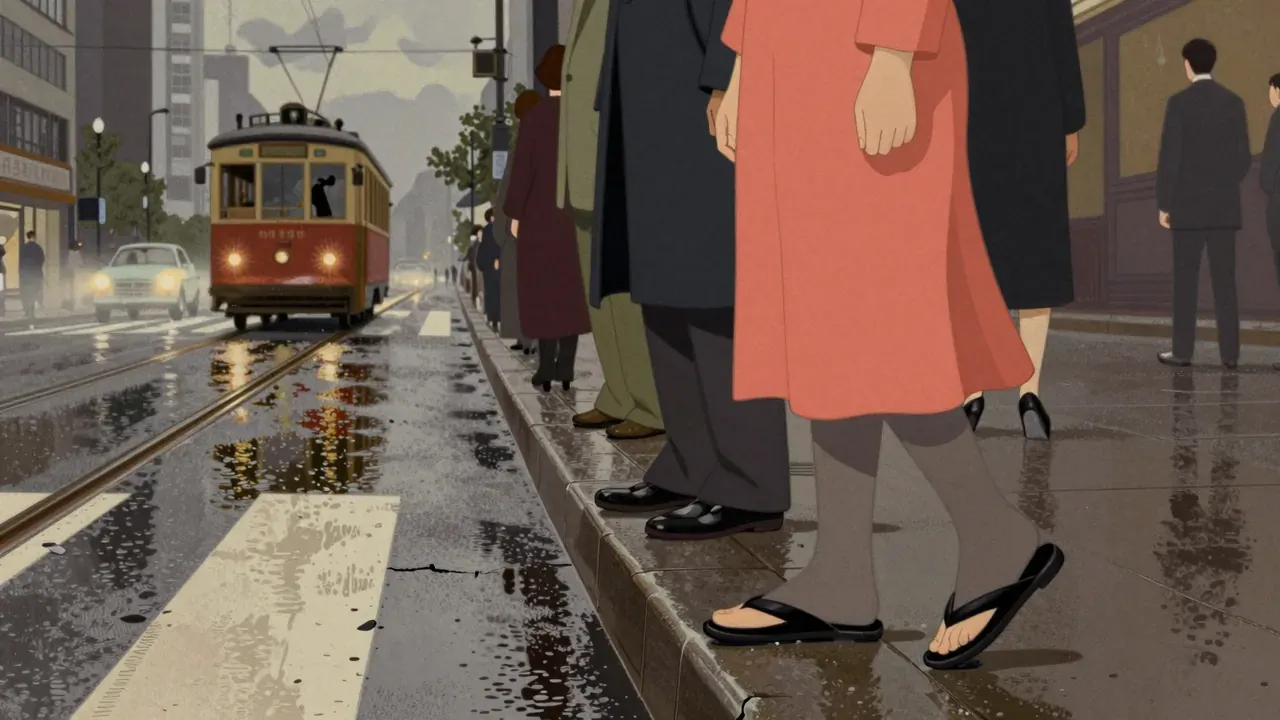
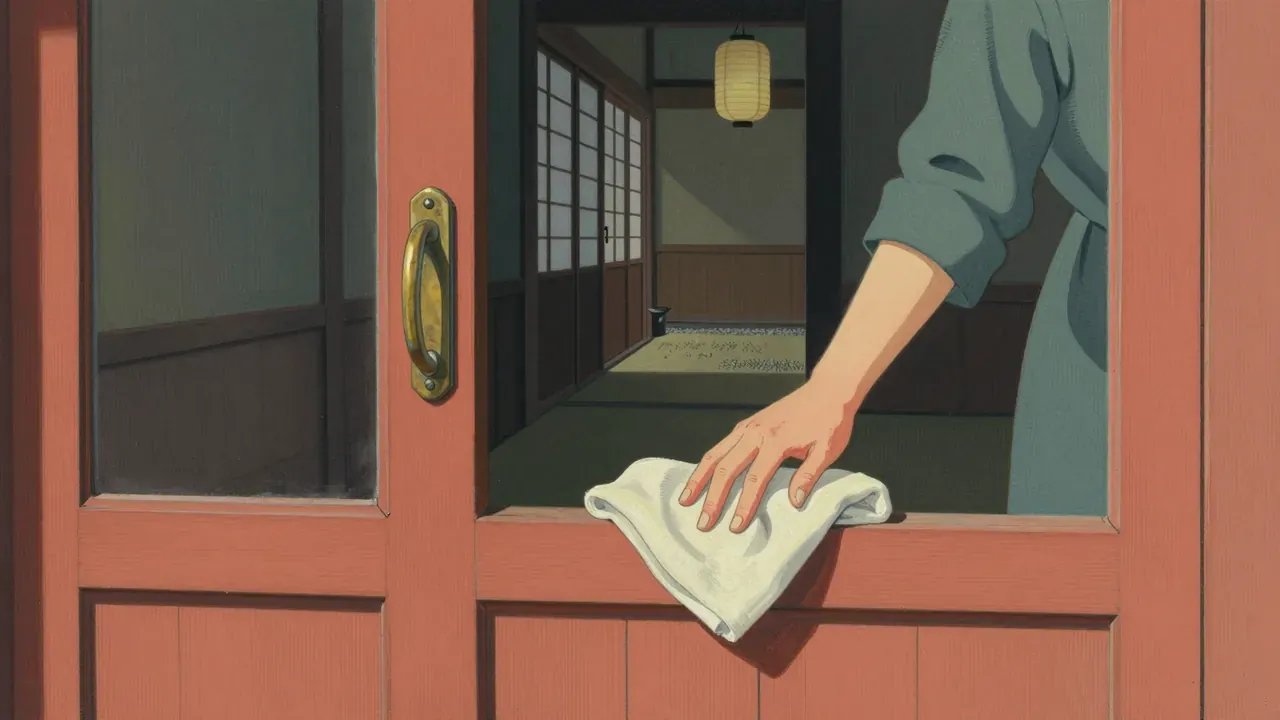
What lands is the cumulative weight of routine: the way Shizuko polishes the same brass handle each morning, how Otane counts coins at the same desk every evening, the repeated sound of geta on gravel as clients arrive. These details do not signify character depth so much as institutional rhythm — the brothel as a place that absorbs time, labour, and identity without return. The film’s moral clarity emerges not through speeches or climaxes but through juxtaposition: Mickey’s father arriving from Kobe with news of her mother’s death, then being shouted down in the same room where she later serves tea to strangers; Yumeko’s son rejecting her outside a shop while she wears the same kimono she wore inside Dreamland. The ending — Shizuko stepping into the doorway as a new prostitute — lands because it follows no emotional arc, only logistical continuity. There is no commentary, no music swell, no cut to black. The shot holds, and the implication settles without insistence. This restraint makes the film’s critique more durable than any polemic could: the system persists not because it is defended, but because it is unremarkable. The performances avoid pathos, favouring steadiness over tremor, which keeps the focus on circumstance rather than individual failing. (157 words)
What does not move
What does not land is the framing of the brothel owners, Kurazō and Tatsuko Taya, as largely passive functionaries rather than agents of extraction. Their authority remains administrative, their motives opaque — a choice that flattens the power dynamic at the centre of the film’s subject. Daisuke Katō’s Brothel Owners’ Association president appears only once, delivering exposition about legislative procedure, and contributes little to the film’s texture. The political context — the Diet’s deliberation — stays abstract, never grounded in protest, pamphlets, or public debate; it arrives as background weather, not lived pressure. Some viewers may find the episodic structure withholding, especially when contrasted with Mizoguchi’s earlier, more tightly woven films like Sanshō the Bailiff. The absence of voiceover, narration, or internal monologue means the film offers no interpretive handrail: it assumes the viewer will register the significance of Yorie’s debt cancellation not as liberation but as procedural accident, and that they will understand Yumeko’s breakdown not as personal collapse but as the logical endpoint of social erasure. Without that assumption, the film risks appearing inert rather than deliberate. Its refusal to dramatise consequence can read as detachment, particularly in scenes where violence occurs off-screen or is implied only through silence. (159 words)
What endures
The themes that matter are debt as social architecture, not financial instrument; shame as enforced silence rather than moral judgement; and labour as continuity, not transition. The film treats prostitution not as a choice or a fall but as work embedded in kinship obligations, housing insecurity, and gendered dependency — Hanae’s husband’s suicidal ideation is inseparable from his inability to earn, just as Yumeko’s estrangement from her son stems from her inability to perform motherhood within respectable norms. Age operates structurally: Mickey’s youth grants mobility but no leverage; Yorie’s middle years bring negotiation but no autonomy; Yumeko’s widowhood brings neither dignity nor exemption. The red-light district is not exoticised but treated as infrastructural — a zone serviced by deliverymen, regulated by bureaucrats, and sustained by adjacent businesses like the fabric shop Yasumi later opens. The film’s most persistent theme is endurance without horizon: no character escapes, reforms, or converts; they adapt, shift roles, or disappear from view. Even the anti-prostitution bill’s failure is presented not as tragedy but as administrative inertia — the system continuing because no alternative has been built, not because it is actively upheld. This is a film about maintenance, not motion. (159 words)
Who sits with it
This film is for viewers who value precision over persuasion, observation over explanation, and duration over development. It suits those accustomed to Japanese studio-era pacing, or to arthouse traditions that treat time as material rather than obstacle. It rewards attention to gesture, spatial relation, and recurring detail — the way light falls on a futon, how a teacup is placed, where characters stand in doorways. It is not for viewers who require narrative propulsion, psychological revelation, or moral resolution. Those expecting Mizoguchi’s lyrical flourishes — the tracking shots of Ugetsu, the painterly compositions of The Life of Oharu — may find Street of Shame austere, even flat. Others may object to its refusal to name complicity: the Tayas are not villains, the clients are not monsters, and the state is not personified. That objection would be valid — the film declines to assign blame, choosing instead to show how blame is distributed across law, custom, and economy. Change the premise — add a protest scene, a flashback to childhood, a voiceover reflecting on memory — and the verdict shifts. As it stands, it asks for patience, not agreement. (158 words)
Is it worth your evening
Yes, it is worth your evening — but only if you accept its terms: no release, no uplift, no closure. It is ninety minutes of sustained, unsentimental attention to how people live inside systems that outlast them. Its value lies in its refusal to flatter the viewer with insight or reward them with catharsis. It is not easier to watch than other Mizoguchi films, but it is more concentrated — every shot calibrated to reinforce the central fact: these women are not exceptional, and their conditions are not aberrant. Someone who finds this unbearable — who needs hope, agency, or even clear antagonism — will rightly reject it. That does not make the film flawed; it makes its contract explicit. To watch it is to sit with the weight of ordinary endurance, and that demands energy, not distraction. If your evening is for rest, diversion, or affirmation, choose elsewhere. If it is for reckoning — with history, with structure, with what persists — then this film delivers, precisely, quietly, and without concession. (159 words)