The premise
Salò, or the 120 Days of Sodom is a deliberate and unrelenting act of political anatomy. Pier Paolo Pasolini transposes the Marquis de Sade’s 1785 novel from eighteenth-century France to the Italian Social Republic in spring 1944 — a puppet state under Nazi control, headquartered in Salò on Lake Garda. The film does not dramatise history but dissects its logic: it isolates power as pure, unmediated will, stripped of ideology, rhetoric or even consistent motive. Its four ruling libertines — a President, a Bishop, a Magistrate and a Duke — are not caricatures but functionaries of annihilation: educated, articulate, and utterly detached from consequence. They select eighteen teenagers — nine boys, nine girls — and subject them over four months to escalating physical, sexual and psychological violation. Pasolini structures this not as narrative but as ritual: four segments modelled on Dante’s Inferno, each named for a stage of moral collapse. The film’s aim is not to shock for shock’s sake but to expose how authority, when divorced from accountability, reduces human beings to interchangeable surfaces — flesh as inventory, speech as noise, resistance as data error. It is an essay in cinematic form, written in extremis.
The look of it
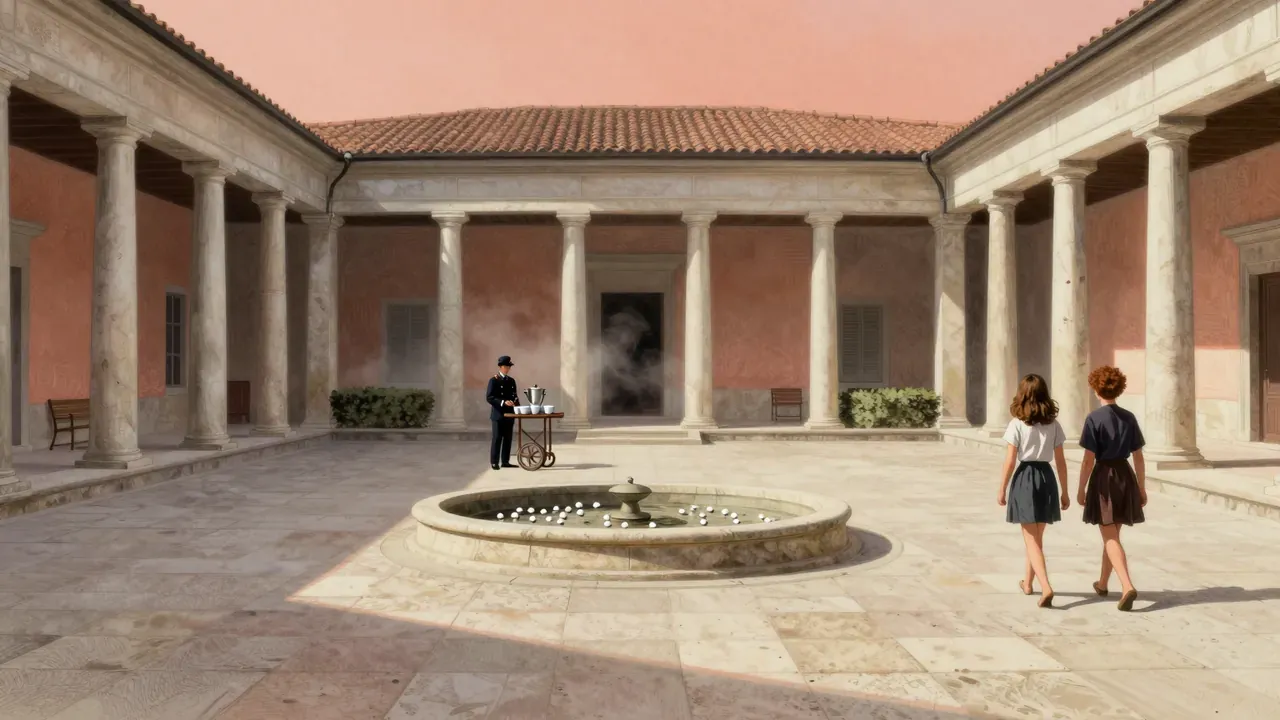
The story unfolds with glacial, procedural rigour: no exposition, no backstory for the victims, almost no dialogue from them beyond whimper or compliance. The libertines speak at length — quoting Nietzsche, Proust, Pound — their erudition functioning as both camouflage and weapon. Performances are deliberately flattened: the young cast, many non-professionals or models, move like sleepwalkers; their silence is structural, not accidental. Tonino Delli Colli’s cinematography avoids flourish — static frames, long takes, symmetrical compositions — treating the villa’s neoclassical interiors and courtyards as sterile laboratories. Ennio Morricone’s score is sparse, mostly piano, punctuated by excerpts from Orff and Chopin that underscore irony rather than emotion. Nino Baragli’s editing sustains duration without emphasis: torture scenes are neither cut away from nor lingered upon for effect, but held at a fixed, forensic remove. Voice work by Giancarlo Vigorelli delivers intertitles with bureaucratic calm. There is no music cue for horror, no close-up to signal trauma — only the camera’s steady, indifferent presence, recording what the characters enact as routine.
The structure
What lands is the film’s implacable architecture of control. The four-part structure — Anteinferno, Circle of Manias, Circle of Shit, Circle of Blood — works not as metaphor but as taxonomy: each segment escalates the abstraction of violence until the body is no longer violated but erased as a site of meaning. The repeated use of classical art on the walls — Severini, Duchamp, Feininger — creates a jarring counterpoint: civilisation’s artefacts framing barbarism as administration. The libertines’ speeches land because they are precise, rehearsed, and chillingly banal — not rants but policy briefings dressed in philosophy. The absence of reaction shots from the victims denies catharsis or identification; instead, the viewer is positioned as witness, not ally. The film’s refusal to aestheticise suffering — no slow motion, no dramatic lighting, no score swell — makes its restraint more unnerving than any excess could be. It forces attention onto the mechanics of domination: how rules are made, enforced, and internalised before the first blow falls. That clarity, that consistency of purpose, is what endures.
The references
What does not land is the film’s reliance on intellectual scaffolding as emotional substitute. Its frequent allusions to Nietzsche’s Genealogy of Morality or Blanchot’s writing assume a readerly engagement the images do not invite — the references remain inert, decorative rather than dialectical. The casting of non-professionals, while conceptually aligned with Pasolini’s interest in the ‘real’ body, results in performances that lack texture or variation: the teenagers blur into types, their passivity indistinguishable from vacancy. Some sequences — particularly those involving coprophagia or ritual humiliation — risk collapsing into spectacle despite the director’s stated anti-sensationalist intent, because the film offers no counterweight: no memory, no interiority, no resistance beyond fleeting flinches. The Dantean framework, though formally rigorous, remains opaque without prior knowledge; the circles do not deepen psychologically but repeat structurally. And the final sequence — the mass execution — lands with numbing inevitability rather than revelation, its power diluted by the preceding two hours’ accumulation of similar gestures. The film’s austerity becomes its own limitation.
The politics
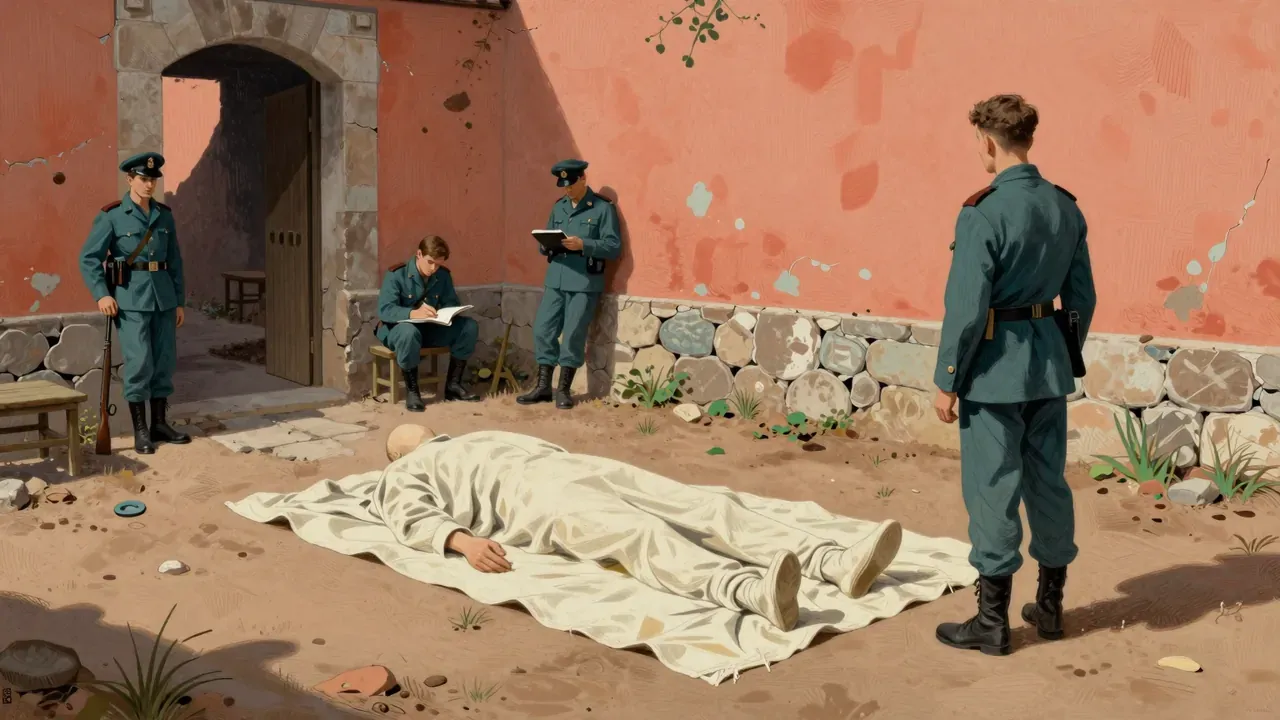
The themes that matter are not sexuality or sadism in themselves, but the instrumentalisation of both as technologies of power. Pasolini treats fascism not as historical aberration but as logical endpoint of consumerist individualism and liberal detachment: the libertines are not monsters but executives of desire, auditing pleasure as auditably as profit. Their wealth, education and taste make them indistinguishable from the bourgeoisie Pasolini elsewhere critiqued — here, stripped of pretence. The film interrogates how language, once severed from ethics, becomes pure command: declarations about freedom, consent or morality are recited as incantations, emptied of referent. It also explores the erasure of history — not as forgetting, but as active deletion: the victims have no names, no pasts, no futures; their bodies are present-tense commodities. Consumerism appears not in shops but in the cataloguing of bodies, the pricing of acts, the scheduling of degradation. Totalitarianism is shown not through rallies or uniforms but through the quiet delegation of cruelty — soldiers who follow orders, servants who serve tea mid-torture, secretaries who take minutes. These are not period themes but operating systems, still legible.
The audience
This film is for viewers who approach cinema as philosophical inquiry and can sustain prolonged exposure to unrelieved moral extremity without seeking catharsis or resolution. It is for those familiar with Pasolini’s broader project — his critique of post-war Italy, his trilogy of life and death, his Marxist-inflected humanism — and who read film as argument rather than entertainment. It is not for anyone seeking narrative immersion, emotional release, character development or aesthetic comfort. It is not for viewers sensitive to graphic depictions of non-consensual violence, psychological coercion or bodily violation — not because these are stylised, but because they are presented without mitigation. Those who expect historical context, biographical grounding or psychological motivation will find none. Critics who argue the film transcends its content — calling it ‘necessary’ or ‘liberating’ — misunderstand its design: it is meant to confine, not free. A change in verdict would require either a fundamental shift in the viewer’s relationship to power, or the film itself offering a point of exit — which it pointedly refuses to do.
The time
It is worth your evening only if you accept that some films exist not to be watched but to be withstood — as tests of endurance, attention and ethical stamina. Its 117 minutes are not spent but occupied: the viewer occupies a position of complicity, however unwilling, simply by remaining seated and looking. It rewards no conventional investment — no suspense, no empathy, no narrative payoff — yet its rigour holds a kind of austere integrity. Those who leave early or look away are not failing the film; they are responding to its terms. But to dismiss it as gratuitous mistakes its method for its motive: every frame is calibrated to deny relief. Its value lies not in enjoyment but in the precision of its diagnosis — of how power operates when unmoored from consequence. Anyone expecting illumination, solace or even clarity will be disappointed. What it offers instead is a mirror polished to a cruel shine: not of who we are, but of what systems we permit to run in our name. That is not entertainment. It is audit. It is necessary only if audit is necessary.