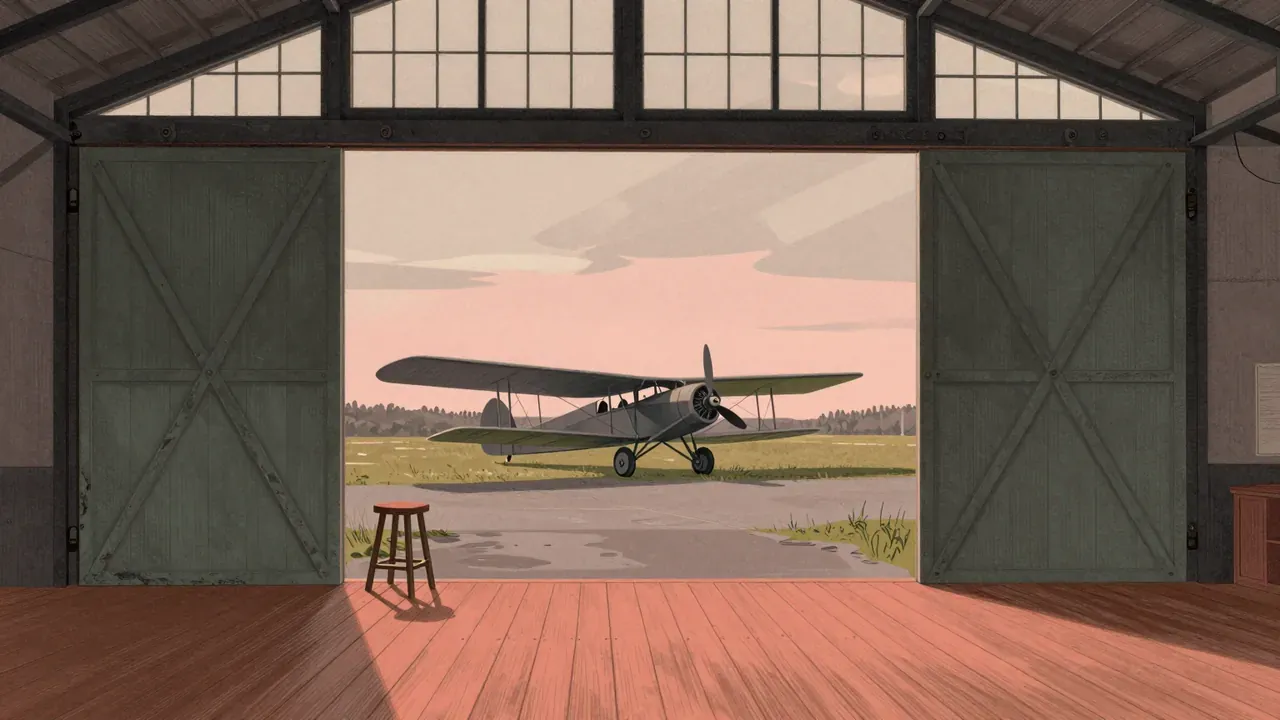
A film made in silence
The Woman Who Dared is a French domestic drama set during the German Occupation, released in January 1944 — a time when film production was tightly constrained and overt political expression forbidden. It does not attempt allegory or resistance-coded metaphor; instead, it locates its urgency in the quiet persistence of personal aspiration amid administrative erasure and social inertia. The film follows Thérèse Gauthier’s slow, self-initiated reclamation of agency — first as a wife displaced by municipal land requisition, then as a manager, then as an aviator — without recourse to spectacle, protest or external validation. Its ambition is structural rather than rhetorical: to show how ordinary competence, sustained attention and mutual recalibration between partners can constitute quiet defiance. Grémillon avoids wartime signifiers — no uniforms, no radio bulletins, no air-raid sirens — and treats the airport expansion not as national policy but as impersonal civic machinery. This restraint is deliberate: the film’s project is to affirm continuity of self within discontinuity of circumstance.
The weight of small choices
The story unfolds with unemphatic causality: Pierre loses his garage, Thérèse takes the dealership job, he drifts into aviation, she returns and resists, then joins him. There are no plot reversals, no villains, no withheld information — only gradual shifts in emphasis and responsibility. Madeleine Renaud’s performance grounds this: her Thérèse moves from dutiful composure to focused resolve without theatrical rupture; her face tightens not in anger but in calculation. Charles Vanel’s Pierre is less a catalyst than a gravitational field — warm, distracted, emotionally porous. Louis Page’s cinematography favours medium shots and shallow depth, keeping interiors softly lit but never dimmed into gloom; windows admit daylight without glare, and aircraft hangars are shot with the same neutral clarity as garages or living rooms. Roland-Manuel’s score is sparse, mostly piano-led, entering only at transitions — never underlining emotion but marking temporal thresholds. Editing by Louisette Hautecoeur proceeds at the pace of habit: scenes end when a task is completed, not when a feeling peaks.
Competence before courage
What lands is the film’s fidelity to incremental change. Thérèse’s decision to fly is not framed as liberation but as consolidation — the logical extension of her earlier competence in managing staff, scheduling repairs and negotiating contracts. Her record flight succeeds not because she overcomes fear, but because she has already mastered logistics, weather assessment and mechanical oversight. The domestic scenes carry equal weight: her calm negotiation with her mother-in-law over childcare, her precise instruction to the mechanic about brake adjustments, her quiet correction of Pierre’s flight log entries — these are the film’s true set pieces. The aviation sequences avoid heroics: take-offs are shown from the ground, engines cough before catching, landings are bumpy but uneventful. Even the final shot — Thérèse stepping from the cockpit, helmet in hand, greeted not with fanfare but with her son handing her a thermos — lands because it refuses climax. The film trusts that endurance, repetition and minor corrections are more persuasive than rupture. Its realism is procedural, not psychological: it shows how things get done, not how people feel while doing them.
What the film leaves unsaid
What does not land is the film’s handling of Pierre’s emotional withdrawal. His neglect of family and work is presented as natural consequence of rediscovered passion, but the script gives no texture to his internal shift — no letters, no diaries, no conversations where he articulates what flying restores to him. He becomes functionally absent rather than psychologically complex, and the reconciliation hinges on Thérèse’s empathy rather than his accountability. Michel François as Claude, their son, is given little beyond dutiful obedience; his presence registers as narrative furniture, not character. Jean Debucourt’s Larcher, the pragmatic businessman who offers the dealership, remains opaque — his motives unstated, his ethics unexamined. The film declines to interrogate the class implications of Thérèse’s upward mobility: she manages a business owned by men whose wealth rests on infrastructure built by requisitioned land. These omissions are not flaws of execution but of scope — the film chooses not to dramatise contradiction, and so leaves certain tensions unresolved rather than explored. It assumes consensus where ambiguity might deepen resonance.
The grammar of work
The themes that matter are endurance, shared labour and the quiet dignity of applied skill. Aviation here is not conquest or escape but continuity — a return to a pre-war competence that had been shelved, not abandoned. The film treats mechanical knowledge, administrative precision and flight discipline as cognate forms of intelligence, all requiring patience, revision and tactile familiarity. Class is present not as conflict but as frictionless transition: Thérèse moves from garage wife to dealership manager without retraining, because her existing capacities — organisation, authority, technical literacy — transfer intact. Gender enters not as barrier but as calibration: her initial exclusion from the hangar is logistical (no facilities), not ideological, and her eventual inclusion follows from demonstrated reliability, not argument. The film’s deepest concern is with time — not historical time, but lived time: the hours spent adjusting carburettors, studying wind charts, folding laundry, calculating fuel margins. It values duration over intensity, maintenance over transformation, and sees aspiration not as rupture but as re-attunement to one’s own capacities.
For whom it waits
This film is for viewers who value procedural realism over psychological exposition, and who find emotional weight in routine competence rather than dramatic revelation. It suits those accustomed to mid-century European cinema’s unhurried syntax — particularly fans of Grémillon’s earlier work or of contemporaries like Renoir’s La Règle du Jeu, though without its irony. It will frustrate viewers expecting narrative escalation, moral ambiguity or stylistic flourish; those who require clear antagonists, decisive turning points or thematic commentary will find it withholding. Anyone seeking wartime context or political subtext will leave unrewarded — the Occupation is ambient, not active. A viewer who values strong female protagonists may be disappointed that Thérèse’s agency emerges through assimilation, not challenge; a viewer attuned to feminist film history might prefer Les Dames du Bois de Boulogne for its formal rigour or Le Corbeau for its moral complexity. What would change the verdict? A tighter focus on Thérèse’s interior life — not her feelings, but her calculations — would sharpen its central proposition.
An evening measured in adjustments
Yes, it is worth your evening — provided you approach it as a study in sustained attention rather than a story demanding resolution. Its 105 minutes unfold with the rhythm of skilled work: steady, unshowy, attentive to detail. You will not gasp, weep or sit bolt upright, but you may notice how rarely films trust their audience to infer motive from gesture, or to register significance in a glance held half a second longer than necessary. It rewards patience not with payoff but with accumulation: by the final frame, Thérèse’s competence feels earned because every prior scene has shown her learning, correcting, adapting. Those who dislike slow pacing, ambiguous endings or absence of moral framing should not watch — but their objection would be to the film’s method, not its failure. What makes it worthwhile is its refusal to mistake intensity for importance. Its quiet insistence — that dignity resides in consistency, not crisis — holds up better now than it did in 1944, when such steadiness was itself an act of quiet resistance.