The shape of it
A Canterbury Tale is a wartime British film that uses the structure of pilgrimage to bind three strangers — a Land Girl, a British soldier and an American GI — into a shared investigation of a local mystery. It aims to affirm continuity between English history and present-day sacrifice, to model Anglo-American fellowship without sentimentality, and to root national identity not in flags or speeches but in landscape, memory and quiet civic duty. The film does not treat the war as distant theatre but as lived texture: bomb sites are shown without commentary; ration books appear in pockets; soldiers lecture on local geology while wearing Home Guard uniforms. Its ambition is modestly monumental — to make the ordinary sacred by placing it under the same light as Chaucer’s pilgrims, not through allegory but through attention. It avoids propaganda by refusing to name the enemy, and sidesteps morale-boosting cliché by giving its moral authority to a flawed, lonely magistrate rather than a hero. The film’s purpose is not to win the war but to preserve the ground on which peace might later stand.
The look of it
The story moves with deliberate, unhurried rhythm: arrival, assault, inquiry, revelation, departure. Eric Portman plays Thomas Colpeper with restrained gravity — no villainy, only conviction warped by isolation and time. Sheila Sim’s Alison carries quiet resolve, Dennis Price’s Peter a dry wit edged with melancholy, and John Sweet’s Bob an open, unperforming sincerity that anchors the film’s transatlantic goodwill. Erwin Hillier’s cinematography works in low contrast and deep focus, holding both cathedral ruins and village lanes in the same tonal register. Alfred Junge’s sets recreate Canterbury Cathedral interiors from memory and perspective, not scale. Allan Gray’s score weaves folk motifs with Bachian counterpoint, never underscoring but often lingering after dialogue ends. John Seabourne’s editing avoids emphasis — cuts land where attention naturally shifts, not where drama demands it. There are no close-ups for revelation, no music swells for realisation. The craft serves duration, not punctuation.
What lingers
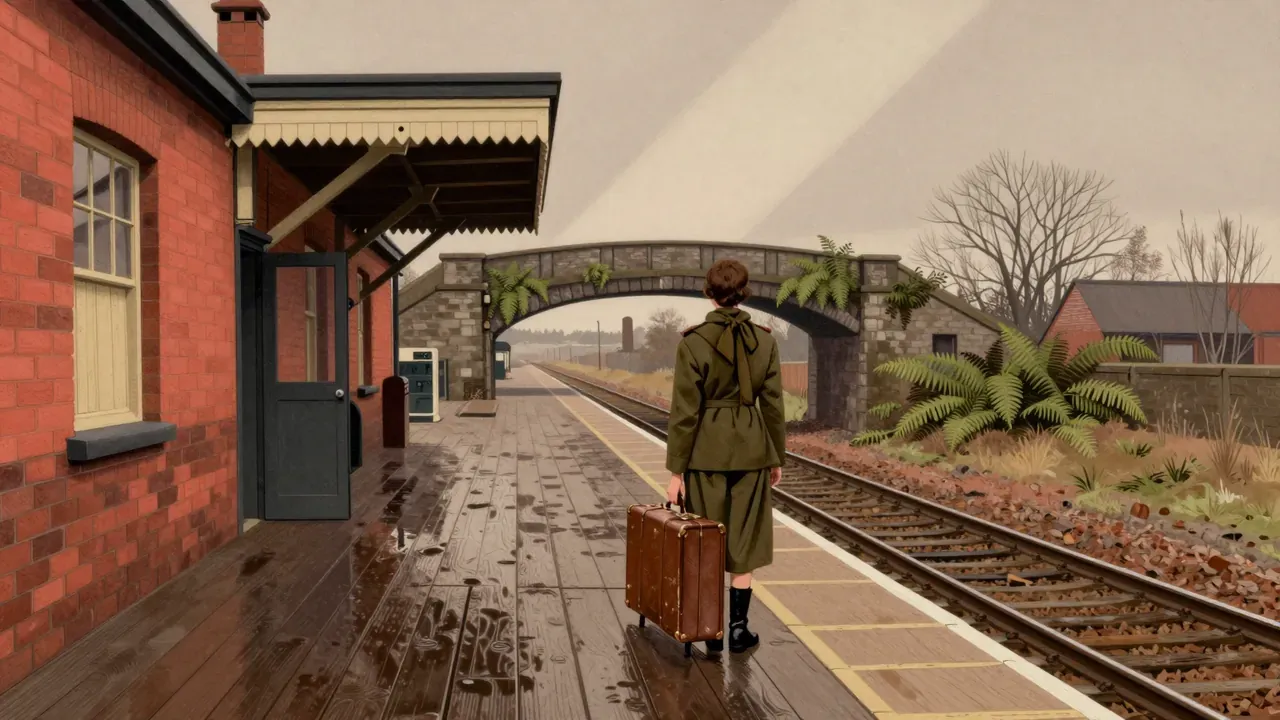
What lands is the weight of place: the chalk paths near Chilham, the boarded windows of Canterbury High Street, the damp stone of Wickhambreaux Court. These are not backdrops but participants — the landscape remembers what the characters forget, and the film trusts the viewer to notice the difference. The glue man mystery functions not as thriller but as narrative spine, allowing the film to pause for children building river forts, for farmers discussing soil rotation, for soldiers listening to lectures on Saxon boundary ditches. The ending lands because it refuses resolution: Alison’s fiancé lives, Bob receives letters, Peter plays Bach — but none of these are triumphs, only small returns. Colpeper is not punished, only understood. The film’s emotional force comes from restraint — from showing how much people carry silently, and how little needs saying when the light falls right on a mill wheel or a railway platform at dusk.
What slips
What does not land is the framing device of Esmond Knight’s narration, which feels detached from the film’s embodied world — a voiceover that names themes rather than deepens them. The American release’s addition of Raymond Massey’s narration and Kim Hunter’s scenes disrupts the original’s tight triangulation of perspectives, making Bob’s arc less earned and the Anglo-American dynamic more didactic. Some exchanges between Peter and Alison verge on archness, particularly early on, as if the script momentarily forgets they are conscripts, not literary types. The film’s faith in communal goodwill occasionally flattens conflict: the Women’s Land Army is shown as uniformly cheerful, the Home Guard as uniformly earnest, with no room for doubt, exhaustion or resentment. The absence of overt class tension — despite Colpeper’s status and Alison’s shopgirl background — feels like omission rather than choice, a smoothing over that weakens the realism the film otherwise honours.
The ground it stands on
The themes that matter are time as sediment, not sequence; landscape as archive; and duty as quiet persistence rather than heroic action. The film treats history not as a set of lessons but as atmosphere — something you breathe in the stones of a ruined cloister or the mud of a Kent field. It explores how war reshapes belonging: Bob arrives thinking he knows Canterbury because his ancestors came from there, only to find the city bombed and unrecognisable; Alison leaves London to work the land she has never seen, yet feels rooted there within days. Colpeper’s obsession with local history is not eccentricity but defence — against erasure, against forgetting, against the idea that the present has no debt to the past. The film’s central proposition is that identity is formed not by declaration but by repetition: walking the same path, tending the same soil, hearing the same bells — even when the bells are silent and the path leads through rubble.
Who it’s for
This film is for viewers who value slowness as substance, who find resonance in weathered brick and unspoken glances, and who trust that a story can hold moral weight without stating it. It rewards patience, familiarity with English topography and tolerance for ambiguity in motive and outcome. It is not for those who require plot velocity, psychological exposition or clear antagonists — viewers expecting a wartime thriller or romantic comedy will find its pace alienating and its resolutions unsatisfying. Those who dislike films where silence lasts longer than dialogue, or where the climax is a conversation on a train rather than a battle, will leave restless. A different verdict would follow if the film were shorter, or if its pacing matched mid-century Hollywood norms — but its length and rhythm are structural, not flaws. To ask it to move faster is to misunderstand its terms.
Is it worth your evening?
Yes, it is worth your evening — provided you give it the attention it assumes: undivided, unhurried, receptive to nuance. It repays close viewing not with revelations but with accumulations — a detail here, a shift in light there, a line of dialogue that gains weight only on second hearing. Its value lies in how it reorients perception: after watching, a village lane or a cathedral wall may feel differently weighted, charged with unseen histories. Those who dismiss it as quaint or dated mistake its stillness for inertia. It is not a relic but a calibration — a reminder that films can map time as terrain, not timeline. Anyone who believes cinema must always explain, accelerate or entertain will find two hours long. But for those willing to walk beside its characters — not ahead of them, not behind — the film offers a rare kind of sustenance: quiet, durable, and deeply English without ever naming it as such.