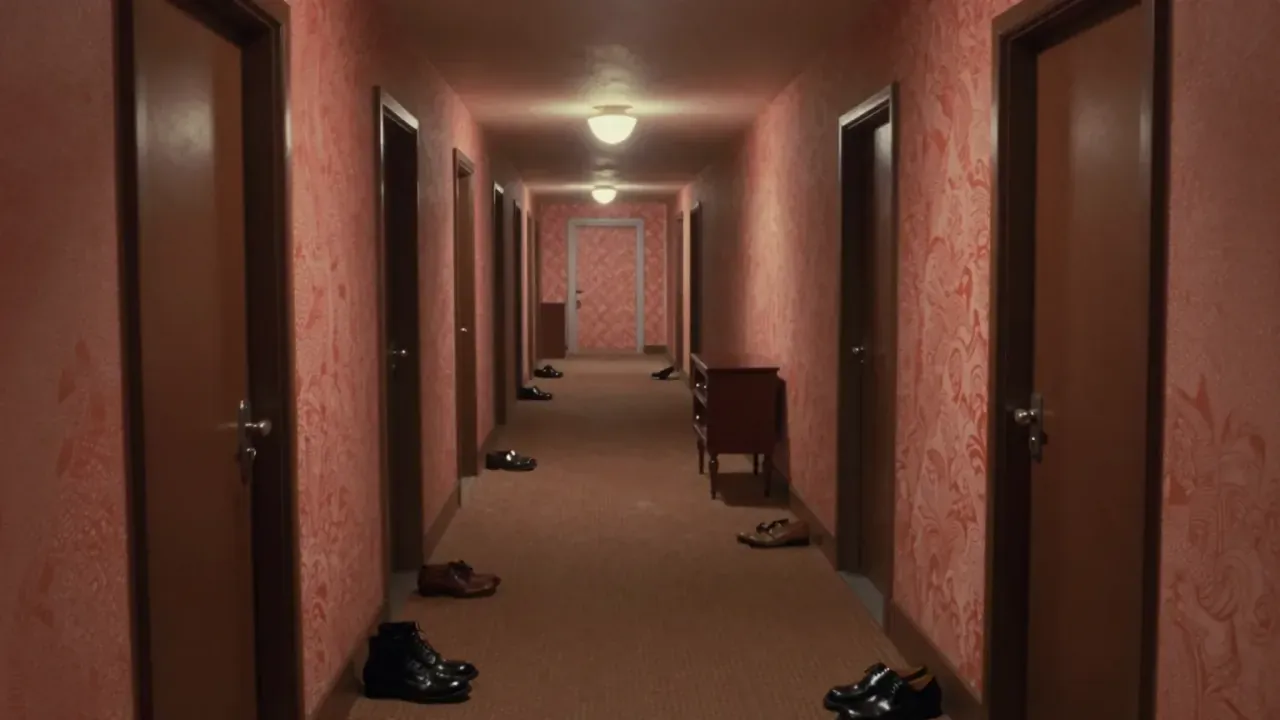
The look of it
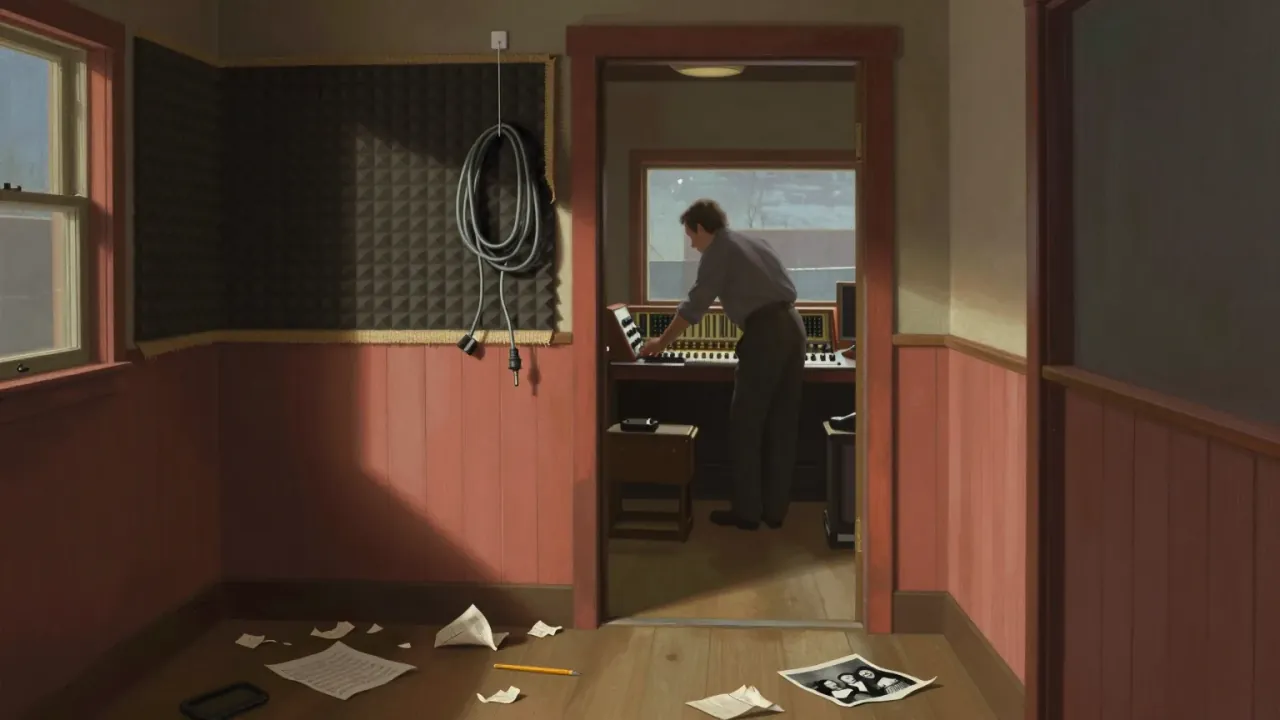
Barton Fink is a tightly wound, self-reflexive period piece set in the summer of 1941, built around a playwright’s disintegration under the pressure of commercial compromise and his own intellectual vanity. It is not a satire of Hollywood so much as a controlled experiment in claustrophobic subjectivity: every visual and acoustic choice serves to narrow the frame of perception until the world outside Barton’s room — and eventually inside it — becomes indistinguishable from hallucination. The Coen brothers do not ask the audience to empathise with Barton so much as to inhabit his narrowing field of reference: the peeling wallpaper, the muffled footsteps, the single recurring image of a woman on a beach. They are testing how much narrative weight can be borne by atmosphere, repetition, and withheld information — less interested in explaining Charlie Meadows than in making the viewer feel the same dread Barton feels when the door handle turns without warning. This is not realism, nor even stylised realism; it is architecture made anxious, a hotel designed to unsettle before a single line of dialogue is spoken. The film’s ambition lies in its refusal to stabilise — not as evasion, but as method.
The weight of a pause
The story follows Barton’s move from New York theatre to a Hollywood studio, but plot is secondary to texture: the Hotel Earle’s art deco decay, the oppressive silence between rooms, the way light pools only where it suits the mood. John Turturro plays Barton with precise physical restraint — shoulders hunched, voice pitched just above a whisper — while John Goodman’s Charlie occupies space like gravity, his warmth never quite dispelling the sense that he is measuring something. Roger Deakins’ cinematography avoids dramatic contrast; instead, he holds interiors in flat, humid tones, letting shadows pool thickly in corners and doorways. Carter Burwell’s score uses piano motifs that repeat, thin out, then vanish — no crescendos, only erosion. Editing by the Coens (credited to Roderick Jaynes) is deliberate, often holding shots past comfort: a ceiling fan turning, a typewriter key depressed and held, a hallway stretching empty into darkness. Every craft decision tightens the vise: no music swells to cue emotion, no cut clarifies intention, no performance broadens to reassure. It is control exercised with surgical patience.
The woman on the beach
What lands is the sustained unease — not as jump-scare tension, but as a low-grade fever of misalignment. The hotel’s emptiness feels lived-in precisely because of what is absent: no faces, only shoes left outside doors, only voices heard through walls, only one woman glimpsed across decades of film stock. The recurring beach image works not as metaphor but as anchor — a fixed point against which all distortion is measured. Goodman’s final monologue lands because it arrives after eighty minutes of withheld context, making its banality feel like revelation. The fire sequence in the hallway lands physically: real flames, real heat, real urgency — a rare moment where the film abandons interiority for visceral momentum. Even the typewriter’s clack lands differently each time: first as industry, then as obsession, then as mimicry of gunfire, then as echo. Nothing is over-explained, yet nothing feels arbitrary. The film trusts its repetitions to accrue meaning without spelling it out — a trust repaid in the quiet weight of its final frames.
The door that doesn’t open
What does not land is the attempt to sustain thematic weight through abstraction alone. The film’s resistance to exposition begins to read as evasion when applied to W.P. Mayhew’s character: his drunkenness, his ghostwriter, his literary stature — all are presented as givens, not dramatised. The studio system critique remains schematic, reduced to Lipnick’s florid speeches rather than embedded in process or consequence. Some supporting performances — Judy Davis’s Audrey Taylor, Michael Lerner’s Jack Lipnick — feel stranded, their arcs truncated or flattened by the film’s inward focus. The religious overtones and literary allusions (Odets, Faulkner) are present as signposts, not substance: they gesture toward depth but do not excavate it. And while the Coens deny a single message, the film’s refusal to engage with the historical specificity of 1941 — the imminence of war, the studio blacklist, the real labour conditions of screenwriters — leaves its ‘slavery of creative labour’ theme feeling allegorical rather than grounded. It is sharp, but sometimes too sharp to draw blood.
The typewriter key
The themes that matter are those anchored in the film’s material reality: the physical toll of writing, the psychological cost of isolation, the friction between intellectual self-regard and bodily need. It treats creativity not as inspiration but as labour — typewriter keys jamming, paper crumpling, sweat on the upper lip. The distinction between high and low culture is tested not in debate but in proximity: Barton’s Marxist theatre ideals sit inches from Charlie’s insurance policies, both written on the same kind of paper, both subject to the same deadlines. Class is rendered acoustically — the muffled thump of unseen tenants versus Lipnick’s booming voice in a soundproof office. The film’s most persistent theme is perception itself: how environment shapes cognition, how repetition breeds familiarity or paranoia, how a single image — a woman on a beach — can become both memory and trap. These are not abstract ideas dressed up as drama; they are dramatised through placement, duration, silence, and surface.
Who hears the footsteps?
It is for viewers who tolerate ambiguity as a condition of attention, who find rhythm in repetition, who prefer questions that settle slowly rather than answers delivered promptly. It rewards patience with texture, not payoff. It is not for those who require narrative propulsion, emotional catharsis, or characters whose motives are legible within three scenes. Some critics have called it emotionally withholding — a fair charge if you expect empathy to be signalled by close-ups or music. Others find its irony too brittle, its symbolism too self-conscious. A viewer who values clarity over atmosphere, resolution over resonance, or who dislikes being held at arm’s length by a film’s design will leave frustrated. The verdict changes only if you accept that discomfort is part of the contract — not a flaw in execution, but the point.
The wave against the rock
Yes, it is worth your evening — not as entertainment, but as an encounter. Its 116 minutes pass with the weight of something consequential, even when nothing seems to happen. You may not like it, but you are unlikely to forget the way the hallway stretches, the way the wallpaper curls, the way silence hums. It demands attention without offering reward on demand, and that is its integrity. It is not for casual viewing, nor for those seeking diversion. But for anyone willing to sit with its stillness, its repetitions, its unresolved tensions — yes, it earns its runtime. Its value lies not in what it says, but in how thoroughly it constructs a world that refuses to explain itself. That is rare. That is worth ninety minutes. That is why it remains distinct thirty years on — not because it is perfect, but because it is uncompromising in its logic, down to the last grain of film stock.