The shape of it
Twin Peaks: Fire Walk with Me is a prequel to the television series Twin Peaks, focusing on the final seven days of Laura Palmer’s life. It begins with an FBI investigation into the earlier murder of Teresa Banks, then narrows to Laura’s escalating terror, abuse, and dissociation in the town of Twin Peaks. David Lynch and Robert Engels conceived it not as exposition or fan service but as a deliberate descent — a forensic, unflinching study of trauma before its resolution. Unlike the TV series, which wove mystery, small-town eccentricity, and surreal humour into its fabric, this film strips away almost all levity, narrative convenience, and structural reassurance. It refuses to treat Laura as a cipher for plot or a MacGuffin for male investigators; instead, it centres her subjectivity, even when that subjectivity fractures under pressure. The film does not aim to explain the series’ unresolved threads, nor to comfort viewers familiar with its tonal duality. Its ambition is narrower and more severe: to hold sustained attention on what it feels like, from the inside, to be slowly undone by violation no one acknowledges. Word count: 148
The feel of it
The story unfolds in jagged, non-chronological fragments, punctuated by abrupt cuts, dissonant sound design, and long silences that resist interpretation. Sheryl Lee’s performance as Laura is physically and vocally calibrated to register incremental collapse: tremors, swallowed breaths, sudden laughter that curdles into panic. Moira Kelly replaces Lara Flynn Boyle as Donna Hayward, lending the character a quieter, more watchful unease. David Bowie appears briefly as FBI Agent Phillip Jeffries, his presence destabilising rather than anchoring — a rupture in time and logic. Ronald Víctor García’s cinematography avoids the soft glow of the TV series; interiors are flatly lit, exteriors drained of warmth, with tight framing that traps Laura in corners or behind glass. Angelo Badalamenti’s score abandons the familiar ‘Laura Palmer’s Theme’ for extended passages of low-frequency drone and distorted lullabies. Mary Sweeney’s editing sustains a rhythm of dread, holding shots just past comfort, cutting away before release. There are no establishing shots to orient the viewer; geography remains stubbornly opaque. Word count: 156
The weight of it
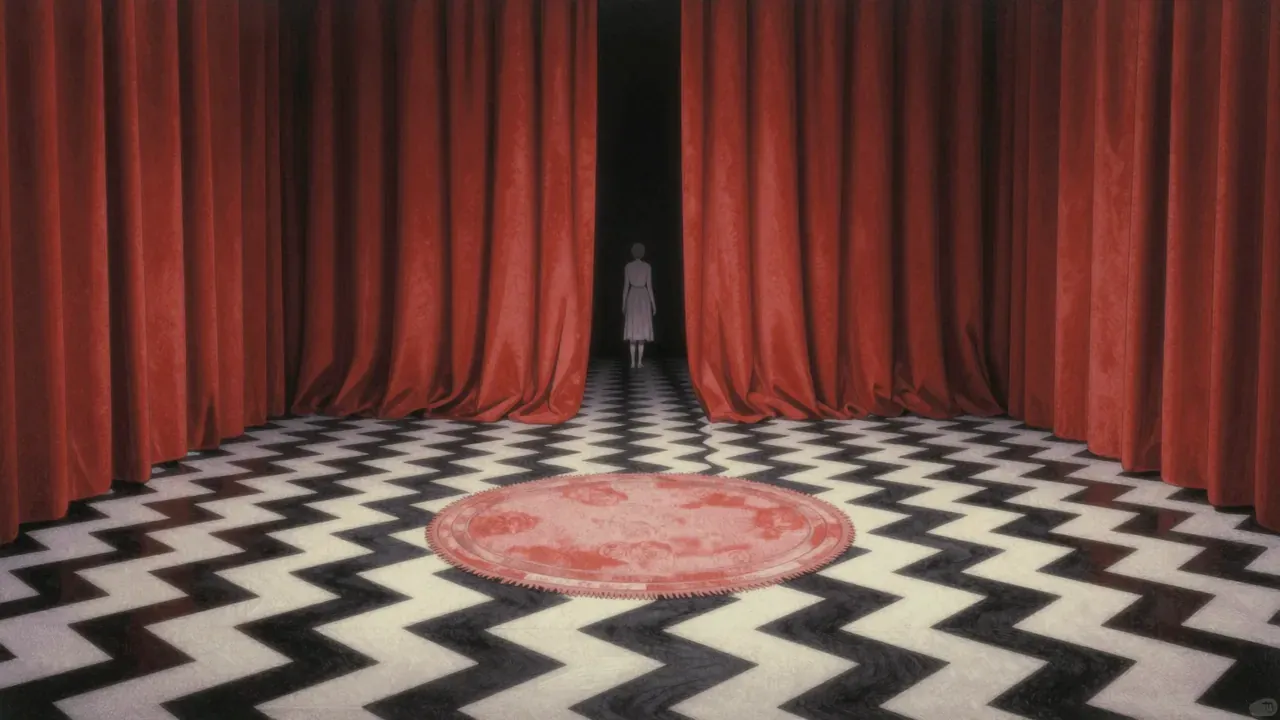
What lands is the cumulative weight of Laura’s isolation — not as metaphor, but as lived texture. Her diary entries, whispered over grainy Super 8 footage, do not romanticise her pain; they render it mundane, repetitive, suffocating. The film’s refusal to aestheticise suffering — its avoidance of slow-motion, poetic voiceover, or symbolic weather — makes the violence feel proximate, unmediated. Scenes such as Laura’s confrontation with her father in the Palmer living room land with physical force because they are shot at eye level, with minimal reaction cuts, and held until the silence becomes unbearable. The Red Room sequences retain their power not through spectacle but through repetition and dislocation: the same phrases recur, the same gestures loop, the floor tilts imperceptibly. Even minor performances — Ray Wise as Leland Palmer, Harry Dean Stanton as Gordon Cole — carry a gravity that feels earned, not imposed. The film’s restraint in depicting abuse — often implied through Laura’s reactions, off-screen sounds, or the sudden absence of music — proves more unsettling than explicit imagery would allow. Word count: 152
The gaps in it
What does not land is the film’s structural asymmetry: the Teresa Banks prologue feels detached, both tonally and narratively, from Laura’s arc, and Chris Isaak’s Agent Chet Desmond remains a cipher whose function is never clarified. Kyle MacLachlan’s reduced role leaves Dale Cooper’s investigative logic absent, depriving the film of a stabilising point of view — a choice that works thematically but undermines coherence for viewers unfamiliar with the series’ mythology. Several supporting characters appear without context or motivation, their reintroduction serving mood rather than meaning. The film’s resistance to exposition extends to its geography: towns, roads, and institutions remain unnamed or inconsistently placed, which deepens alienation but also risks obscuring emotional stakes. Some surreal interludes — particularly those involving the Black Lodge — rely on iconography established elsewhere, making them opaque without prior knowledge. The pacing, while deliberate, occasionally stalls in stretches where tension is maintained not by progression but by sheer duration, testing patience without clear narrative return. Word count: 154
The time of it
The themes that matter are trauma as accumulation, not event; the erasure of female interiority beneath social performance; and the failure of institutions — family, law, religion — to recognise or contain harm. Laura’s double life — homecoming queen by day, drug-using, abused teenager by night — is not framed as contradiction but as survival strategy, a set of masks worn so constantly they begin to dissolve the wearer. The film treats adolescence not as transition but as siege: every corridor, car, and bedroom is potentially a site of violation. Its horror is psychological not because it imagines monsters, but because it insists that the real terror lies in the ordinary — in the father’s smile, the neighbour’s knock, the school bell’s chime. The recurring motif of cherry pie and coffee is stripped of irony; here, they are rituals of normalcy performed while the ground gives way. Time itself becomes unstable, not as fantasy but as symptom: flashbacks bleed into present tense, dreams interrupt waking, and memory fractures under pressure. The film’s central question is not ‘who killed Laura Palmer?’ but ‘who witnessed her while she was alive?’ Word count: 150
The cost of it
This film is for viewers who value psychological precision over narrative clarity, who can sit with discomfort without demanding catharsis, and who accept that some stories resist resolution. It rewards attention to gesture, silence, and sonic texture more than plot mechanics. It is not for those who require moral scaffolding, explanatory dialogue, or tonal consistency — nor for viewers seeking the whimsy, ensemble warmth, or procedural satisfaction of the TV series. Those who found the show’s surrealism decorative rather than diagnostic may find this film punishing. Anyone unsettled by prolonged depictions of psychological distress, coercive control, or implied sexual violence should approach with caution. A viewer who values formal rigour and thematic focus over accessibility will find it essential; one who prioritises narrative momentum or emotional safety will likely reject it. Word count: 149
The refusal of it
Yes, it is worth your evening — but only if you are prepared to meet it on its own terms: as a durational, unsparing portrait of fracture, not a puzzle to solve or a world to tour. Its 135 minutes demand active endurance, not passive consumption. It repays close viewing not with answers but with deeper questions about how trauma distorts perception, how silence functions as complicity, and how genre conventions obscure real harm. Those who dismiss it as ‘unwatchable’ often do so because it refuses the consolations of thriller pacing or redemptive arcs — a valid objection, but one that misidentifies the film’s purpose. If Lynch had softened its edges, expanded its explanations, or restored its lighter scenes, it would have failed its own task. Its value lies precisely in its refusal to yield. Word count: 149