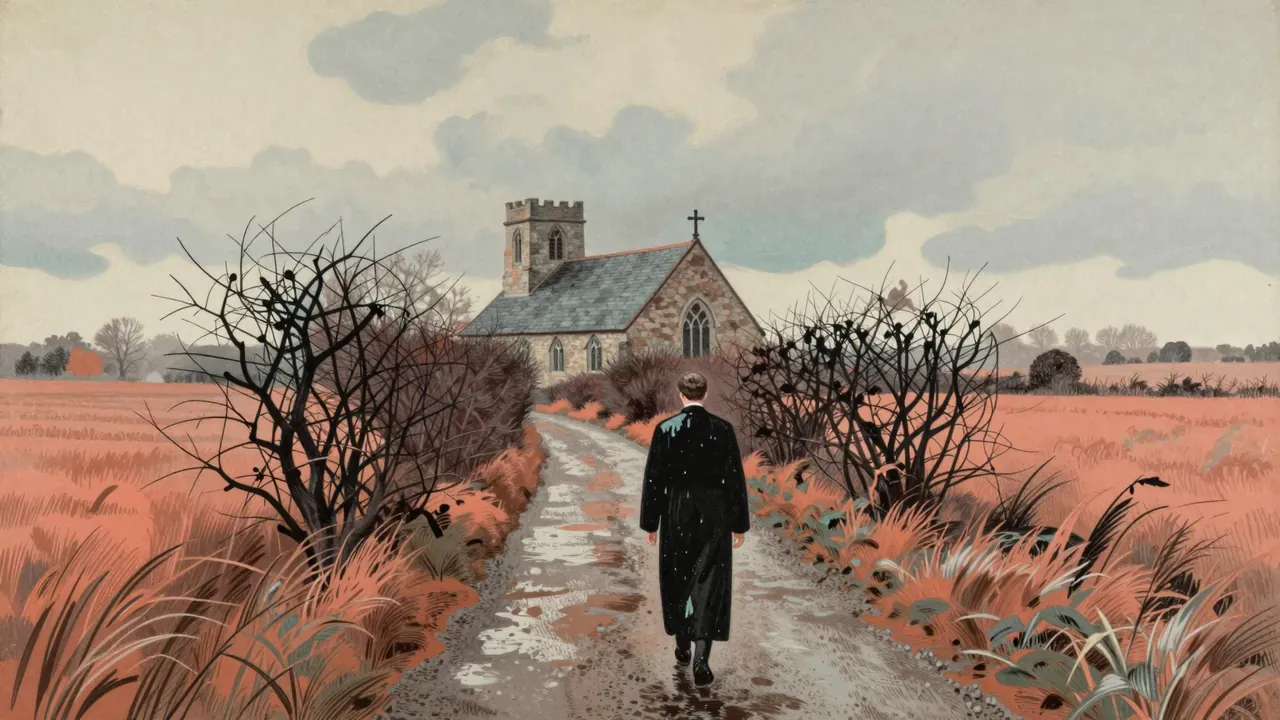
The look of it
Diary of a Country Priest is a French-language drama from 1951, adapted by Robert Bresson and Georges Bernanos from Bernanos’ 1936 novel. It sets out to render spiritual extremity without ornament: not the spectacle of faith, but its quiet erosion and stubborn persistence in a body failing under poverty, doubt, and silence. Bresson strips away theatrical psychology, rejecting expressive performance in favour of restraint, repetition, and voice-over that often repeats what is already visible on screen. The film does not dramatise belief as conviction, nor doubt as crisis; it treats both as conditions of existence, sustained by habit, duty, and unspoken grace. Its fidelity to the novel’s tone — austere, interior, morally unsparing — is structural, not illustrative: the camera avoids close-ups of faces in anguish, the soundtrack omits ambient warmth, and dialogue is pared to functional exchanges or theological precision. This is not a film about conversion or revelation, but about endurance within a vocation that offers no reward, only obligation. It asks the viewer to attend not to what the priest says he feels, but to how his gestures, silences, and physical frailty accumulate meaning across time. (158 words)
The way it moves
The story follows a newly ordained priest assigned to Ambricourt, a northern French village where faith has receded into routine or resentment. His diary entries — delivered in voice-over by Claude Laydu — anchor the narrative, though their content often duplicates action rather than explaining it. Laydu, making his feature debut, performs with minimal inflection and suppressed movement, consistent with Bresson’s direction of non-professionals as ‘models’. Léonce-Henri Burel and Robert Juillard’s cinematography keeps interiors dim and exteriors flat, avoiding pictorial beauty; light falls evenly, never dramatically. Jean-Jacques Grunenwald’s score is sparse and liturgical, used sparingly. Sound design privileges diegetic silence — footsteps on gravel, a spoon clinking in a cup — over music or ambient texture. Dialogue scenes are static, framed in medium distance, with cuts timed to pauses rather than emotional beats. The Countess’s death occurs off-screen; Dr. Delbende’s suicide is reported, not shown. Even the priest’s final words — ‘All is grace’ — arrive without emphasis, spoken quietly after a long silence. Bresson’s method is cumulative: meaning accrues not through plot turns but through recurrence — of illness, refusal, unanswered prayer, and small acts of witness. (159 words)
What holds
What lands is the film’s unwavering consistency of tone and method. The austerity never falters, and that rigour becomes its moral weight. Laydu’s performance holds without ever asserting itself; his exhaustion is legible in posture and breath, not expression. The voice-over does not clarify but deepens ambiguity — when the priest writes ‘I am not understood’, the line lands because the film has already withheld understanding from the viewer, too. Burel and Juillard’s compositions refuse to flatter or comfort: walls are blank, skies are overcast, rooms feel airless not because they are poorly lit but because they are deliberately uninflected. The repeated motif of bread and wine — consumed as sustenance, sacrament, and symptom of illness — gains resonance across scenes without explanation. Even minor characters register precisely: Nicole Maurey’s Miss Louise moves with polite evasion, Adrien Borel’s Priest of Torcy speaks with weary authority, Rachel Berendt’s Countess carries grief like a physical burden she cannot set down. The film’s power lies in its refusal to resolve tension — between duty and despair, obedience and honesty, presence and absence — leaving those contradictions intact, unsoftened, and therefore credible. (157 words)
What resists
What does not land is any attempt to read the film as psychologically legible in conventional terms. Viewers expecting character motivation, emotional catharsis, or narrative payoff will find none. The priest’s decisions — refusing to use the Countess’s letter, declining medical diagnosis, seeking absolution from an ex-priest — are presented without exposition or justification. There is no flashback to explain his formation, no confessional monologue to unpack his theology. Chantal’s shift from hostility to tentative reverence happens off-screen and is conveyed only in her final, cryptic exchange; her interiority remains inaccessible. The film’s rejection of psychologism means some relationships — particularly between the priest and the Count — lack dramatic friction because Bresson refuses to stage conflict as confrontation. Likewise, the village itself stays abstract: no establishing shots, no crowd scenes, no sense of communal rhythm beyond the daily mass attended by one woman. This is not negligence but principle — yet it can read as withholding, even coldness, to those accustomed to narrative scaffolding. The film assumes patience with silence, tolerance for unresolved gesture, and willingness to sit with uncertainty as substance rather than gap. (159 words)
What it thinks about
The themes that matter are not abstraction but condition: vocation as endurance, grace as unearned and unexplained, faith as practice rather than feeling. The film treats religious life not as doctrine but as bodily discipline — fasting, walking, kneeling, writing — performed amid indifference. It explores how institutions fail individuals not through malice but through inertia: the Church offers no support, medicine no diagnosis, the aristocracy no hospitality. Secularism here is not ideological but atmospheric — a slow draining of meaning from ritual, language, and relationship. The Countess’s renunciation of God is not rebellion but exhaustion; Chantal’s nihilism is not philosophy but mimicry of adult despair. Bresson frames these not as failures of belief but as consequences of a world where transcendence has been evacuated from daily life, leaving only the residue of form — the Mass, the diary, the confessional — stripped of assurance. Mortality is treated with the same neutrality as weather: present, inevitable, unremarkable until it arrives. The film’s central question is not whether God exists, but whether attention — to another person, to duty, to suffering — can be its own kind of sacred act, even when no witness remains. (158 words)
Who meets it
This film is for viewers who value formal rigour over emotional accessibility, who find clarity in restraint and meaning in repetition. It rewards attention to sound, duration, and negative space — those attuned to Bresson’s later work, or to Dreyer, Ozu, or early Tarkovsky, will recognise its lineage. It is not for those who require narrative propulsion, psychological exposition, or visual richness; its refusal of cinematic ‘warmth’ may read as alienation rather than intention. Some will find its pace glacial, its silences oppressive, its theology impenetrable without prior grounding in Catholic thought. Others — particularly those familiar with Bernanos’ prose or mid-century French Catholic intellectual life — may find its spiritual grammar intuitive. A viewer who values moral complexity over resolution, or who finds profundity in understatement, will meet the film on its terms. Those who expect cinema to affirm, console, or explain will leave unreconciled. Nothing in the film would change this verdict: its power depends on its refusal to accommodate. (159 words)
What it asks of you
Yes, it is worth your evening — provided you approach it as an act of attention, not entertainment. Its 115 minutes unfold with the weight of ritual: each scene is measured, each cut deliberate, each silence calibrated. It does not yield its effects quickly, but it repays sustained watching with a rare kind of clarity — not about God or salvation, but about how human beings persist in meaning-making when meaning seems absent. It is not ‘difficult’ in the sense of obscurity, but in its demand for stillness and receptivity. Those who watch while distracted, or who seek diversion, will find it arid. But those willing to sit with its austerity — to notice how light falls on a wall, how a spoon rests in a saucer, how a voice breaks just once — will encounter a film whose economy feels necessary, not ascetic for its own sake. Its worth lies not in what it gives, but in what it refuses to give — and what that refusal makes possible. (159 words)