The subject of it
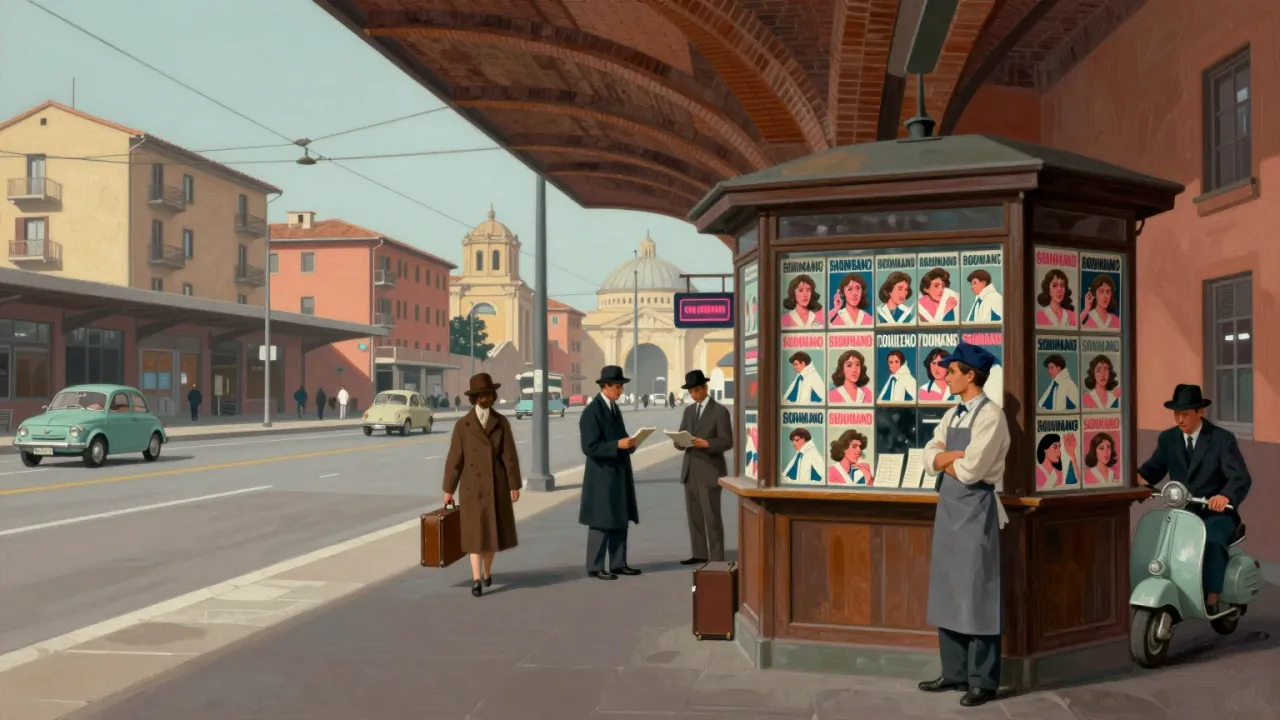
The White Sheik is Federico Fellini’s first solo feature, a satirical comedy-drama that targets Italy’s postwar fotoromanzi culture — illustrated photo-novels modelled on Hollywood romance and melodrama. It does not aim for realism but for calibrated absurdity: the film treats photonovel fantasy not as escapism but as a parallel social system with its own hierarchies, rituals, and moral logic. Fellini, aided by writers Pinelli, Flaiano, Antonioni and his own background in cartooning, constructs a world where the line between fiction and lived reality is porous, even contractual: characters perform roles assigned by pulp narratives, and social credibility depends on adherence to those scripts. The film’s ambition is structural satire — exposing how mass media shapes desire, decorum and self-presentation in a newly urbanising, Catholic, petit-bourgeois Italy. It is not a critique of illusion per se, but of the specific grammar of illusion circulating in 1950s Rome: sentimental, hierarchical, gendered, and commercially engineered. Its tone is detached, not mocking; it observes conventions without endorsing them, and dismantles them without offering alternatives.
The look of it
The story follows Ivan Cavalli, a timid provincial groom, as he navigates Rome with his new wife Wanda, who vanishes to meet the fictional ‘White Sheik’ — a matinée idol played by Alberto Sordi. Leopoldo Trieste’s performance anchors the film: his Ivan is physically stiff, verbally hesitant, and emotionally overburdened by familial expectation. Brunella Bovo plays Wanda with quiet agency — her disappearance is neither rebellious nor foolish, but a logical extension of her immersion in photonovel logic. Arturo Gallea’s cinematography favours shallow focus and slightly flattened compositions, reinforcing the film’s staged, illustrative quality; interiors are often cramped and lit like studio sets, while exteriors in Fregene and Vatican City retain a documentary grain. Nino Rota’s score is light, melodic, and deliberately unobtrusive — underscoring irony rather than emotion. The editing avoids flourish: scenes build through repetition and slight variation, as when Ivan rehearses excuses for Wanda’s absence, each iteration tightening the knot of social fiction.
The rhythm of it
What lands is the film’s precise calibration of social embarrassment as structural principle. Ivan’s escalating lies — told to his uncle, his father-in-law, his priest — gain weight not from farce but from their banality: each evasion feels necessary, plausible, and quietly devastating. The photonovel sequences themselves land because they are rendered with deadpan fidelity: Lilia Landi’s gipsy Felga, Ernesto Almirante’s director Dottore Fortuna, and Fanny Marchiò’s Marilena all inhabit their roles with the solemnity of ritual performers. Even Alberto Sordi’s White Sheik works not as parody but as embodiment — a man who has internalised his own myth so completely that he cannot distinguish it from duty. Giulietta Masina’s brief appearance as Cabiria lands with particular force: her physical expressiveness, her stillness amid chaos, and her unspoken recognition of Ivan’s predicament establish a tonal pivot. The film’s best moments do not rely on punchlines but on duration — the long pause before a lie is delivered, the silence after a character realises their script has run out.
The gap in it
What does not land is the film’s attempt to sustain dual registers — the domestic farce of Ivan’s deception and the metafictional satire of photonovel production — without fully integrating them. The two spheres remain adjacent rather than interwoven: the photonovel studio feels like a separate film grafted onto the main narrative, its aesthetics and rhythms distinct but not dialectically engaged. Ivan’s arc never meaningfully intersects with the mechanics of image-making beyond surface-level confusion; he remains an outsider to the industry he unwittingly critiques. Some performances falter under the weight of exposition: Gina Mascetti’s Aida Rivoli, though well-cast, functions more as plot device than character, and Ugo Attanasio’s uncle lacks the specificity needed to ground the family pressure Ivan endures. The ending, too, resolves too neatly — a return to orthodoxy that undercuts the earlier destabilisation of social codes. Critics at the time noted this discontinuity; it is not a flaw of execution but of conception, where satire and narrative pull in divergent directions.
The grammar of it
The themes that matter are not love or marriage in the conventional sense, but the labour of maintaining appearances in a society newly saturated with mass-produced fantasy. Class is rendered not through economics but through syntax: Ivan’s stilted speech, his deference to titles and institutions, his fear of misquoting scripture or protocol — all signal a class whose status depends on flawless performance of inherited scripts. Gender operates similarly: Wanda’s desire is legible only through the photonovel’s grammar, and her agency is circumscribed by its tropes — she seeks the White Sheik not as lover but as narrative validation. The film also treats authorship as unstable: the photonovel is credited to no single creator, its characters recycled across strips, its plots formulaic and interchangeable — a condition mirrored in Ivan’s own role as husband, son, nephew, and pilgrim, each identity requiring a different script. Faith, too, is presented as another layer of performance: the pilgrimage to the Pope is less spiritual act than social obligation, its rituals as rehearsed as any photonovel scene.
The audience for it
This film is for viewers who value formal precision over emotional immediacy, and who read satire as diagnosis rather than dismissal. It rewards attention to gesture, framing, and repetition — not just what characters say, but how they hold their hands, where they stand in relation to doorways, how long a silence lasts before a line is spoken. It is not for those who require clear protagonists, psychological motivation, or narrative closure: Ivan remains opaque, Wanda enigmatic, and the White Sheik unknowable by design. Anyone expecting the warmth or pathos of La Strada or Nights of Cabiria will find The White Sheik cool, withholding, even alienating. Those who dislike films where irony is structural rather than tonal — where the camera watches without judging, and the music refuses to tell you how to feel — should look elsewhere. A viewer who values Fellini’s later work may find this one thin; a student of Italian neorealism may find it too stylised. But for those attuned to mid-century satire as architecture, not anecdote, it repays close study.
The time for it
Yes, it is worth your evening — provided you watch it as a period document of cultural mechanics, not as a story about people falling in love or finding themselves. At 85 minutes, it moves briskly, and its structure is tight enough to resist drift. It demands little in the way of exposition but rewards patience with accumulating detail: the way a handkerchief is folded, the rhythm of a train announcement, the precise shade of grey in a studio backdrop. Those who find it thin are not wrong — it is thinner than Fellini’s later films, and thinner than contemporaneous neorealist works — but its thinness is deliberate, a refusal of psychological density in favour of schematic clarity. A viewer who prefers emotional resonance over conceptual rigour may leave unsatisfied; a historian of Italian popular culture will find it indispensable. Its value lies not in what it reveals about individuals, but in how precisely it maps the infrastructure of collective fantasy in early 1950s Italy.