The silence of it
The Naked Island is a Japanese black-and-white drama from 1960 that attempts to depict human endurance without recourse to spoken language. Kaneto Shindō conceived it as a formal experiment: a film in which dialogue is almost entirely absent, relying instead on rhythm, repetition, physical exertion and silence to articulate struggle. Its premise—a family farming a barren island in the Seto Inland Sea—serves not as narrative scaffolding but as a vessel for sustained observation. Shindō stripped away exposition, psychology, and even conventional characterisation to focus on the mechanics of survival: rowing, climbing, carrying water, planting, harvesting, grieving. The film’s ambition is structural and ethical: to make labour visible as both fact and metaphor, and to ask whether meaning can reside in action alone when words are withheld. It is not a parable with a moral, nor a sociological study; it is an austere arrangement of time, space and effort, built to test how much weight a film can bear without speech.
The rhythm of it
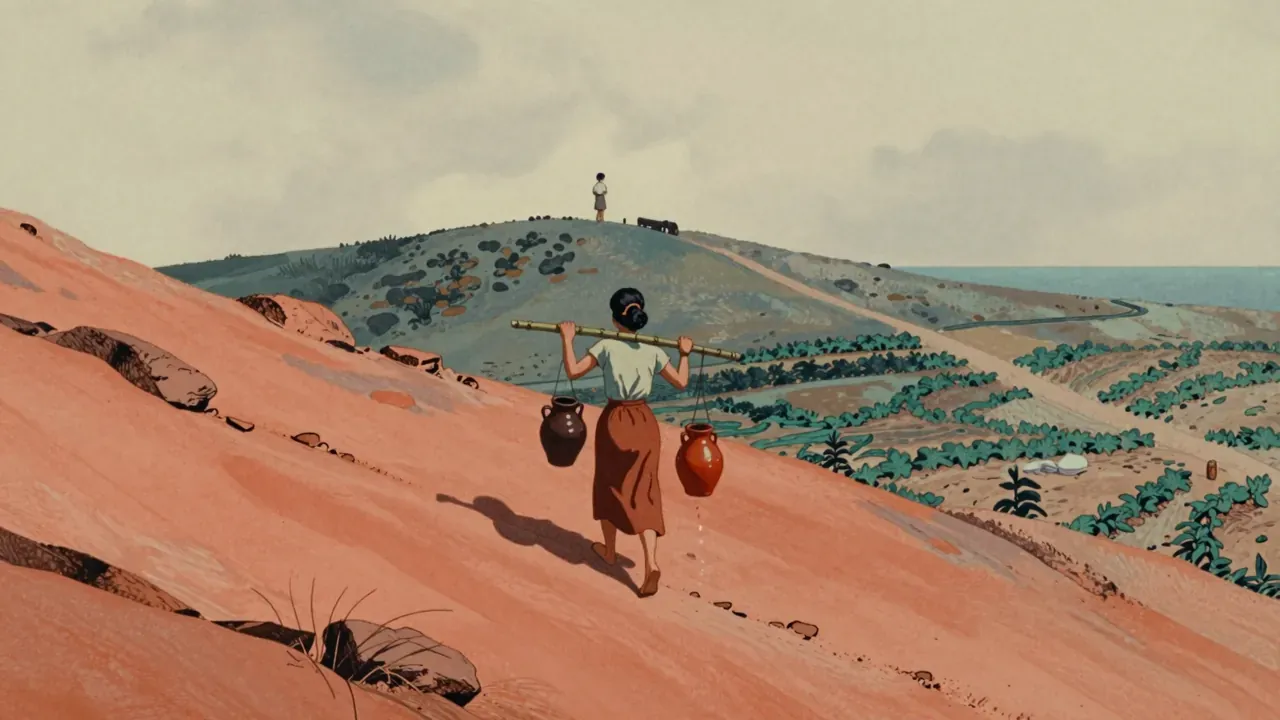
The story unfolds across a single year in unbroken chronological order, following a husband, wife and two young sons as they ferry water daily from a neighbouring island to irrigate sweet potatoes on Sukune Island. Nobuko Otowa and Taiji Tonoyama perform with minimal inflection, their faces registering fatigue more than emotion; their bodies do the work of expression. Kiyomi Kuroda’s cinematography is patient and frontal, favouring medium shots and static compositions that emphasise the island’s flatness and the family’s isolation. The camera watches them climb the same rocky path dozens of times, each ascent measured by the bend in the yoke across their shoulders—a detail Shindō insisted on for symbolic clarity. Hikaru Hayashi’s score repeats a single theme in variations, reinforcing cyclical time rather than dramatic progression. There are no close-ups of tears, no flashbacks, no voiceover. Even the boy’s death arrives without fanfare: the father runs, the doctor arrives too late, the funeral is brief and communal. Every craft choice serves the principle of restraint.
The weight of it
What lands is the cumulative weight of repetition—the way carrying water becomes a liturgy, the way silence amplifies the sound of oars dipping, the way the family’s routine acquires gravity through sheer duration. The scene where they travel to Onomichi stands out precisely because it breaks the rhythm: the cable car, the restaurant, the television set—all rendered with the same neutral gaze, making modernity feel alien rather than liberating. The film’s most effective moments are those where physical strain aligns with symbolic weight: the yoke bending under water, the older son’s small body laid out on the floor, the mother’s hands scrubbing the same stone step day after day. These are not gestures toward meaning but meaning made tangible—achieved not through symbolism imposed from outside, but through the unvarnished accumulation of gesture over time. The absence of dialogue does not feel like deprivation; it feels like precision. The film earns its silence by ensuring every frame has something to say without words.
The contradiction of it
What does not land is the premise’s internal inconsistency—not as a flaw in storytelling, but as a rupture in its own logic. Shindō later acknowledged that sweet potatoes do not require the constant, laborious irrigation depicted, undermining the central physical justification for the family’s suffering. This matters because the film stakes its authority on realism: the bent yoke, the real island, the actor’s recovered health—all presented as factual anchors. When the agricultural basis proves false, the film’s claim to documentary-like truth weakens, leaving the hardship feeling stylised rather than necessary. Likewise, the boys’ schooling on a neighbouring island introduces a social dimension the rest of the film pointedly excludes, making their brief appearance at the funeral feel narratively orphaned. The film’s rigour is admirable, but its refusal to acknowledge these contradictions—either by adjusting the premise or by naming them—leaves a gap between its method and its material that no amount of visual discipline can fully close.
The endurance of it
The themes that matter are endurance as ritual, labour as identity, and silence as both condition and consequence. The family’s life is not framed as poverty to be alleviated but as a closed system in which effort defines existence. Water is not just sustenance but the axis around which time, geography and relationship rotate. The film treats grief not as an interior state but as a return to routine—the mother resumes scrubbing, the father rows again, the younger son carries his brother’s bucket. There is no catharsis, no resolution, only continuation. This is not stoicism as virtue but stoicism as fact: the world does not pause for loss. The island is not allegorical—it is specific, named, real—but its specificity makes the broader questions sharper: what does it mean to persist when no one is watching? When no one speaks? When no one rewards? The film refuses to answer, and in that refusal lies its quiet insistence: endurance is not heroic. It is what remains when everything else has been subtracted.
The demand of it
This film is for viewers who value formal discipline over narrative convenience, who find resonance in repetition, and who trust images to hold meaning without explanation. It suits those accustomed to arthouse pacing, to silence as texture, and to films that withhold rather than offer. It is not for viewers who rely on character psychology, plot momentum or emotional signposting to orient themselves. Those expecting insight into post-war Japan, or a critique of rural marginalisation, will find the film too sparse; those needing closure or moral framing will find it withholding. A viewer who values Hikaru Hayashi’s score may respond differently to one focused on Kuroda’s framing. Someone who finds beauty in austerity may see dignity where another sees monotony. What would change the verdict is not a different performance or edit, but a different contract with the audience—one that acknowledges its own constructedness rather than presenting itself as inevitable.
The worth of it
Yes, it is worth your evening—if you approach it as a study in cinematic economy, not as entertainment or exposition. Its ninety-four minutes pass slowly, but never emptily: every shot has purpose, every silence is calibrated, every repetition deepens the impression of lived time. It rewards attention not with revelation but with recalibration—of how we measure effort, how we read fatigue, how we understand resilience when stripped of rhetoric. It is not universally accessible, nor intended to be; its power lies in its refusal to accommodate. Those who leave frustrated are not wrong—they are responding honestly to its terms. But for those willing to sit with its rhythms, it offers something rare: a film that asks nothing of the viewer except presence, and repays that presence with unwavering honesty about what it costs simply to continue. Its value is not in what it says, but in how thoroughly it refuses to say anything else.