The premise
Shock Corridor is a 1963 American film noir that uses the framework of a journalistic investigation to stage a sustained, stylised assault on rational perception. Samuel Fuller wrote, directed and produced it as a self-contained allegory — not a diagnosis, not a documentary, but a deliberately compressed, high-contrast representation of mid-century American psychic strain. It sets out to show how ideology, trauma and institutional power converge inside a single mind, then inside a single building: the psychiatric hospital as microcosm, its patients as living symptoms rather than case studies. The plot device — a reporter feigning insanity to solve a murder — is secondary to the film’s structural insistence that sanity is contingent, language unstable, and reality porous under pressure. Fuller does not ask whether Johnny Barrett becomes mad; he asks what kind of madness the world makes inevitable when war, racism and nuclear fear are treated as background noise rather than active poisons. The film’s ambition is neither realism nor escapism, but forensic distortion: sharpening reality until its edges bleed meaning.
The look of it
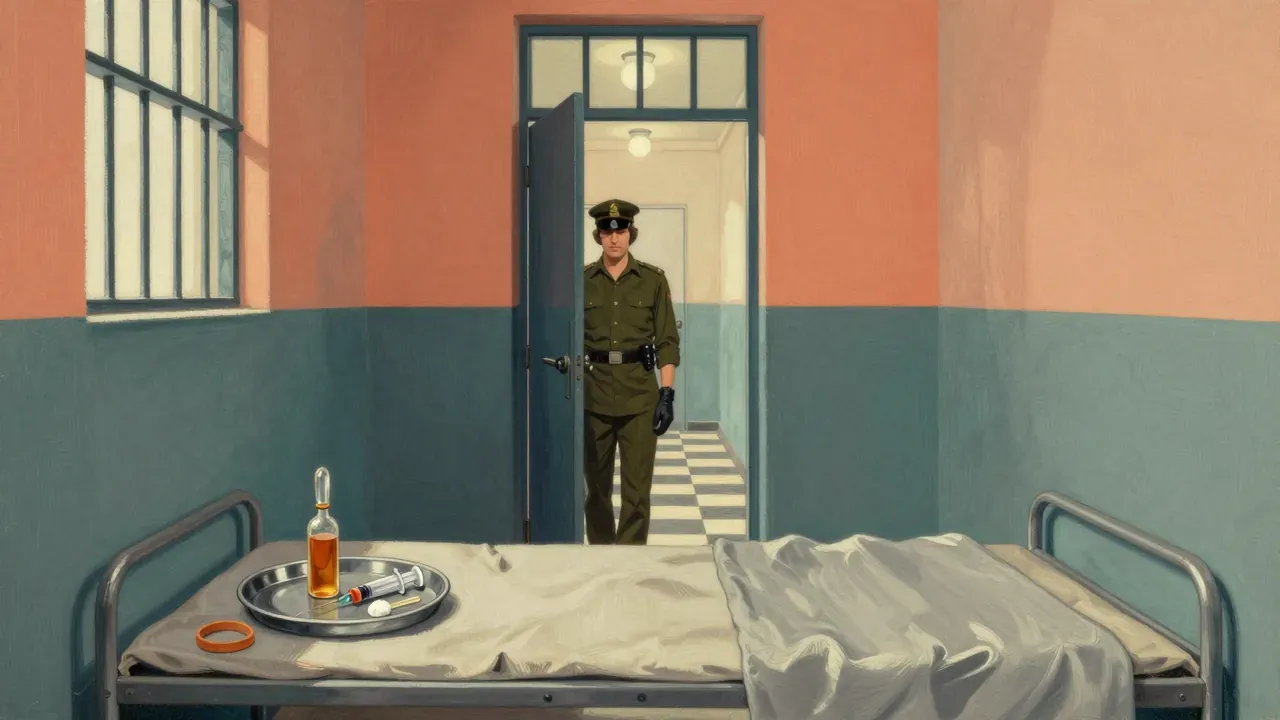
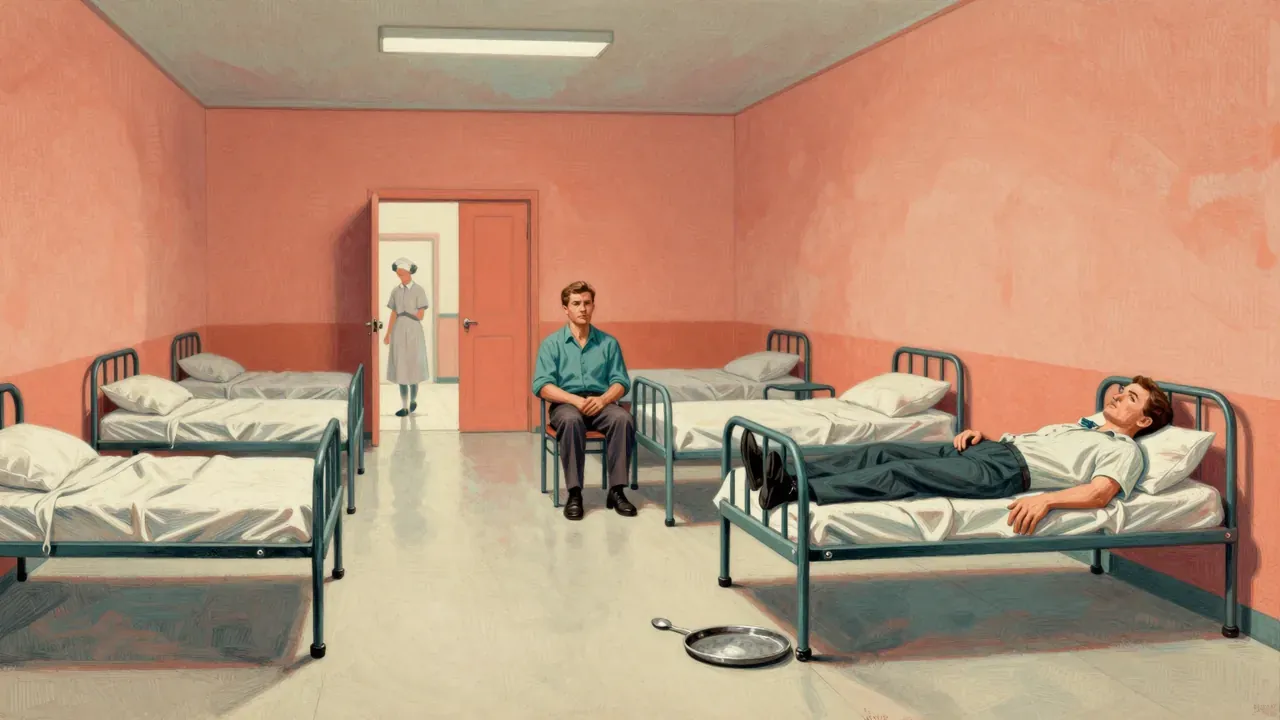
The story moves with the tight, staccato logic of a tabloid headline — exposition delivered in voiceover, motivation stated outright, plot turns timed like punches. Peter Breck plays Johnny Barrett with controlled physicality: his posture stiffens as his grip on reality loosens, his eyes narrow not with cunning but with mounting disorientation. Constance Towers’ Cathy is written with little interiority but performed with quiet gravity — her final scene carries weight because she says almost nothing. Stanley Cortez’s cinematography works against naturalism: interiors are lit with hard, directional sources, walls tilt at deliberate angles, colour is applied selectively — reds flare in moments of violence or arousal, blues pool in corridors where time seems to stall. Jerome Thoms’ editing favours abrupt cuts over dissolves, matching the script’s refusal of psychological continuity. Paul Dunlap’s score uses percussive brass and jagged strings not to underscore emotion but to mimic neural misfiring. There is no attempt to soften the artifice; the craft insists on its own constructedness, treating the frame as a diagnostic tool rather than a window.
The rhythm
What lands is the film’s unrelenting tonal consistency — its refusal to pause for breath or explanation. The three inmate witnesses do not function as characters so much as symbolic vectors: Stuart’s Confederate delusion, Trent’s Klan fantasy and Boden’s infantilisation each land with the blunt force of a parable, not a portrait. Their monologues are delivered with theatrical precision, their ward settings rendered with graphic simplicity — a Confederate flag draped over a gurney, white hoods hanging from a locker, a child’s toy train circling a bed. The hydrotherapy room confrontation works because it abandons suspense for ritual: Wilkes is not outwitted but cornered by the very system he exploits, and Johnny’s confession extract is less a triumph than a collapse into procedural clarity. The final image — Johnny catatonic, Cathy speaking over him — lands without sentimentality, its power drawn from the absence of resolution. Fuller does not resolve the tension between truth and psychosis; he holds it in suspension, and that suspension remains physically palpable long after the credits.
The gaps
What does not land is the framing device of Cathy as both girlfriend and fabricated sister — it strains credulity not for moral reasons but for structural ones, introducing a layer of psychological doubling that the film never interrogates or integrates. The incest pretext feels perfunctory, a narrative lever rather than a thematic anchor. Likewise, Dr. Fong’s role is reduced to a single functional scene, his expertise unexamined, his presence purely transactional. The film’s ten-day schedule shows in places: some transitions are jarring not by design but by necessity, and the hospital’s geography remains stubbornly unclear — corridors loop without logic, wards blur into one another. There is no attempt to ground the setting in social realism, but the lack of spatial coherence occasionally undermines the allegory’s precision. A viewer expecting psychological nuance in the supporting cast will find little: Trent, Stuart and Boden are potent symbols, but their backstories arrive as bullet points, not biographies. Fuller’s economy is deliberate, yet here it tips toward abstraction without sufficient grounding.
The weight
The themes that matter are those embedded in the film’s architecture: the weaponisation of diagnosis, the instability of testimony under duress, and the way national anxieties migrate into individual pathology. War, racism and nuclear dread are not background context but active agents — each witness internalises a dominant cultural panic until it supplants memory. The asylum is not a place apart but an amplification chamber, where societal fractures become audible, visible, violent. Fuller treats psychiatry not as science but as social control: the straitjacket, the shock treatment and the enforced silence of the catatonic ward all mirror mechanisms used elsewhere — in schools, barracks, newsrooms. Ambition is shown as both engine and toxin; Johnny’s Pulitzer fixation is indistinguishable from the pathologies he investigates. There is no outside vantage point: the journalist, the doctor, the attendant and the patient are all caught in the same feedback loop. The film’s enduring relevance lies not in its period detail but in its demonstration that institutions do not contain madness — they distribute it, codify it, and often profit from its management.
The audience
This film is for viewers who value formal rigour over psychological verisimilitude, who respond to visual metaphor as readily as dialogue, and who accept that a film can be politically urgent without offering solutions. It rewards attention to composition, pacing and rhetorical repetition — the way a phrase returns altered, the way a colour recurs in escalating intensity. It is not for those who require character arcs with emotional closure, or who expect mental illness to be represented with clinical accuracy rather than symbolic compression. Some critics have found its approach reductive — Andrew Sarris called it ‘subreal’, not surreal — and that charge holds weight for anyone seeking empathy over indictment. A viewer who values therapeutic narratives or incremental realism may find its relentlessness alienating. But that relentlessness is the point: Shock Corridor does not invite identification. It demands calibration — adjusting one’s perception to its frequency, then holding that adjustment long enough to feel its resonance.
The finish
Yes, it is worth your evening — not as relaxation, but as recalibration. Its 101 minutes operate like a controlled exposure: brief, intense, and calibrated to leave a residue. It repays close viewing not because it hides meaning but because it layers it — every tilted frame, every abrupt cut, every burst of dissonant brass serves the central inquiry into how reality is manufactured and unmade. Those who dismiss it as dated or schematic miss how precisely its methods anticipate later work in essay-film and institutional critique. A viewer expecting conventional thriller mechanics will be frustrated; someone open to cinema as argument-in-motion will find it galvanising. Its value lies not in what it resolves but in how insistently it refuses resolution — holding the question of sanity, authority and truth in sharp, unwavering focus until the viewer must choose where to stand, or whether standing is even possible.