The look of it
Juliet of the Spirits is Federico Fellini’s first feature-length colour film, a fantasy-drama structured as a woman’s inward journey through memory, desire and spiritual unease. It attempts to render the interior life of Giulietta Boldrini — a middle-aged Roman housewife — not through psychological realism but through symbolic tableaux: visions of masked dancers, spectral nuns, carnival clowns, and shifting domestic spaces. The film does not dramatise marital breakdown as social problem or moral crisis; instead, it treats Giorgio’s infidelity and Giulietta’s passivity as entry points into a psychic landscape where repression, envy, erotic longing and religious guilt coalesce. Fellini and his co-writers build this world from associative logic rather than cause-and-effect narrative, using colour, costume and set design as primary carriers of meaning. The ambition is structural and sensory: to make the unconscious visible, legible not as diagnosis but as spectacle. It is less about what happens to Giulietta than how her mind rearranges reality when it begins to resist its own containment. This is not therapy on screen, but theatre of the self. (142 words)
The weight of her stillness
The story unfolds in episodic, dream-adjacent sequences, anchored by Giulietta Masina’s performance — precise, tremulous, physically contained yet emotionally porous. She moves through rooms that swell with saturated reds or recede into cool blues, each shift calibrated by Gianni Di Venanzo’s cinematography: light pools unevenly, shadows thicken without explanation, and focus drifts as if vision itself is unmoored. Nino Rota’s score deploys circus motifs, wordless vocalisations and cocktail piano not for whimsy but as rhythmic counterpoint to Giulietta’s disorientation. Ruggero Mastroianni’s editing avoids continuity logic, favouring juxtaposition over progression — a close-up of a trembling hand cuts to a flock of doves exploding from a cage. Sets built at Safa Palatino and Cinecittà are deliberately artificial, their theatricality foregrounded; costumes by Piero Gherardi (though uncredited in the fact sheet) operate as emotional armour or disguise. Sandra Milo’s Suzy functions less as character than catalyst — a mirror held up to Giulietta’s suppressed appetite for attention, freedom, even vulgarity. The craft serves one principle: nothing here is neutral. Every object, hue and pause has been placed to provoke recognition, not explanation. (158 words)
The light in the rooms
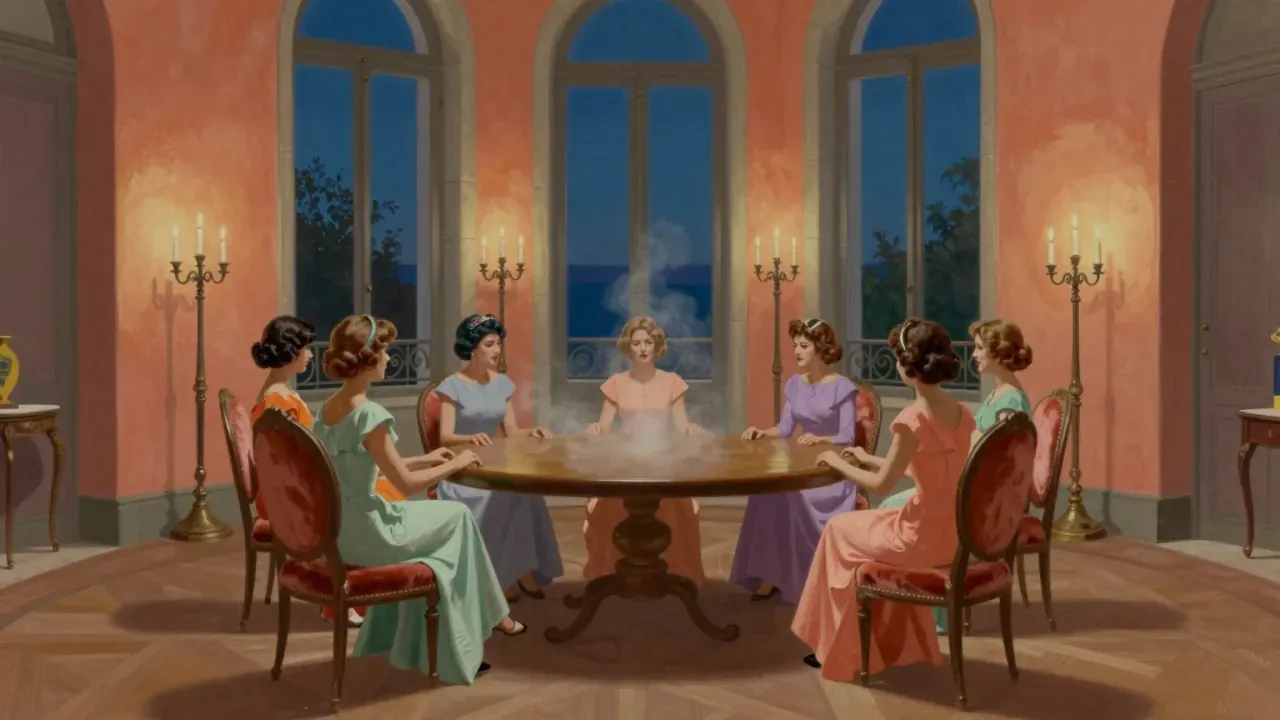
What lands most securely is the film’s tonal consistency: its refusal to settle into satire, pathos or mysticism alone. The sequence in which Giulietta attends a spiritualist séance — surrounded by women in pastel gowns chanting over a levitating table — works because it sustains ambiguity: it is absurd, eerie and tender all at once, never tipping into mockery or reverence. Masina’s physical restraint makes the eruptions of feeling — a sudden laugh, a flinch at a touch, a slow blink that reads like revelation — land with quiet force. The use of colour as psychological register remains persuasive: warm golds accompany moments of self-recognition; sickly greens signal shame or intrusion; deep violets gather around figures who represent unresolved grief. Di Venanzo’s lighting keeps interiors dim but legible, avoiding chiaroscuro drama in favour of a hushed, watchful atmosphere. Even the more baroque flourishes — the masked ball, the garden of statues — retain weight because they emerge from Giulietta’s gaze, not from directorial imposition. The film earns its spectacle by tethering it to a single, sustained point of view: not omniscient, not ironic, but intimately, vulnerably subjective. (152 words)
The sound beneath the silence
What does not cohere is the film’s treatment of time. Its episodic structure accumulates mood but rarely momentum; scenes dissolve without clear emotional or narrative consequence, leaving some passages — particularly extended tableaux involving minor characters like the silent nun or the laughing man in the garden — feeling ornamental rather than necessary. The boundary between Giulietta’s projections and external reality blurs so thoroughly that certain sequences lack dramatic stakes: if everything is hallucination, then nothing carries irreversible consequence. This is deliberate, but it risks diffusing tension. Some critics, notably Giovanni Grazzini in Corriere della Sera, found the visual richness overwhelming the human core — a charge that holds where the decor outpaces the psychology, as in the over-stuffed costume party scene, where spectacle crowds out subtext. The film also assumes familiarity with Fellini’s recurring motifs — the circus, the confessional, the grotesque — without re-grounding them for new viewers. Without that context, certain images read as decorative rather than diagnostic. The ending, though intentionally open, offers no pivot — only suspension — and may frustrate those expecting resolution or even clarified intention. (149 words)
The shape of her imagining
The themes that matter are not marital fidelity or female liberation in any programmatic sense, but the labour of self-perception: how difficult it is to see oneself clearly when habit, religion and social expectation have spent decades smoothing over the cracks. Ageing appears not as decline but as a threshold — Giulietta’s body remains present, her gestures small but insistent, her voice rarely raised yet always audible. Mysticism here is neither belief nor parody, but a vocabulary for states language cannot name: dread without cause, joy without occasion, attraction without consent. The film treats memory not as archive but as active agent — childhood scenes recur not to explain but to destabilise the present. Colour functions as moral grammar: not good versus evil, but saturation versus pallor, warmth versus sterility. There is no critique of Catholicism as institution, but a persistent engagement with its imagery — confessionals, rosaries, stained glass — as infrastructure of the inner life. Fantasy is not escape but rehearsal: each vision is a trial run for autonomy, a way of testing what selfhood might feel like before it is spoken aloud. These concerns remain urgent, not because they are resolved, but because they are rendered with such tactile specificity. (147 words)
The space after the last word
This film is for viewers who tolerate ambiguity as a condition of perception, who find value in sustained metaphor over exposition, and who accept that a woman’s awakening may look like stillness, hesitation or laughter at the wrong moment. It rewards patience with texture, not plot. It is not for those who require narrative propulsion, psychological clarity or moral anchoring — viewers who expect Giorgio to be punished, or Giulietta to deliver a speech, or the ending to confirm growth will leave unsatisfied. Those who respond strongly to realism in performance or setting may find Masina’s stylisation distancing, or the sets too obviously constructed. A viewer who values Fellini’s earlier neorealist work — or who approaches the film expecting a feminist manifesto — will likely misread its aims. The film assumes a baseline familiarity with mid-century European art cinema conventions; without that, its repetitions and digressions can feel indulgent rather than intentional. Change the context — show it without framing, or to an audience primed for linear storytelling — and the verdict shifts decisively. (150 words)
The terms of entry
Yes, it is worth your evening — but only if you grant it the time and attention it demands, not as background or diversion but as an object to be inhabited slowly. Its 145 minutes unfold at a pace that mirrors Giulietta’s own dawning awareness: not rushed, not stalled, but rhythmically deliberate. The colour, the music, the performances accumulate meaning cumulatively, not episodically. To watch it impatiently is to miss its architecture. Those who dismiss it as dated or self-indulgent are not wrong about its surface qualities — the wigs are big, the sets theatrical, the symbolism overt — but they mistake ornament for emptiness. What endures is the precision with which Fellini and Masina map the quiet violence of being unseen, and the radical gentleness of allowing that invisibility to dissolve not with a shout, but with a breath, a glance, a change in light. It is not a film about becoming someone else. It is about remembering how to occupy your own skin. That remains rare, and worth the sitting. (149 words)