The shape of love
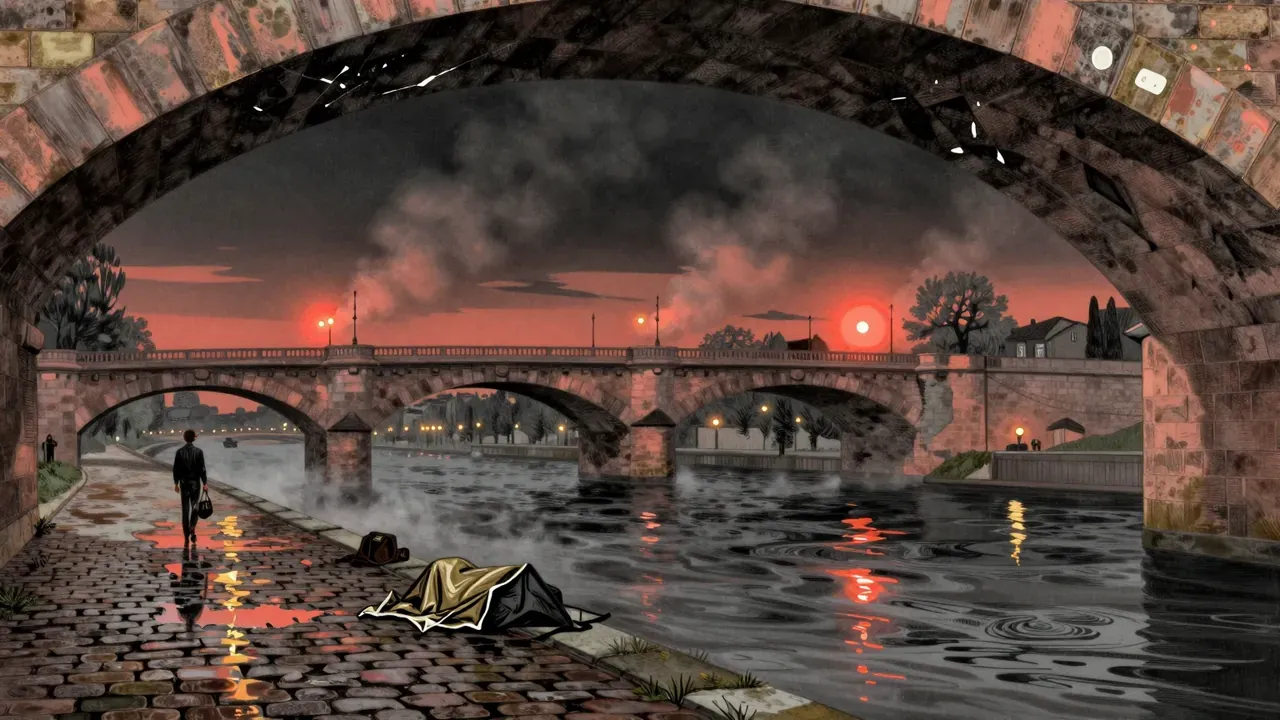
Les Amants du Pont-Neuf is a French romance film that attempts to stage love as physical endurance — not as dialogue or psychology, but as shared exposure: to cold, rain, vertigo, chemical dependency, and the slow erosion of sight. It sets its story on and around a replica of Paris’s oldest bridge, built at vast expense in southern France because filming on the real Pont Neuf proved logistically impossible. Leos Carax wrote and directed it as a mythic counterpoint to urban modernity: two vagrants, Alex and Michèle, inhabit the bridge not as outcasts but as sovereigns of a suspended world, where fireworks, speedboats and Rembrandt’s self-portrait all exist on the same plane of desire. The film refuses social realism; it treats poverty, addiction and blindness not as conditions to be explained but as textures of atmosphere, lit by Jean-Yves Escoffier and scored by Arvo Pärt’s sparse, resonant strings. Its ambition is architectural as much as emotional: to build a space where romance operates outside time, law or narrative causality. It is less about what happens than what persists — light on water, breath in cold air, a hand gripping another’s wrist mid-fall. (158 words)
The rhythm of it
The story unfolds in episodic set-pieces rather than cause-and-effect progression: Alex fire-breathing on wet cobblestones, Michèle sketching strangers while her vision blurs, Hans silently mending a boat. Juliette Binoche and Denis Lavant perform with minimal inflection — their faces register fatigue more than revelation, their bodies absorb weather and gravity. There are no close-ups for emphasis, no cuts to reaction shots; Escoffier’s camera holds wide, low, steady, letting action play out in full frame, often at distance. Nelly Quettier’s editing avoids rhythm for its own sake — scenes bleed into one another via dissolves timed to breath or tide, not beat. Arvo Pärt’s music enters only where silence has worn thin, never underscoring emotion but marking thresholds: water-skiing begins in near-silence, then swells into ‘Fratres’ as the boat cuts past the replica façades. The craft is unified in its refusal of emphasis: no performance shouts, no shot lingers, no note insists. Even the fireworks — staged for Bastille Day 1989 — are filmed from below, half-obscured by bridge arches, so light fractures before it lands. This is not stylisation as ornament, but as discipline. (159 words)
The weight of it
What lands is the film’s tactile conviction: the weight of wet wool, the grit of pavement under bare feet, the way candlelight pools in a tin cup held between two palms. The bridge set — however expensive or ill-fated — functions as a coherent, breathable world, not a backdrop. Its forced perspective does not deceive but invites attention to construction itself: the seams in plaster stone, the mismatched bricks, the way floodlights catch dust motes above a sleeping figure. Binoche’s physical commitment registers without exposition — her unblinking gaze when painting, the slight tremor in her fingers as she traces a cat’s spine, the way she leans into Lavant’s shoulder not for comfort but balance. The water-skiing sequence works because it feels dangerous in real time: the boat jerks, the rope pulls, her body fights the current before yielding to it. Even the film’s most theatrical gestures — Alex diving from the bridge, Michèle walking alone through crowds with eyes half-closed — land because they are anchored in duration and resistance. There is no irony in the spectacle; the film believes in its own surfaces, and that belief is contagious. (157 words)
The gaps in it
What does not land is the film’s attempt to imply psychological depth through absence. Alex’s fear of abandonment is stated late, then left to hang without development; his sabotage of Michèle’s treatment arrives without prior tension, making it feel like narrative convenience rather than consequence. The subplot involving Hans remains opaque — his hostility, his knowledge, his eventual aid — all implied but never dramatised, leaving his arc unresolved rather than enigmatic. The film’s rejection of exposition extends too far: we learn nothing of Michèle’s disease beyond its effect on sight, nothing of Alex’s sedative use beyond its presence, nothing of their pasts beyond fragments. This isn’t restraint — it’s omission. Some viewers will find this generative; others will find it withholding. The film also misjudges scale in its final third: the fireworks, the boat chase, the rescue by the riverboat named after producer Christian Fechner — these escalate visually but not emotionally, as if grandeur could substitute for stakes. The ending, too, resolves nothing except geography: characters move, but no internal shift is legible. The film trusts image over implication, and sometimes image alone cannot carry the weight it’s asked to bear. (159 words)
The ideas in it
The themes that matter are sovereignty and suspension. Not love as union, but love as mutual occupation of a contested space — the bridge as both refuge and prison, both stage and shelter. It treats blindness not as loss but as recalibration: Michèle’s drawings grow bolder as her vision fades, her touch more precise, her listening more acute. Addiction is shown not as moral failure but as metabolic rhythm — Alex drinks not to escape but to keep pace with a world that moves too fast for sobriety. The bicentennial fireworks are not ironic commentary on revolution but ambient pressure: history as weather, celebration as noise you sleep through. Class is present but unnamed — the luxury shops across the Seine are visible but never entered, their lights reflected in puddles rather than windows. The film’s deepest concern is with duration: how long can a body hold a pose? How long can two people share a single coat? How long can a bridge — real or built — bear weight before it cracks? These are physical questions first, philosophical only in retrospect. The film refuses to translate them into language, trusting instead that ten seconds of Binoche blinking against wind-blown rain says more than any monologue could. (156 words)
The audience for it
This film is for viewers who value texture over explanation, duration over plot, and physical presence over psychological disclosure. It rewards patience with sensory fidelity: the sound of gravel under tyres, the way light bleeds through torn tarpaulin, the heft of a stolen bottle in a palm. It is not for those who require narrative clarity, character motivation, or emotional payoff tied to cause and effect. Anyone needing to know why Alex acts as he does — or why Michèle stays — will leave frustrated. Those who expect romance to proceed via conversation or confession will find little here. The film assumes familiarity with Carax’s earlier work, with French New Wave pacing, and with Arvo Pärt’s aesthetic of silence-as-structure. A viewer who dislikes long takes, ambient sound design, or ambiguity in motive will reject it outright. That said, its appeal is not niche by accident: its visual grammar is precise, its performances unshowy, its world fully realised. To dislike it is to reject its premises — not its execution. Change the demand for psychological scaffolding, and the verdict changes. (158 words)
The time it takes
Yes, it is worth your evening — provided you watch it as a sustained physical event, not a puzzle to solve. Its 125 minutes pass with the weight and rhythm of weather: sometimes still, sometimes violent, always consequential in the moment. It repays attention not with revelations but with accumulation — small details accrue until the final shot of water flowing beneath the bridge feels inevitable, not arbitrary. You do not need to admire Carax or know French cinema history to feel the chill in Michèle’s fingers or the strain in Alex’s shoulders. What makes it worthwhile is its refusal to flinch: from discomfort, from silence, from the sheer labour of staying upright in a world that offers no handrail. Those who find it inert have likely approached it as drama rather than environment. Its value lies in its stubborn materiality — the grain of film stock, the echo in concrete, the drag of wet fabric. It is not entertainment. It is immersion. And immersion, when done this thoroughly, is rare. To call it ‘slow’ mistakes duration for emptiness; to call it ‘impenetrable’ mistakes opacity for absence. It is dense, yes — but every atom is accounted for. (159 words)