What it is trying to do
Fox and His Friends is a West German drama from 1975, written and directed by Rainer Werner Fassbinder, who also appears in the cast. It sets out to dissect how affection becomes transactional when money enters a relationship — not as metaphor, but as mechanism. The film follows Franz ‘Fox’ Bieberkopf, a carnival worker whose sudden lottery win triggers a rapid, irreversible shift in his social orbit: from working-class gay spaces into the cultivated, coldly aesthetic world of Eugen, the son of an industrialist. Fassbinder does not frame this as a moral fable about greed or betrayal alone; rather, he treats class mobility as a form of psychological colonisation, where Fox’s gestures, speech, even grief are reshaped — then discarded — once their utility expires. The title’s irony is structural: there are no friends here, only positions, contracts, and thresholds crossed and then locked behind him. The film’s ambition is sociological as much as emotional: to show love not as failing, but as never having existed outside the terms of exchange.
How it works
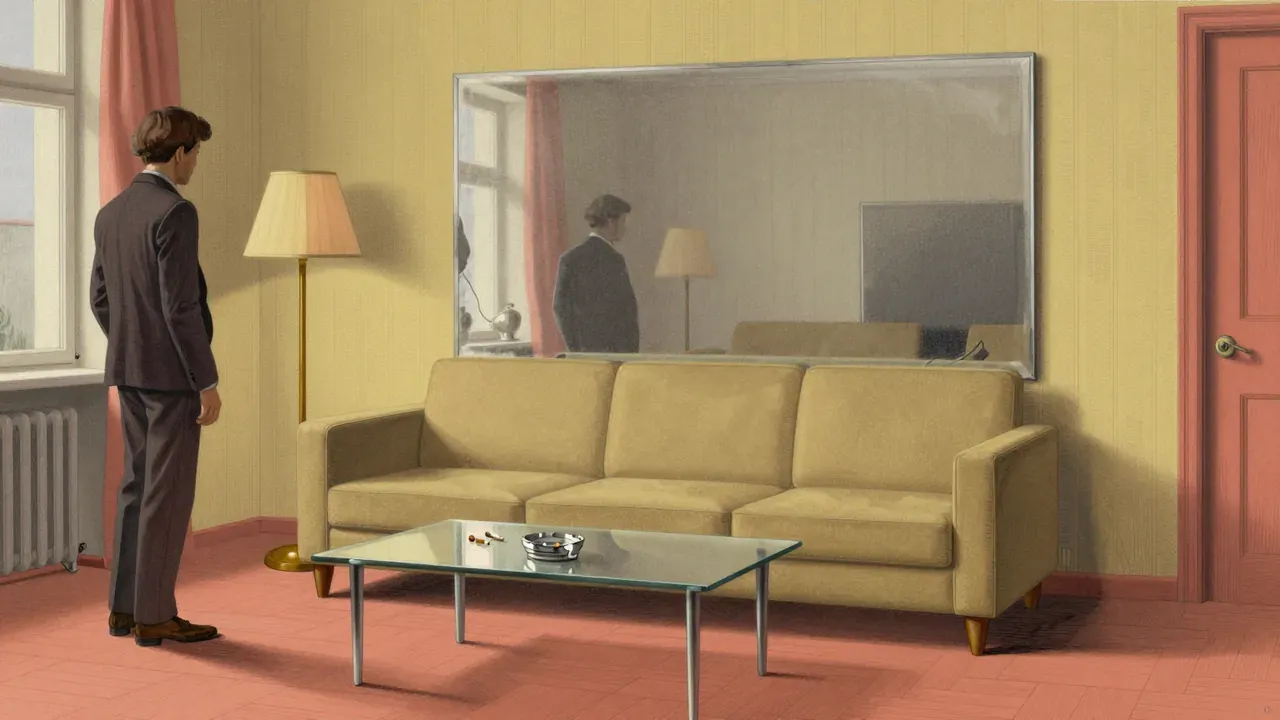
The story unfolds across twelve weeks, paced with deliberate, unblinking slowness. Peter Chatel plays Fox with minimal inflection — a quiet, open face that registers hurt only after it has already settled in his shoulders and hands. Rainer Werner Fassbinder, as Eugen, performs restraint as a weapon: every smile calibrated, every pause weighted, every touch measured for yield. Michael Ballhaus’s cinematography keeps interiors tightly framed and lit with flat, unromantic clarity; mirrors recur not for symbolism but as functional surfaces — showing who is watching whom, who is being assessed. Peer Raben’s score is sparse, often absent, letting silence accumulate between lines. Thea Eymèsz’s editing avoids rhythm or relief: scenes end not with closure but with Fox left standing, waiting, or walking away. There are no montages, no flashbacks, no music swells — just accumulation, repetition, and the slow erosion of agency. Even the Marrakesh sequence feels less like escape than relocation: same power dynamic, new geography.
What lands
What lands is the film’s unflinching refusal to flatter its characters or its audience. Fox’s vulnerability is never sentimentalised; his kindness is shown as naive, not noble. Eugen’s cruelty is not theatrical but procedural — delivered in boardrooms, over lunch, during contract signings. The class critique works because it is embedded in behaviour: the way Fox holds cutlery, the way Eugen’s friends glance at each other before speaking, the way Max the antique dealer watches Fox with the same detached interest he gives a porcelain vase. The film’s most effective moments are small and unremarkable: Fox signing a loan document without reading it, or staring blankly at a restaurant menu he cannot parse, or sitting alone in a car that no longer belongs to him. These are not dramatic beats but documentary ones — observed, not staged. The film’s realism is not in verisimilitude but in consequence: every decision has a cost, and every cost is accounted for in marks, minutes, and metres of social distance.
What does not
What does not land is the film’s length relative to its structural repetitions. At 123 minutes, it insists on showing Fox’s degradation multiple times — at the opera, at the factory, at the dinner table — without varying the register or deepening the insight. The second half risks monotony not through dullness but through rigidity: the pattern is set early, and the variations are cosmetic. Some performances falter under the weight of exposition: Karlheinz Böhm’s industrialist father speaks in platitudes that sound rehearsed rather than lived; Ulla Jacobsson’s Hedwig veers toward caricature in her drunken interjections. The film’s refusal to offer counterpoint — no warmth from peers, no solidarity from community, no irony from narration — begins to feel less like austerity and more like exhaustion. A viewer may accept the bleakness, but not the insistence that it be felt twice, thrice, four times over the same ground, with diminishing returns each time.
The themes that matter
The themes that matter are class, commodification, and the illusion of autonomy within capitalism. Money does not corrupt love in this film — it reveals love’s absence. Fox believes he is buying affection; Eugen believes he is selling competence. Neither sees the exchange as dehumanising because both accept the premise that value must be legible, measurable, and convertible. The film treats sexuality not as identity but as context: Fox’s gayness places him in certain spaces, but it does not define his exploitation — his class does. The spa, the bar, the factory, the apartment: these are not queer spaces per se, but sites where capital circulates and labour is extracted. Even suicide is rendered bureaucratically — Fox dies alone underground, two schoolboys loot his body while adults walk past, uninvolved. There is no grand tragedy, only arithmetic: 500,000 marks won, 8,000 marks for the car, 150,000 marks lost on imprints, zero marks left for dignity. The film’s political force lies in its refusal to separate economic logic from emotional life.
Who should watch it, and who should not
This film is for viewers who can sit with sustained discomfort and who treat narrative economy as a virtue, not a constraint. It suits those familiar with Fassbinder’s repertory style, or with West German New Cinema’s rejection of catharsis. It is not for viewers who require emotional release, character redemption, or tonal variation — the film offers none. Those who find irony or satire essential to social critique may resist its flat affect; those who expect queer representation to affirm community or resilience will find little here. The film’s verdict does not change if watched on a large screen or with subtitles — its rigour is formal, not technical. A viewer who values thematic precision over pacing, or who reads class as grammar rather than backdrop, will find it indispensable. Anyone needing narrative momentum, warmth, or resolution should look elsewhere.
Is it worth your evening
Yes, it is worth your evening — but only if you go in knowing it will not entertain, console, or surprise. Its value lies in its exactitude: every shot, line, and silence serves the central proposition — that love under capitalism is contract work. It rewards attention not with pleasure but with clarity. Those who dismiss it as monotonous are not wrong, but they mistake its method for its message: the monotony is the point. A different edit — tighter, with fewer repetitions — would weaken its argument. A warmer performance, a gentler score, a single moment of grace would dilute its thesis. It is not for casual viewing, nor for first-time Fassbinder watchers. But for anyone willing to meet it on its own terms — as a forensic study, not a story — it remains one of the sharpest films ever made about what money does to the shape of feeling.