The joke
The Joke is a 1969 Czechoslovak drama adapting Milan Kundera’s 1967 novel, directed by Jaromil Jireš during the Prague Spring and released months after the Warsaw Pact invasion. It sets out to dramatise the corrosive logic of ideological enforcement through one man’s expulsion from the Communist Party over a sardonic postcard, and his later attempt at revenge. The film does not aim for historical sweep or institutional exposé but for psychological precision: how dogma reshapes intimacy, memory, and moral reflex. Its method is structural — alternating between Ludvík Jahn’s present-day return to his hometown and tightly framed flashbacks to his college years, army service, and re-education — treating time not as sequence but as wound and echo. It assumes familiarity with mid-century Czechoslovak politics not as backdrop but as grammar: the Party hearing, the auxiliary battalion, the language of ‘healthy spirit’ and ‘Trotskyist deviation’ are presented without gloss, as lived idioms. This is not allegory; it is reportage in fictional form, calibrated to the texture of daily compromise under authoritarianism. (158 words)
The shape of memory
The story unfolds through restrained cause-and-effect: Jahn’s postcard, Markéta’s betrayal, Pavel’s opportunistic vote, the six-year rupture, then Helena’s unwitting role in his plan. Josef Somr plays Jahn with minimal inflection — a man whose irony has calcified into posture, not wit. Věra Křesadlová’s Věra registers quiet complicity without caricature; Luděk Munzar’s Pavel is all clipped authority and unexamined certainty. Jan Čuřík’s cinematography favours medium shots and shallow focus, keeping faces half-obscured in doorways or behind glass, while Zdeněk Pololáník’s score uses sparse piano motifs that recur like half-remembered slogans. Josef Valušiak’s editing avoids rhetorical montage: flashbacks arrive without fanfare, often mid-sentence, refusing to separate past from present as if trauma were simply chronology mislaid. The film’s craft is cumulative, not emphatic — no single shot announces itself, but the accumulation of glances, silences, and bureaucratic settings builds a world where ideology is less doctrine than atmosphere. (159 words)
The wrong woman
What lands is the suffocating banality of punishment. The scene where Jahn stands before the Party hearing, surrounded by peers who avoid his eyes, carries more weight than any courtroom confrontation: the real violence is in the refusal to meet his gaze. The army sequences — men breaking rocks, drilling under a sergeant who quotes Party directives as if they were weather reports — land because they show discipline as performance, not conviction. Helena’s gradual shift from professional detachment to emotional exposure works precisely because it is understated: her hands tremble once, then she steadies them on the table; she doesn’t weep, but her voice tightens when speaking of Pavel. The film’s irony is structural, not verbal: cutting from a choir singing ‘No More Masters’ to prisoners swinging hammers does not need explanation — the dissonance is built into the edit, not the commentary. These moments succeed because they trust the viewer to hold two truths at once: that the system is absurd, and that its consequences are absolute. (157 words)
The look of it
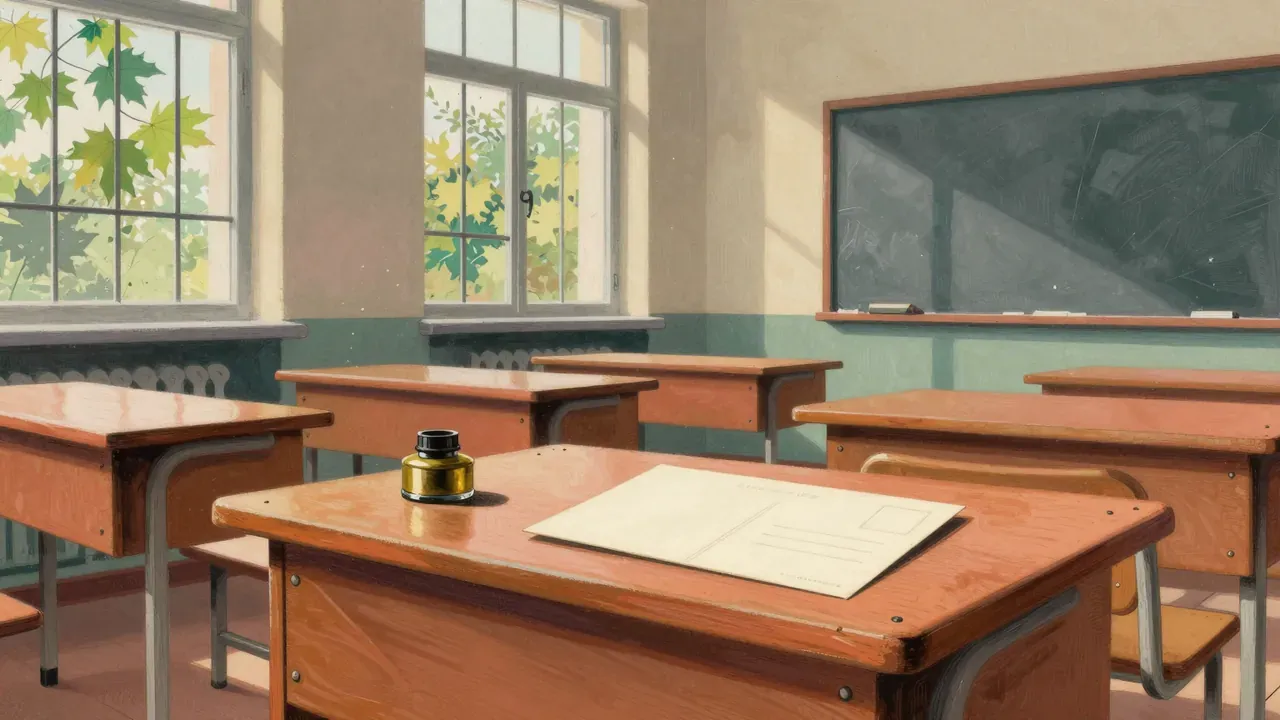
What does not land is the framing device of Jahn’s return to his hometown, which feels narratively inert rather than reflective. His interviews with Helena lack sufficient friction to sustain the present-tense thread, and their dialogue occasionally slips into exposition that the flashbacks already render redundant. The character of Alexej — the devout communist who appeals up the chain only to be expelled and commit suicide — remains underdeveloped: his crisis is stated, not dramatised, and his death arrives off-screen without the weight it demands. Some transitions between eras rely too heavily on voiceover, diluting the visual economy elsewhere. The satire, while sharp in intent, sometimes flattens into illustration: a shot of a bust of Stalin looming over a classroom desk reads as obvious, not incisive. These are not failures of ambition but of calibration — moments where the film chooses clarity over ambiguity, and in doing so loses some of the moral unease that defines its best passages. (154 words)
The sound of agreement
The themes that matter are the weaponisation of language, the erosion of private thought under collective scrutiny, and the self-defeating nature of revenge pursued through the same logic it opposes. The postcard is not funny because it is clever, but because it is trivial — and that triviality is what makes its punishment grotesque. The film treats memory not as fidelity but as selection: Jahn recalls Markéta’s face clearly but cannot reconstruct her tone when she handed in the card. Loyalty is shown as transactional, not emotional — Pavel betrays Jahn not out of malice but because loyalty to the Party requires discarding inconvenient friends. Even love is bureaucratised: Markéta’s devotion is inseparable from her Party membership; Helena’s affection becomes legible only when stripped of professional distance. The film’s central insight is that totalitarianism does not require monsters — only people who mistake procedure for principle, and who believe that sincerity justifies cruelty. (155 words)
The logic of the hearing
This film is for viewers who tolerate slow, unsentimental storytelling and who read political history not as event but as habit — those accustomed to films where silence carries policy and a glance implies consequence. It suits readers of Kundera or viewers of early Forman or Chytilová, who expect irony to reside in structure, not punchlines. It is not for those who require narrative propulsion, moral resolution, or character arcs that move toward clarity. Anyone expecting satire with the velocity of Dr Strangelove or the caricature of The Death of Stalin will find it too muted, too patient with its own gravity. A viewer who values explicit critique over implication, or who needs catharsis rather than contemplation, will leave frustrated. That said, its restraint is deliberate, not deficient: remove the pauses, the repetitions, the withheld reactions, and the film’s indictment collapses into polemic. (159 words)
The last silence
Yes, it is worth your evening — but only if you approach it as a document of tone, not a plot to follow. Its eighty minutes accumulate weight not through incident but through accrual: each shot, each line of dialogue, each cut reinforces the same condition — that ideology, once internalised, becomes indistinguishable from common sense. It repays attention not with rewards but with recalibration: after watching, casual political language sounds thinner, bureaucratic gestures more ominous. Those who dismiss it as ‘slow’ or ‘dated’ miss that its pace is its argument — totalitarianism does not announce itself with fanfare but with the dull thud of routine. A viewer who watches for spectacle or resolution will feel short-changed; one who watches for texture, for the way power settles into posture and speech, will find it exacting and unforgettable. Its value lies not in what it says, but in how thoroughly it makes you feel the air it describes. (159 words)