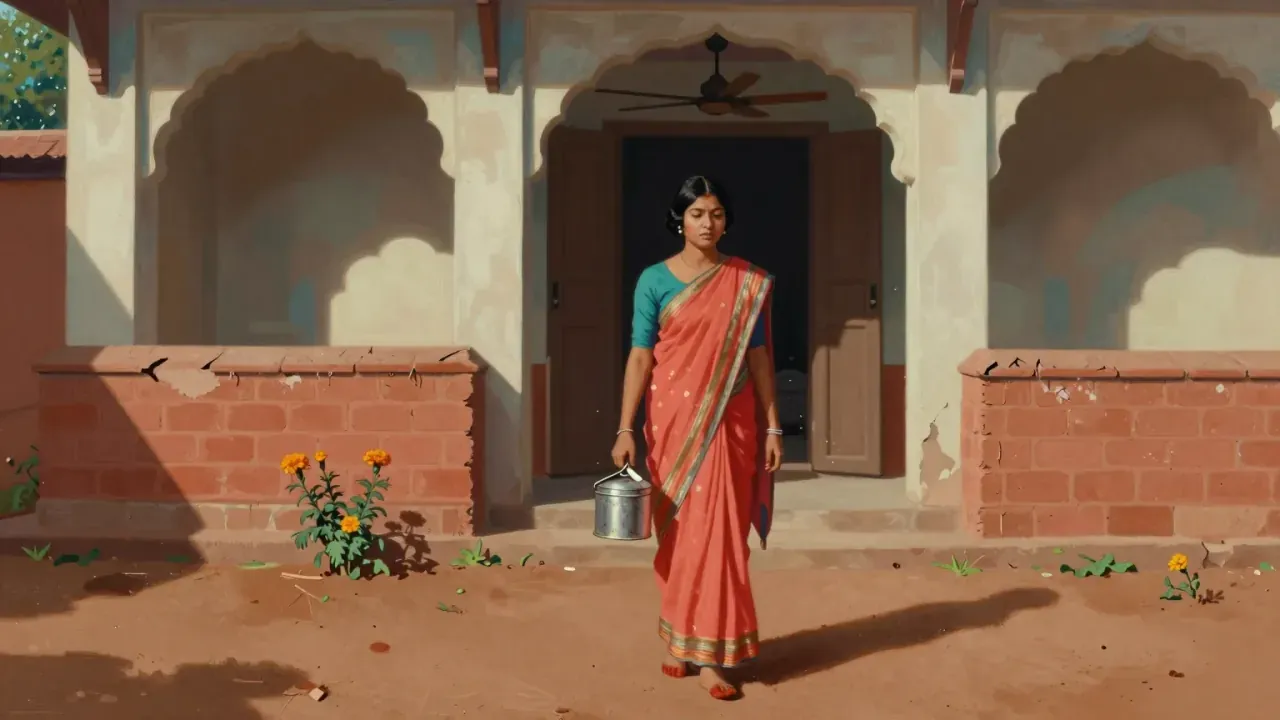
The source, relocated
An Enemy of the People is Satyajit Ray’s 1990 Bengali-language adaptation of Henrik Ibsen’s 1882 play, relocated to Chandipur — a small Indian town sustained by pilgrimage and tourism centred on the Tripureshwar temple. Ray does not transpose the Norwegian setting but reworks its moral architecture into an Indian civic context: the conflict is not between individual truth and abstract majority opinion, but between scientific evidence and entrenched local power — municipal officials, temple trustees, newspaper editors — all profiting from silence. The film attempts something precise: to dramatise how institutional corruption calcifies around ritual authority, and how dissent is recast as sacrilege when it threatens revenue. It avoids allegory in favour of procedural realism — water testing, committee meetings, editorial negotiations — treating each as a site where ethics are tested and failed. Ray’s script tightens Ibsen’s five-act structure without flattening its dialectical tension; the stakes remain personal, professional and spiritual. The film is not about ideology in the abstract, but about what happens when a doctor’s diagnosis becomes a political liability. (158 words)
The machinery of silence
The story unfolds with deliberate, unembellished pacing: Ashok Gupta’s discovery of contaminated charanamrita, his methodical attempts to alert authorities, the incremental withdrawal of institutional support, and his eventual isolation. Soumitra Chatterjee plays Gupta with quiet physical restraint — no grand speeches, few raised voices — his authority conveyed through posture, pauses and the weight of withheld frustration. Dhritiman Chatterjee’s Nishith is equally measured: not a cartoon villain but a functionary who believes his brother’s alarmism endangers stability. Gordon Willis is not involved; Satyajit Ray handles cinematography himself, using shallow depth of field and muted natural light to compress space and amplify claustrophobia. Dulal Dutta’s editing sustains continuity without flourish, cutting on action or silence rather than emphasis. Ashoke Bose’s art direction grounds the film in a recognisable, slightly worn Bengali urbanity — municipal offices with peeling paint, temple courtyards thick with dust and incense. Sujit Sarkar’s sound design avoids scoring emotion; ambient noise — temple bells, crowd murmur, typewriter clatter — carries narrative weight. (159 words)
The look of it
What lands is the cumulative erosion of credibility. Ray shows, never tells, how consensus unravels: first the hospital director’s hesitant deflection, then the newspaper editor’s nervous refusal, then the public meeting’s orchestrated collapse. Each refusal is plausible, each actor rational within their role — the editor fears circulation loss, the chairman fears electoral defeat, the priest fears doctrinal compromise. The film’s moral force comes from this plausibility. The final shift — when students and theatre performers rally behind Gupta — avoids triumphalism; it arrives as a quiet, contingent reversal, not a vindication. Mamata Shankar’s Indrani registers her father’s ostracism in small gestures: tightening a sari pallu, pausing mid-sentence, turning away from a mirror. Ruma Guha Thakurta’s Maya sustains dignity without stoicism, her exhaustion visible in the way she folds laundry while listening to radio reports. Even minor roles — Biresh Guha’s weary civil servant, Adhir Mukherjee’s pragmatic journalist — land because they behave like people who have made compromises before and will make them again. The film trusts its audience to infer motive, not explain it. (157 words)
How belief holds up
What does not land is the resolution. The late surge of support feels narratively underprepared: the students’ allegiance appears without prior establishment of their political consciousness; the theatre troupe’s intervention lacks rehearsal in earlier scenes; the assistant editor’s resignation arrives without preceding friction at the paper. These are not implausible events, but Ray gives them no dramatic scaffolding — no scene where the editor debates conscience, no moment where students overhear Gupta’s suppressed lecture. The final ‘Long Live Dr. Ashok Gupta!’ chant is visually muted, shot from a distance, and its emotional resonance depends on goodwill the film has not fully earned. Similarly, the contamination’s medical specificity — jaundice, water testing, pipe damage — is clear, but the epidemiological logic remains underserved: we see the report, but not Gupta’s process of elimination, nor the counter-arguments of those who dismiss it. The film assumes familiarity with Ibsen’s structure, so viewers unfamiliar with the play may find the escalation abrupt, the opposition diffuse. There is no single antagonist, which strengthens realism but weakens dramatic focus in the final act. (156 words)
What holiness costs
The themes that matter are not truth versus falsehood, but truth versus utility — how facts are weighed against income, reputation and communal identity. The film interrogates the infrastructure of belief: not just religious faith, but trust in institutions — the municipality, the press, the medical profession — and how easily that trust can be hollowed out by material interest. It treats ‘holiness’ not as metaphysical assertion but as economic category: charanamrita is holy because it draws pilgrims, and pilgrims sustain livelihoods. Corruption here is banal, not venal — less about bribes than about deferred maintenance, suppressed memos and polite refusals. The film also explores the loneliness of professional integrity: Gupta’s expertise isolates him not because he is arrogant, but because his conclusions demand collective action he cannot compel. His family’s parallel marginalisation — daughter dismissed, landlord evicting — shows how systems punish not just dissenters but their dependants. Class is present but unspoken: the temple’s devotees are poor; its beneficiaries are middle-class functionaries. The film refuses to romanticise either group, showing piety without condescension and self-interest without caricature. (159 words)
Where the water flows next
This film is for viewers who value procedural rigour over catharsis, who follow arguments more readily than arcs, and who accept that moral clarity rarely arrives with fanfare. It suits those familiar with Ray’s later work — where pacing is unhurried and exposition sparse — or with Ibsen’s dramaturgy, where ideas drive action. It is not for viewers who require narrative momentum, visual invention or psychological revelation; those expecting heightened performance or symbolic imagery will find it austere. Some may object to its lack of irony or satire — it treats the temple’s sanctity seriously, never mocking devotion even while exposing its instrumentalisation. Others may find the 1990 setting too literal, missing the metaphorical elasticity of Ibsen’s original. A viewer who values cinematic urgency over ethical precision would reasonably judge it inert. Its worth depends on whether one prizes fidelity to process over spectacle of consequence — and that is a preference, not a failing. (158 words)
The last test
Yes, it is worth your evening — provided you approach it as a study in civic erosion, not a thriller of resistance. Its ninety-five minutes unfold with the gravity of a municipal hearing, and its rewards are cumulative, not climactic: the slow dawning that Gupta’s isolation is structural, not personal; the quiet horror of watching institutions fold one by one. It repays attention to gesture, to bureaucratic language, to the rhythm of refusal. Those who dislike films where characters speak plainly and consequences accrue incrementally will find it unrewarding. But for viewers who believe cinema can clarify how power operates in plain sight — not through villains but through vested interests, inertia and polite consensus — this remains singular. Its verdict is not optimistic, but it is honest: justice arrives not as restoration, but as a fragile, locally negotiated realignment. That honesty demands time, and gives it back. (159 words)