The premise is the world
Orpheus is a French fantasy film from 1950, written and directed by Jean Cocteau, adapting his own 1926 play and reworking the Orpheus myth into a post-war Parisian allegory. It does not aim to retell the myth literally but to stage a poetic logic in which death, love, poetry and mirrors operate as interlocking systems of transformation. Cocteau treats the myth not as antique material but as living syntax: the underworld is a bombed-out military academy; motorcyclists are emissaries of fate; a car radio broadcasts abstract verse like divine static. The film’s ambition is structural and metaphysical — to build a world where reality bends under the weight of artistic necessity, not spectacle. Its method is not exposition but invocation: it assumes the viewer will accept that a mirror may be a threshold, that silence may carry legal force in the afterlife, that grief and obsession are indistinguishable in their grammar. It is not illustrative; it is propositional. It asks the audience to inhabit its internal consistency — one governed by dream-logic, yes, but also by rigorous craft choices, repeated motifs and self-imposed rules. This is not escapism. It is architecture for the imagination.
The look of it
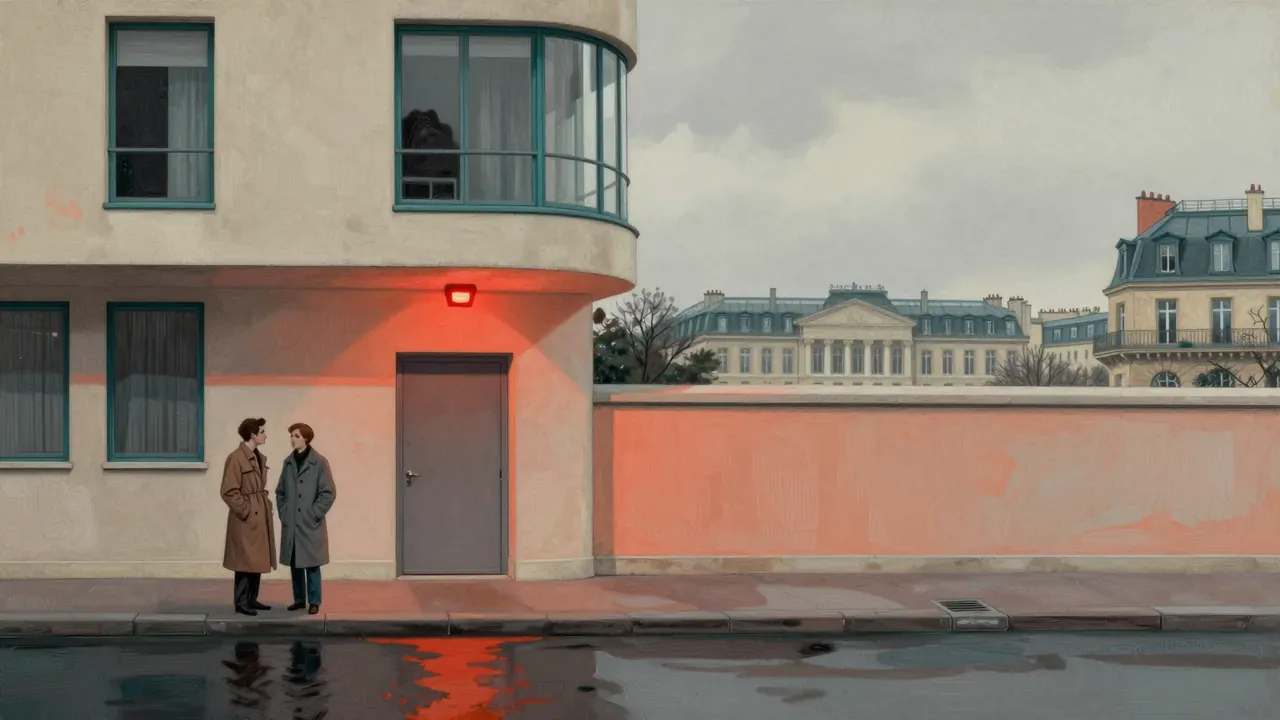
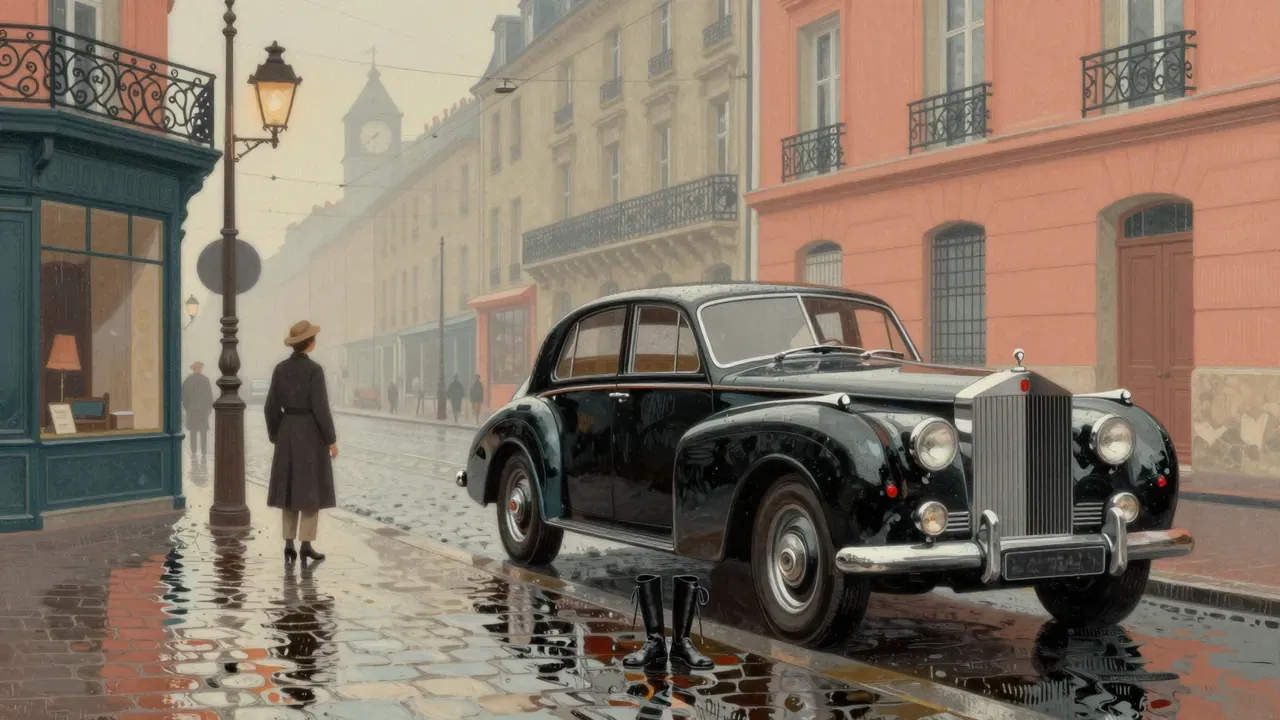
The story follows Orpheus, a poet estranged from his wife Eurydice, drawn into a bureaucratic afterlife after witnessing a death orchestrated by the Princess — an incarnation of Death who speaks in riddles and drives a Rolls-Royce. Jean Marais carries the role with contained gravity, never emoting but registering shifts in perception like geological strata. François Périer’s Heurtebise moves with quiet loyalty and unspoken longing, while María Casares’ Princess is all stillness and implication, her authority rooted in silence rather than volume. Nicolas Hayer’s cinematography avoids flourish: he films ruined buildings head-on, keeps interiors dim and uncluttered, lets mercury pools reflect faces without commentary. Georges Auric’s score is spare, tonal, never underscoring but occupying space like another character. The effects — reversed motion, negative landscapes, superimpositions — are practical, visible, never concealed. They do not simulate wonder but present it as labour: you see the wires, the sloping floor, the vat of mercury. Cocteau does not hide technique; he makes it part of the poem’s texture. Every choice serves the central conceit: that the poet’s vocation is a form of passage, and passage requires both surrender and precision.
What holds it together
What lands is the film’s unwavering commitment to its own grammar. The mirrored doorway into the underworld feels inevitable, not clever — because the film has spent its first twenty minutes training us to read reflections as thresholds, not surfaces. The tribunal scene works not as satire but as deadpan ritual: its procedural dryness makes the stakes feel real, not whimsical. The ruined Saint-Cyr set, with its crumbling walls and distant train whistles left in the soundtrack, grounds the myth in tangible post-war exhaustion. Even the motorcycle riders — black-clad, faceless, moving in formation — land as mythic figures because they appear without explanation and are never demystified. Their presence is treated as fact, not metaphor, and that refusal to translate gives them weight. The film’s emotional pivot — Orpheus choosing Death over Eurydice — lands because it is presented not as betrayal but as recognition: he has been listening to her voice on the radio long before he sees her face. The final return to ordinary life, with Orpheus learning he is to be a father, lands because it is delivered without fanfare, as if rebirth were simply the next line in the same stanza.
Where the surface cracks
What does not land is the film’s occasional reliance on opaque signposting. The ‘League of Women’, led by Aglaonice, remains underdeveloped — its allusion to the Maenads is clear, but its function within the narrative logic is thin, serving more as decorative allusion than dramatic engine. Some of the dialogue, particularly in courtroom exchanges, veers toward declamation at the expense of psychological traction: characters state positions rather than discover them. The pregnancy subplot, though emotionally pivotal, is introduced too late and resolved too neatly, lacking the texture given to Orpheus’s obsession or Heurtebise’s quiet devotion. A few transitions — notably the shift from Orpheus’s home to the underworld via surgical gloves — feel abrupt even by the film’s own dream-logic standards, relying on symbolic shorthand rather than sustained rhythm. These are not failures of vision but of pacing: moments where the film’s intellectual density outpaces its emotional scaffolding. They do not break the spell, but they cause brief friction — a stumble in the otherwise steady descent.
What it is really about
The themes that matter are mortality as apprenticeship, poetry as perilous access, and mirrors as instruments of self-confrontation. Cocteau treats death not as an end but as a series of thresholds the artist must cross — first through reputation, then through love, then through surrender. The film’s repeated emphasis on listening — to radio static, to silence, to voices from beyond — frames attention itself as a moral act. The tribunal is not a parody of bureaucracy but a literalisation of poetic accountability: every line written, every glance withheld, carries consequence. Mirrors recur not as vanity devices but as sites of judgment: Orpheus fails when he looks at Eurydice in reflection, not because he breaks a rule, but because he reasserts the old self — the one who observes rather than participates. The film’s modernity lies in how it locates the mythic in infrastructure: motorcycles, radios, garages, police reports. These are not ironic updates but the actual vessels through which eternity now circulates. The theme is not that myth survives modernity, but that modernity has always been mythic — we just stopped recognising the rites.
Who walks through the mirror
This film is for viewers who trust images before explanations, who find rhythm in repetition and meaning in restraint. It rewards patience with coherence, not payoff — those expecting narrative resolution or psychological realism will leave frustrated. It is not for viewers who require causal clarity, emotional exposition or character arcs defined by change rather than revelation. Those who dislike ambiguity in motive or resist formal repetition — the mirrored entrances, the returning ruins, the identical motorbike formations — will find it monotonous rather than hypnotic. It is also not for viewers allergic to mid-century French inflection or slow, deliberate speech rhythms. That said, its accessibility is wider than its reputation suggests: no knowledge of Greek myth is required, only willingness to follow its internal cadence. Anyone who has ever stared into a mirror and felt time thin may find it immediate. Its resistance to interpretation is not obscurity — it is insistence.
Why it stays
Yes, it is worth your evening — provided you watch it as a score to be followed, not a puzzle to be solved. Its ninety-five minutes unfold with the inevitability of a sonnet: every image, every pause, every reversal serves the central proposition. It does not waste time on exposition or character backstory because it treats presence as sufficient — Marais is Orpheus because he stands there, listens, walks, looks away. The film’s endurance across seventy years is not nostalgic but functional: its techniques remain legible, its questions urgent. Those who find it cold do so because it refuses to flatter the viewer’s need for reassurance — it offers transformation instead. It is worth your evening if you believe cinema can be a form of philosophical notation. It is not worth it if you watch primarily for plot propulsion, emotional catharsis or visual novelty divorced from meaning. Its value lies not in what it shows, but in how insistently it asks you to recalibrate what showing means.