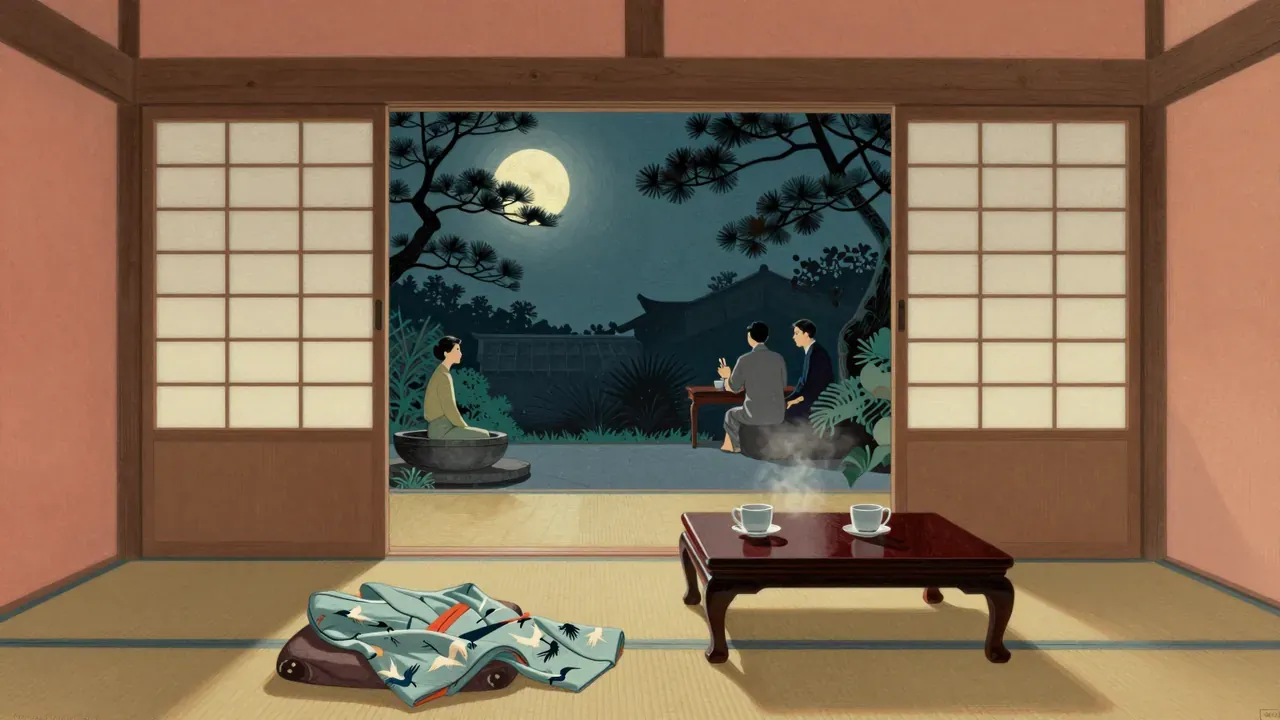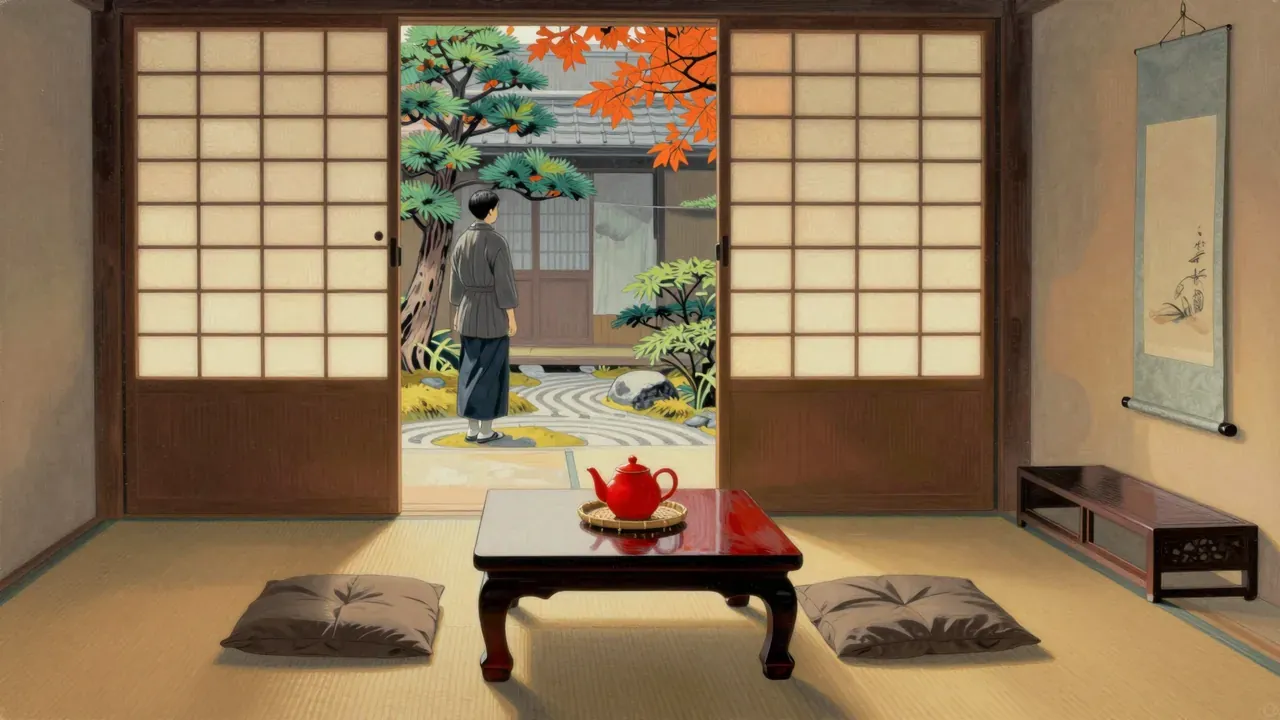
The look of it
Equinox Flower is Yasujirō Ozu’s first colour feature and a deliberate pivot within his late style: a domestic comedy built on generational friction, not quiet despair. It sets out to examine the erosion of paternal authority in post-war Japan—not through crisis or rupture, but through polite persistence, small evasions, and the slow accumulation of minor concessions. The film does not argue for modernity or tradition; it watches both as habits worn thin by repetition. Its tone is calibrated to the rhythm of Tokyo middle-class life: meetings at offices, tea poured in measured silence, daughters returning home with unspoken decisions already made. Ozu and his co-writers Kōgo Noda and Ton Satomi adapt Satomi’s novel not as social reportage but as structural counterpoint—each generation’s speech patterns, spatial positioning, and silences are arranged like variations on a single theme. The film’s ambition is modest: to hold a mirror to the ordinary without distorting it, and to do so in colour for the first time—not as spectacle, but as a subtle recalibration of tone and weight. (158 words)
The grammar of stillness
The story unfolds in tight domestic circuits: Hirayama’s office, his living room, a bar, a train station. Yūharu Atsuta’s cinematography uses Agfa colour stock deliberately—the red teapot, Fujiko Yamamoto’s blouses, the higanbana motif—without flourish, keeping saturation low and contrast soft. Takanobu Saitō’s score is sparse, mostly piano and strings, entering only where dialogue pauses. Performances are restrained: Shin Saburi’s Hirayama moves with bureaucratic stiffness, Kinuyo Tanaka’s Kiyoko listens more than she speaks, and Fujiko Yamamoto’s Yukiko occupies the frame with stillness that reads as agency, not passivity. The editing follows Ozu’s signature 360-degree spatial logic, cutting on action but never rushing it—doors close, hands fold laundry, trains pull away, all at the same pace. There are no close-ups of faces in distress; emotion registers in posture, in the angle of a shoulder turning away, in how long a character remains seated after another has left. The craft serves continuity, not emphasis: every shot confirms the world’s stability even as its rules quietly shift. (159 words)
The weight of small reversals
What lands is the cumulative weight of small reversals. Hirayama’s insistence on arranging his daughter’s marriage unravels not through argument but through the quiet consistency of others: his wife’s dry observation, his younger daughter’s open disbelief, Mikami’s parallel surrender. The ruse Yukiko engineers—posing a hypothetical to extract his consent—is not manipulative but procedural: it exposes the gap between Hirayama’s stated principle and his lived response. The film’s comic timing rests in understatement—the way he stares at the red teapot after his daughter picks it up, the pause before he boards the train to Hiroshima, the absence of fanfare at the wedding. These moments land because they refuse to name what they show: resignation dressed as acquiescence, tradition yielding not to force but to fatigue. Even the colour works this way: the higanbana is never shown in bloom, only named and implied—its redness appears elsewhere, muted, persistent, unexplained. The film trusts the viewer to register the shift without underlining it. That trust is repaid in quiet recognition, not laughter or catharsis. (157 words)
The loose thread
What does not land is the framing of Yukiko as plot engine. Though Fujiko Yamamoto receives sole screen credit—a rarity in Ozu—the role itself sits uneasily: her intervention is clever but narratively convenient, and her motivations remain opaque. She is positioned as a protégé of Hirayama, yet their relationship lacks texture beyond function. Similarly, the subplot involving Mikami’s daughter Fumiko feels detached, introduced early and resolved off-screen, serving only to foreshadow Hirayama’s arc without deepening it. The film’s commitment to restraint occasionally slips into omission: we see Hirayama’s professional stature but not his work; we hear references to corporate hierarchy but never witness its pressure. His resistance to his daughter’s choice is presented as temperament, not ideology—yet the script gives him no language for either, leaving his stubbornness unmoored from context. This makes his eventual concession feel less earned than inevitable, a structural necessity rather than a psychological turn. Some viewers may find the pacing too even, the stakes too contained, the resolution too gentle to satisfy narrative hunger. (158 words)
The quietest theme
The themes that matter are inheritance and attenuation—not of property or title, but of habit, syntax, and silence. The film treats tradition not as doctrine but as routine: the way tea is poured, how fathers greet daughters at doorways, the order in which family members sit at meals. What erodes is not respect but repetition—the rituals lose their weight when performed without belief. Ageing is present not as decline but as displacement: Hirayama is not frail, but his authority no longer aligns with the tempo of daily life. The colour palette reinforces this: Agfa’s reds are warm but faded, like old lacquer, not vibrant pigment. Generational difference is rendered spatially—Yukiko stands in doorways while Hirayama remains seated; Setsuko walks ahead on the street while he lags behind—not as rebellion but as simple misalignment of pace. There is no nostalgia here, only observation: the past persists not as memory but as residue, visible in furniture, in speech rhythms, in the way a teacup is held. The film’s quietest theme is exhaustion—not of individuals, but of forms. (159 words)
The gate, not the flaw
This film is for viewers who value precision over propulsion, who find tension in stillness and meaning in placement. It rewards attention to gesture, to the weight of an unspoken pause, to how light falls across a tatami mat. It is not for those who require narrative escalation, moral clarity, or emotional exposition. Anyone expecting satire will find its comedy too dry; anyone seeking psychological depth may find Hirayama’s interiority withheld beyond tolerance. Those who dislike Ozu’s formal rigour—his static frames, his refusal of dramatic angles—will find little here to persuade them. A viewer who values thematic resonance over plot mechanics, or who finds beauty in compositional balance, will engage readily. But someone watching for incident, for revelation, or for a clear authorial stance on modernity versus tradition will leave unsatisfied. The film assumes patience as a condition of viewing, not a virtue to be rewarded. That assumption is its gate, not its flaw. (158 words)
The terms of the evening
Yes, it is worth your evening—if you approach it as a study in equilibrium, not a story with a destination. Its 118 minutes unfold at the pace of breath, not beat. It asks for nothing more than sustained attention to how people occupy rooms, how they speak around subjects rather than at them, how colour can carry weight without shouting. Those who find this mode absorbing will leave with a clearer sense of how social change registers in the body, in the glance, in the arrangement of objects. Those who do not will feel time stretch, not deepen. The verdict does not hinge on whether the film ‘succeeds’ but on whether its terms match yours: if you accept that a father’s surrender can be signalled by the way he holds a teacup, then yes—it is worth your evening. If you need his conflict named, argued, resolved, then no. The difference is not quality, but contract. (159 words)