The shape of longing
Children of Paradise is a French romantic drama set in the theatrical Paris of the 1830s, centred on the Boulevard du Temple and the Funambules theatre. It attempts to portray love not as resolution but as persistent, asymmetrical yearning — embodied by four men whose affections for the courtesan Garance are defined less by her consent than by their own temperaments: the mime’s silent devotion, the actor’s performative charm, the criminal’s cold calculation, the aristocrat’s possessive control. Marcel Carné and Jacques Prévert conceived it as a portrait of art-making under constraint: both the historical constraints of the July Monarchy and the immediate, suffocating conditions of German-occupied France. Its scale — a quarter-mile set, 1,800 extras, two-part structure — is not spectacle for its own sake but an insistence on density: of social strata, of artistic disciplines, of moral ambiguity. It treats the theatre not as escape but as microcosm, where class, craft, and consequence collide under gaslight and footlights. The film’s ambition is structural and ethical: to hold four irreconcilable loves in equilibrium, without granting any one narrative or emotional primacy.
The theatre as document
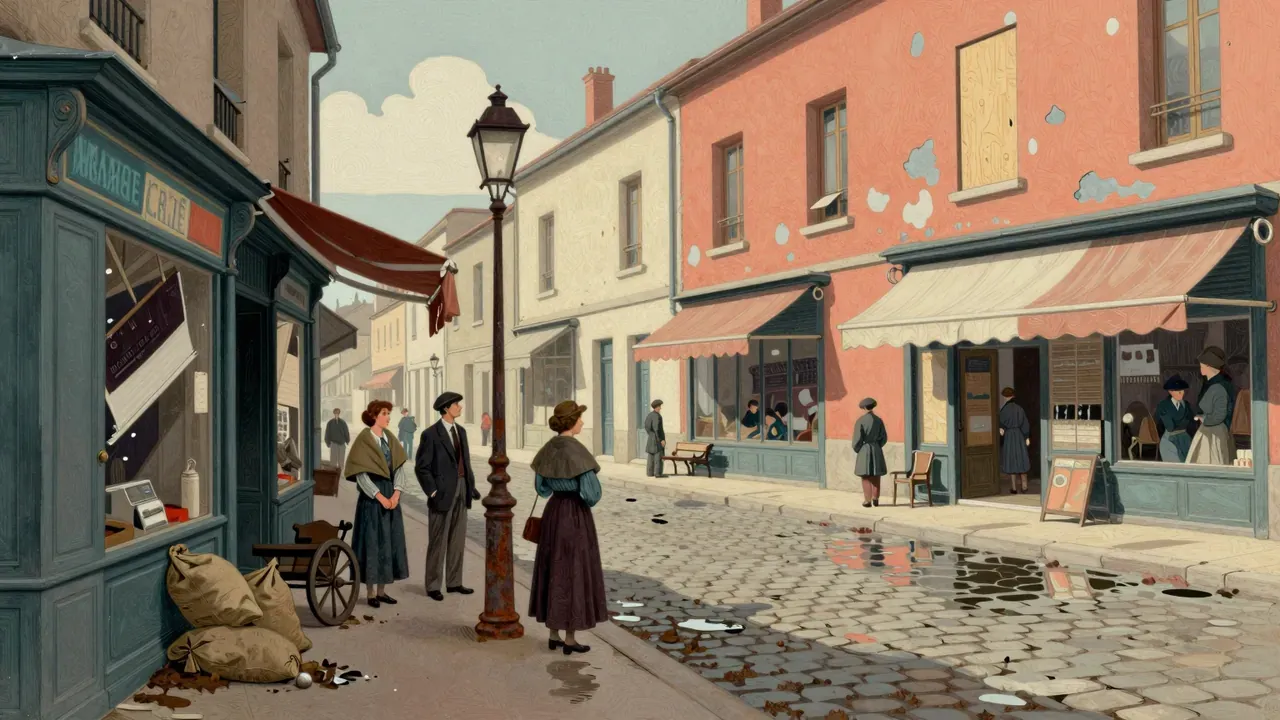
The story unfolds in two parts — ‘Boulevard du Crime’ and ‘L’Homme Blanc’ — following Garance (Arletty) as she moves between Baptiste Deburau (Jean-Louis Barrault), Frédérick Lemaître (Pierre Brasseur), Lacenaire (Marcel Herrand), and Édouard de Montray (Louis Salou). Barrault’s mime sequences are choreographed with surgical precision: every tilt of the head, pause, and gesture carries narrative weight, unmediated by speech. Arletty’s Garance is neither passive nor manipulative; her agency lies in withdrawal, in choosing silence over alignment. Roger Hubert and Marc Fossard’s cinematography favours deep focus and layered compositions — crowds spill into frame, balconies loom overhead, doorways frame characters in transit. Maurice Thiriet’s score avoids leitmotif in favour of atmospheric underscoring, while Henri Rust’s editing sustains rhythm across long takes and abrupt cuts alike. The production design by Alexandre Trauner — built under rationing, secrecy, and storm damage — renders the boulevard as both stage and street: lived-in, weathered, porous. Costume work by Mayo, using Lanvin materials, distinguishes class through cut and texture, not caricature.
The look of it
What lands is the film’s refusal to sentimentalise longing. Baptiste’s final scene — watching Garance from afar, unseen, unacknowledged — carries no catharsis, only quiet gravity. The courtroom sequence, where Lacenaire dissects justice as performance, lands with forensic clarity because it mirrors the film’s own method: exposing how power, law, and desire operate through scripted roles. Arletty’s presence holds the centre not through charisma alone but through stillness: her face registers recognition, fatigue, amusement, and dismissal in near-silent succession. The crowd scenes function as chorus, not backdrop — their laughter, hisses, and murmurs shape meaning as much as dialogue does. The film’s pacing, though deliberate, never lingers without purpose: a slow pan across the Funambules auditorium establishes hierarchy; a tracking shot through backstage corridors maps access and exclusion. Even minor figures — Decroux as Baptiste’s father, Jane Marken as the pragmatic landlady — occupy space with psychological specificity. The title’s double meaning — paradise as theatre gallery, paradise as illusion — resolves not in irony but in accumulated, tactile truth.
The making of it
What does not land is the second part’s structural drift after Lacenaire’s arrest. The trial provides moral and rhetorical focus; what follows — Montray’s decline, Baptiste’s isolation, Garance’s ambiguous departure — lacks equivalent dramatic pressure. Louis Salou’s Édouard, though well-acted, remains underwritten: his aristocratic entitlement reads more as plot device than psychology. The film’s commitment to ensemble balance means no single arc achieves full closure, and that choice, while principled, leaves certain threads — particularly Garance’s interiority — deliberately opaque to the point of elision. Some transitions feel dictated by production necessity rather than narrative logic: the abrupt shift from Nice to Paris studios, the re-shooting of Jéricho’s role after Robert Le Vigan’s flight, register as fractures in continuity. The 190-minute runtime demands sustained attention, and while most sequences earn their length, a handful — notably extended rehearsal montages — test patience without deepening character or theme. The film assumes familiarity with French theatrical history; without context, Lacenaire’s dandyism or Lemaître’s star persona lose some of their charge.
The heart of it
The themes that matter are those forged in constraint: art as survival, love as non-possession, performance as identity. The film treats the stage not as fiction but as the site where social truths are rehearsed, contested, and sometimes enacted for real — Baptiste’s mime is not escapism but a language honed in silence; Lacenaire’s criminality is a perverse form of authorship. Class is rendered materially: the ‘paradis’ balcony is not metaphor but architecture — wooden, cramped, loud — and the film repeatedly frames characters looking down from it or up towards it. Memory and erasure recur: reels hidden from the occupiers, sets rebuilt after storms, actors replaced mid-shoot. These are not incidental hardships but thematic anchors: the film insists that culture persists not despite interruption but through adaptation, concealment, and stubborn reassembly. Prévert’s script treats romance as a series of failed translations — between gesture and word, desire and duty, public face and private need — and the tragedy lies not in loss but in the impossibility of full mutual understanding.
The pace of it
It is for viewers who value sustained immersion over exposition, who find pleasure in compositional detail and rhythmic pacing, and who accept that emotional resonance may arrive obliquely — in a glance, a pause, a costume’s frayed hem. It is not for those who require clear moral alignment, rapid plot propulsion, or psychological exposition. Those who expect romance to resolve in union or catharsis will find its ending withholding. Viewers unfamiliar with French theatrical history or interwar European context may miss layers of allusion, though the film’s human dynamics remain legible without them. Anyone resistant to black-and-white cinematography, long takes, or subtitles may find the barrier too high — not because the film refuses accessibility, but because it declines to flatten its textures for convenience. A viewer who values narrative efficiency over atmospheric accumulation will likely grow impatient before the first intermission.
The weight of it
Yes, it is worth your evening — provided you watch it whole, undistracted, and allow its rhythms to settle. Its 190 minutes unfold like a piece of chamber music: dense, interwoven, demanding attention to counterpoint and silence alike. The restoration makes visible what wartime scarcity obscured — the grain of the film stock, the texture of Trauner’s plaster facades, the sweat on Barrault’s brow during mime sequences. To skip it is to miss a benchmark in how cinema can hold contradiction: grandeur and intimacy, discipline and improvisation, occupation and creation. Those who find it slow are not wrong — it is slow — but the slowness is structural, not inert. It would change its verdict only if viewed in fragments, dubbed, or stripped of its original aspect ratio and score. Its endurance is not historical accident but formal necessity: this is a film that insists on being met on its own terms, and repays that meeting fully.