The shape of the play
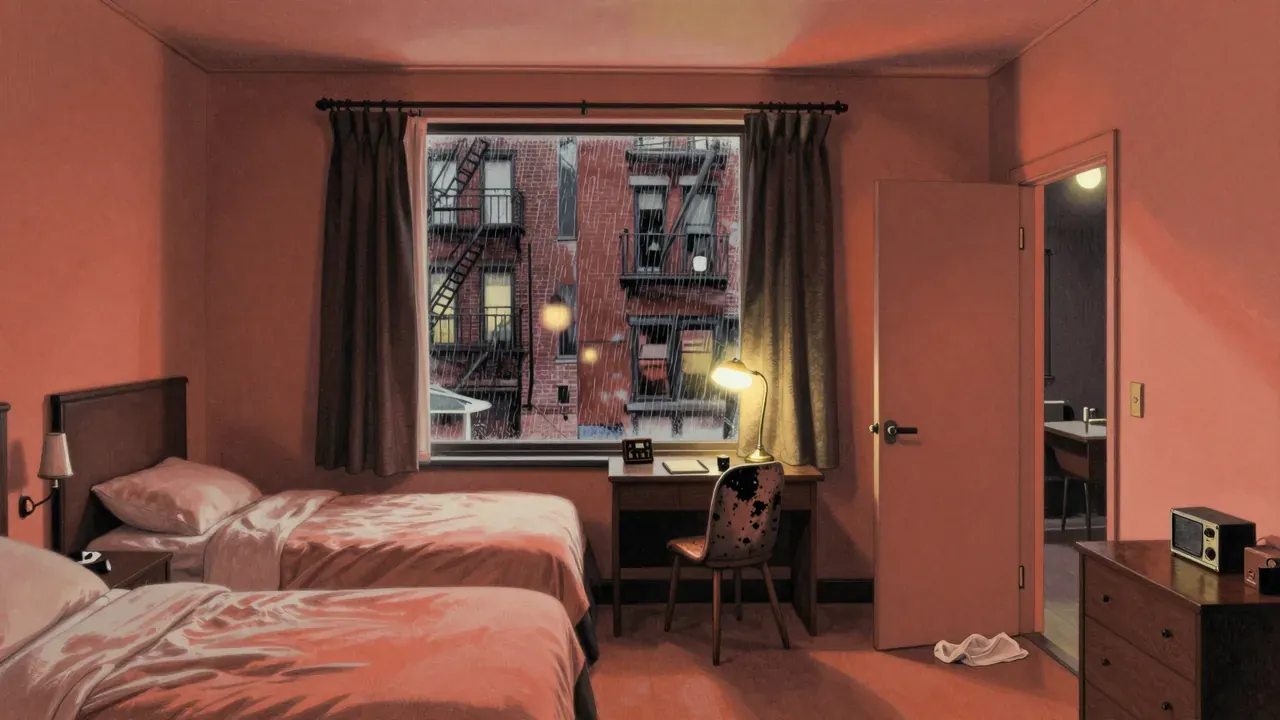
Insignificance is a 1985 British film adaptation of Terry Johnson’s 1982 stage play, transposing its four archetypal figures — a movie star, a physicist, a baseball player and a politician — into a single night in a New York hotel. It does not aim to reconstruct history but to hold fame, power and vulnerability in simultaneous focus, using fictionalised versions of Marilyn Monroe, Albert Einstein, Joe DiMaggio and Joseph McCarthy as vessels for inquiry rather than subjects of biography. Nicolas Roeg’s direction treats the hotel as both literal setting and conceptual chamber: a place where public personas collide with private exhaustion, where ideas about relativity and celebrity operate on parallel planes. The film’s ambition lies in its structural restlessness — flashbacks and imagined sequences interrupt linear time, and spatial logic bends to accommodate emotional truth. It seeks no resolution, only juxtaposition: the Senator’s moral coercion beside the Actress’s physical fragility; the Professor’s intellectual solitude beside the Ballplayer’s performative masculinity. This is not satire nor homage, but a calibrated experiment in proximity — what happens when icons are stripped of context and left to speak, stumble, misread and fail in real time. Word count: 158
The look of it
The story unfolds across one evening and morning, anchored by Theresa Russell’s performance as the Actress — physically precise, tonally restless, avoiding mimicry while sustaining Monroe’s cadence and collapse. Tony Curtis plays the Senator with clipped authority and brittle certainty; Gary Busey’s Ballplayer is all nervous energy and unspoken hurt; Michael Emil (not listed in the fact sheet but confirmed by the encyclopedia context) grounds the Professor in quiet gravity, his voice low, his gestures economical. Roeg and editor Tony Lawson fracture chronology without disorientation: a flashback to the Seven Year Itch shoot appears not as exposition but as embodied memory, its white-dress image echoed later in Hockney’s fractured nude still. Stanley Myers’ score is sparse, often absent — silence carries weight, especially in the hotel corridor scenes. Cinematographer Anthony B. Richmond avoids stylisation; light falls unevenly, rooms feel lived-in and slightly oppressive. Production design leans on suggestion: Picasso’s Woman and Child on the Seashore hangs as quiet indictment, not decoration. The craft serves compression — every object, every pause, every cut implies a larger world without naming it. Word count: 156
The talk between them
What lands is the film’s central paradox: that intimacy is possible only when identity dissolves. The Actress and the Professor’s conversation — toys, flashlights, balloons standing in for spacetime — feels genuinely playful and intellectually generous, not glib. Their brief connection works because neither performs for the other; she speaks plainly about wanting to sleep with him, he listens without deflection. The elevator scene between the Professor and Will Sampson’s Cherokee elevator man is another quiet success — a moment of mutual recognition outside hierarchy, unburdened by exposition. Roeg’s use of the hotel’s architecture — corridors, stairwells, doorways — creates natural tension without music or close-ups. The physicality of Russell’s performance remains consistent: her laugh, her posture, the way she holds a balloon or folds her legs on a bed all register as choices, not mannerisms. Even the film’s most abstract device — the splintered Hockney image — functions as visual shorthand for psychic fragmentation, not decorative flourish. These moments land because they resist explanation, trusting the viewer to sit with ambiguity rather than resolve it. Word count: 154
The Senator’s shadow
What does not land is the Senator’s arc, which flattens into caricature despite Curtis’s control. His threat lacks psychological texture — he is ideology made flesh, but never flesh made ideology. The film gives him no interior life beyond function, and his final confrontation collapses into physical violence that feels narratively abrupt and emotionally unearned. The Ballplayer’s subplot also frays: his marital exhaustion is clear, but his passivity — falling asleep mid-conversation, disappearing from key scenes — leaves his character under-anchored. The film assumes familiarity with DiMaggio’s public persona, but offers no counterpoint to make his silence legible as grief rather than indifference. Some of Roeg’s lateral expansions — particularly the imagined sequences — dilute rather than deepen: a fantasy of the Actress dancing alone in a vast hall adds atmosphere but no insight. The film’s refusal to clarify timelines occasionally confuses rather than intrigues, especially around the pregnancy question, which hangs unresolved not as mystery but as omission. The ending — implied miscarriage, unspoken — risks sentimentality through ellipsis, not restraint. Word count: 157
The theory of relativity
The themes that matter are not fame or physics in isolation, but the friction between how people are known and how they know themselves. The film treats celebrity as a kind of gravitational field — distorting perception, bending time, warping relationships. Relativity here is both scientific and social: status alters cause and effect, memory reshapes event, desire rewrites motive. The Actress’s childlessness and the Professor’s exile are linked not by plot but by shared erasure — one from motherhood, one from homeland — both rendered visible only through absence. The Senator embodies institutional certainty, yet his certainty is revealed as brittle performance; the Ballplayer’s athletic fame masks profound loneliness. The film’s deepest concern is epistemic humility: the idea that no one fully comprehends another, not even themselves. This is clearest in Roeg’s framing — characters often occupy separate halves of the frame, or speak while looking away, or are seen through doorways, always partially obscured. The hotel becomes a microcosm of post-war America: crowded, loud, full of intersecting lives that never truly meet. Word count: 159
Who walks in, who walks out
This film is for viewers who value precision of tone over narrative propulsion, who find resonance in silence and discomfort in clarity. It suits those familiar with Roeg’s non-linear syntax, or with Johnson’s theatrical economy, or with the cultural weight of its reference points — not as trivia, but as shared language. It is not for viewers who require psychological exposition, causal logic or redemptive arcs. Those who expect biographical fidelity will be frustrated; those who need moral resolution will leave unsettled. The film assumes patience with ambiguity and tolerance for unresolved pain — particularly the Actress’s physical and emotional violation, which it presents without catharsis or commentary. A viewer who values historical accuracy over metaphor, or who finds abstraction alienating rather than clarifying, will likely reject its methods. Its appeal narrows further for anyone unwilling to engage with 1980s British arthouse pacing — long takes, minimal scoring, dialogue that circles rather than advances. Word count: 159
The weight of the evening
Yes, it is worth your evening — but only if you arrive prepared to sit with unease rather than seek answers. Its 110 minutes unfold deliberately, refusing to flatter attention spans or confirm expectations. What makes it worthwhile is its consistency of vision: every choice — from Russell’s vocal register to the placement of Picasso’s painting — serves the same inquiry into visibility and erasure. It rewards rewatching, not for plot clarification but for noticing how Roeg layers sound, how Johnson tightens a line, how Emil holds stillness. Those who dismiss it as pretentious are not wrong about its difficulty — but they mistake difficulty for obscurity. Its flaws are structural, not careless: the Senator’s thinness reflects the film’s deliberate refusal to humanise power, not a failure of writing. A tighter edit might sharpen the Ballplayer’s arc, but would risk flattening the film’s central argument — that some fractures cannot be mended, only witnessed. Word count: 159