The shape of the story
Céline and Julie Go Boating is a 193-minute French film directed by Jacques Rivette that treats narrative not as fixed structure but as shared, mutable space. It sets out to dissolve the boundary between spectator and story—not through metafictional winks, but by having its two protagonists enter, memorise, rehearse and finally rewrite a looping domestic tragedy housed within a Parisian mansion. The film does not parody storytelling so much as model it: repetition, recall, variation, intervention. Its ambition is procedural rather than symbolic—less ‘what does this mean?’ than ‘how might one step inside a story and change its course?’ It assumes the viewer’s willingness to sit with slowness, ambiguity and recursive logic, and it refuses to separate magic from method: spells are written in notebooks, time travel triggered by candy, authorship claimed through rehearsal and correction. This is not fantasy dressed as realism, but realism reconfigured as ritual.
The look of it
The story unfolds across three interlocking registers: the drifting, sunlit present of Paris in 1974; the stylised, stage-bound interior of 7 bis, rue du Nadir-aux-Pommes; and the liminal transitions between them, marked by taxi rides and dissolving consciousness. Dominique Labourier and Juliet Berto ground the film in unforced physicality—their sprinting up Montmartre stairs, their shared silences, their gradual shedding of jobs and routines. Jacques Renard’s cinematography avoids flourish: long takes, natural light, shallow focus in interiors, a refusal to underline significance. Nicole Lubtchansky’s editing sustains rhythm without urgency, letting scenes breathe and recur with subtle shifts in emphasis. The script, co-written by Rivette, de Gregorio, Berto and Ogier, favours conversational cadence over exposition, trusting repetition to reveal meaning. There are no score cues to signal transition or emotion; the soundscape remains diegetic—street noise, piano practice, rustling paper—leaving tonal shifts to performance and pacing.
The rhythm of return
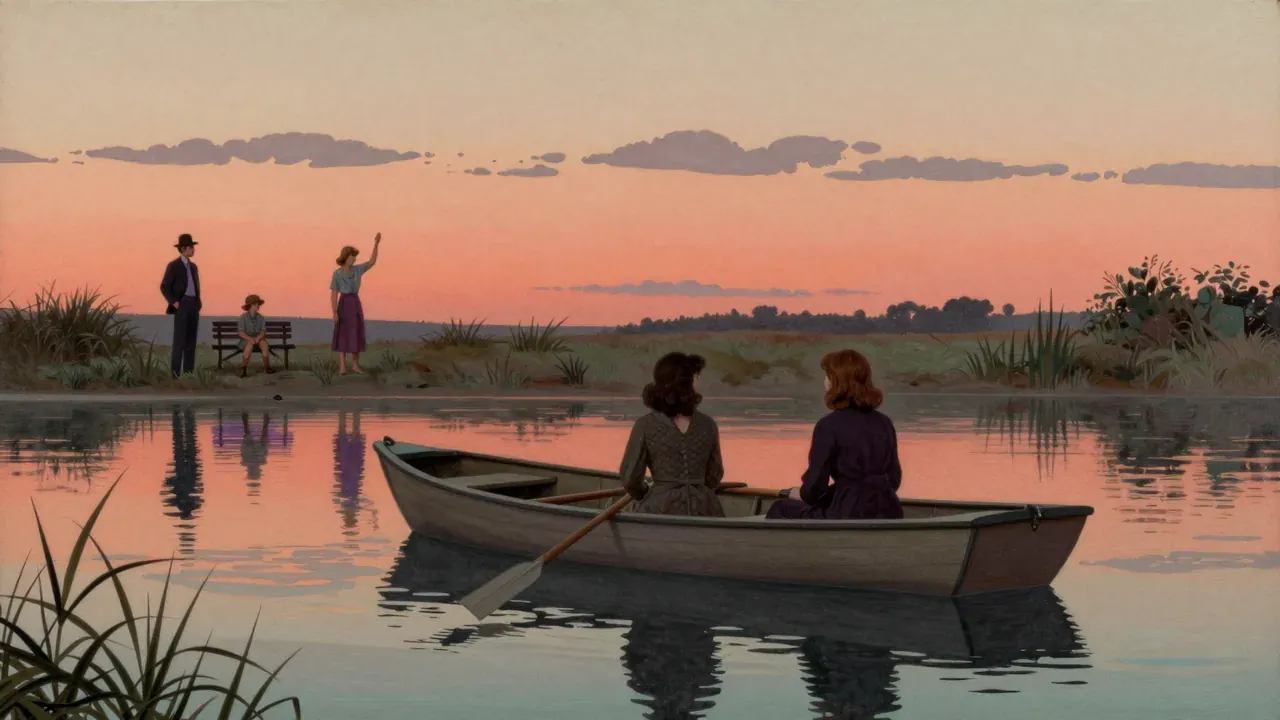
What lands most firmly is the film’s quiet insistence on female collaboration as both method and subject. Céline and Julie do not compete, confess or resolve; they observe, compare notes, test hypotheses, and revise. Their growing synchronicity—mirroring gestures, finishing each other’s lines, swapping identities without explanation—feels earned, not contrived. The house sequence works because its repetitions are precise, its emotional stakes visible even when its logic remains elusive: the sick child’s vulnerability, the widower’s passivity, the sisters’ brittle rivalry—all recur with theatrical fidelity, making each intervention feel consequential. The final rowboat scene lands not as closure but as gentle, hard-won equilibrium: three women adrift on water, watching frozen figures recede, no longer inside the story but holding its shape in memory. The film’s charm lies in its patience—it trusts that attention, given steadily, will be repaid in texture, not revelation.
The weight of the middle
What does not land is the film’s assumption of shared cultural literacy. Its allusions—to Lewis Carroll, Henry James, Feuillade, Proust—are structural, not decorative, and their weight is unevenly distributed. A viewer unfamiliar with the mechanics of serial fiction or early cinema may find the house sequences inert rather than incantatory. The 193-minute runtime compounds this: the middle stretch, where Céline and Julie rehearse variations on the same scene, risks monotony without sufficient tonal or spatial variation. Some performances—particularly Barbet Schroeder’s cameo as a distracted academic—feel underwritten, serving plot function more than character. The film also presumes comfort with ellipsis: motivations for leaving jobs, the origins of the magic book, the nature of the ‘other reality’ are left unexplained, not as mystery but as irrelevance. For viewers who require causal clarity or psychological continuity, these omissions register not as openness but as evasion.
The work of making real
The themes that matter are memory as rehearsal, fiction as habitat, and authorship as collective labour. The film treats storytelling not as transmission but as inhabitation: the women do not interpret the house’s drama—they absorb it, internalise its rhythms, then intervene from within. Identity is treated as provisional and transferable, less a fixed self than a role one steps into and out of, like an actor changing costume. Magic here is procedural: Tarot readings, spell books, candies—each is a tool for shifting perspective or altering conditions, never supernatural power. Time is neither linear nor cyclical but palimpsestic: past events remain legible beneath present action, and can be rewritten without erasure. The film’s feminism is embedded in form: no male figure resolves the central mystery; no authority validates the women’s discoveries. Their knowledge accrues through shared attention, not revelation. The house is not haunted—it is unfinished, waiting for its co-authors.
Who sits with it
This film is for viewers who value duration as a condition of understanding, who find pleasure in repetition with variation, and who accept that some mysteries exist to be inhabited, not solved. It suits those familiar with French New Wave pacing, with avant-garde theatre, or with novels that reward slow rereading—readers of Perec, Duras or Calvino may feel at home. It is not for viewers who require narrative propulsion, clear motivation or emotional payoff within conventional arcs. Those who dislike ambiguity, resist passive observation, or expect films to explain themselves will find it frustrating. A viewer who values tight plotting over atmospheric accumulation, or who finds 193 minutes of unresolved tension exhausting rather than immersive, should set expectations aside—or skip it entirely. Its demands are formal, not moral; its rewards accrue only to sustained attention.
The rowboat at dusk
Yes, it is worth your evening—if you have the evening to give. Not as entertainment, but as engagement: a rare film that asks you to hold multiple temporalities at once, to notice what changes between repetitions, to trust that a gesture repeated three times becomes syntax. Its length is not indulgence but necessity: the house’s logic only reveals itself through recurrence, and the women’s agency only becomes legible through sustained presence. Those who approach it expecting a puzzle to solve will leave tired; those who treat it as a space to occupy, like a room or a rhythm, may find it quietly transformative. It does not demand belief, only attention—and repays that attention with a model of storytelling that is collaborative, reversible, and tender. To call it ‘difficult’ mistakes its method for its aim: it is not withholding meaning, but inviting participation.