The look of it
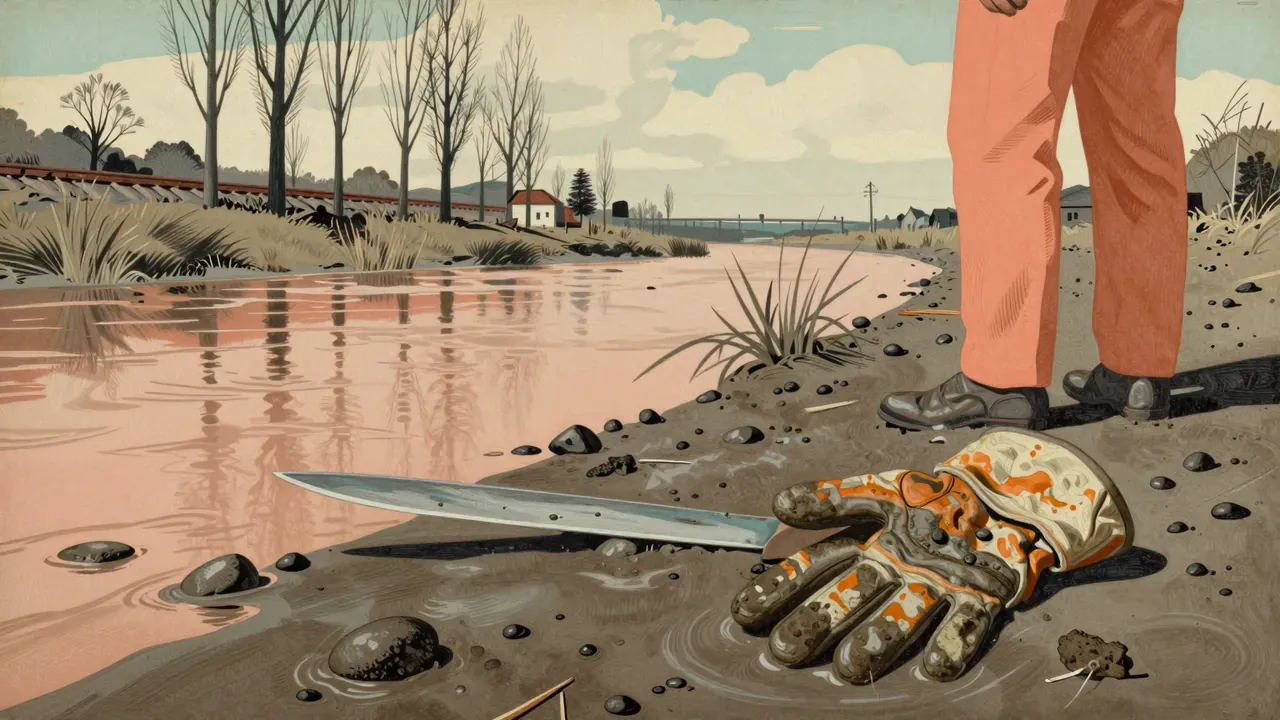
The Woman in the Dunes is a Japanese drama film that adapts Kōbō Abe’s 1962 novel into a tightly controlled, physically grounded allegory. It does not aim to entertain or explain, but to immerse the viewer in an inescapable material reality — sand, heat, thirst, slope — and use that reality to test assumptions about freedom, labour, consent, and self-determination. Its method is not symbolic decoration but structural repetition: shovelling, sliding, falling, rising, failing, adapting. It treats the dune not as backdrop but as agent — a slow, indifferent force that reshapes perception through sheer physical persistence. The film belongs to no genre convention beyond ‘drama’, yet it operates with the rigour of a philosophical experiment: isolate one man, one woman, one pit, one task, and observe what remains when all social scaffolding is removed. It makes no claim to realism in the documentary sense, but insists on tactile authenticity — every grain of sand, every rope fibre, every bead of sweat is rendered with forensic attention. This is not metaphor dressed as story; it is story made from the weight of matter. (158 words)
The weight of it
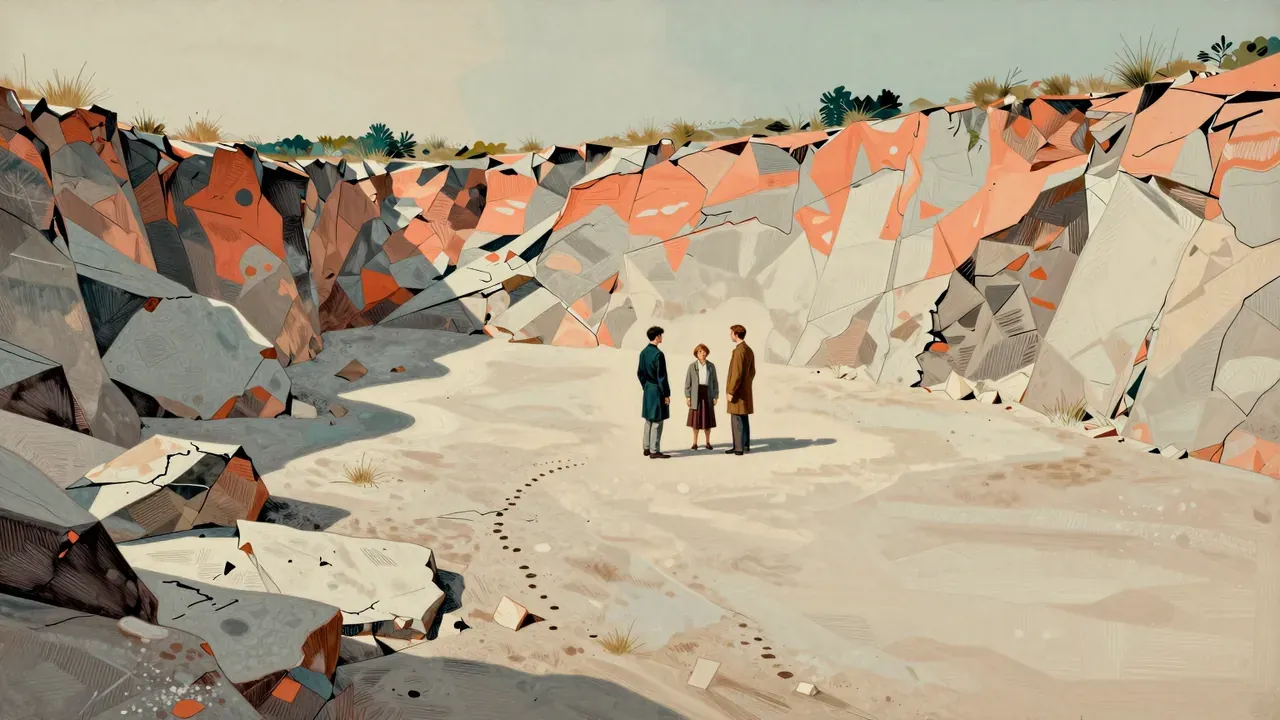
The plot follows Niki Junpei, an entomologist who descends into a sand pit and cannot climb out. Eiji Okada plays him with restrained agitation — his frustration is in his shoulders, his impatience in his hands, his resignation in the slackening of his jaw. Kyōko Kishida’s widow is quieter, less legible: her gestures are economical, her silences dense with unspoken history. Hiroshi Segawa’s cinematography keeps the frame low and tight, often shooting from inside the hut or just above the sand line, so the dune looms like a wall rather than a landscape. Tōru Takemitsu’s score avoids melody; instead, it uses percussive scrapes, breath-like pauses, and sudden metallic stabs that mimic the sound of shovel on grit. The editing refuses relief — no cutaways, no establishing shots once Junpei is trapped. Even the rope ladder appears only in fragments: a coil, a shadow, a hand gripping it. Every craft choice reinforces enclosure. There are no flashbacks, no voiceover, no exposition beyond what the characters say or do. The village elder, played by Kōji Mitsui, speaks little and never explains. His authority is in his stillness, his timing, his refusal to meet Junpei’s eyes. (159 words)
The rhythm of it
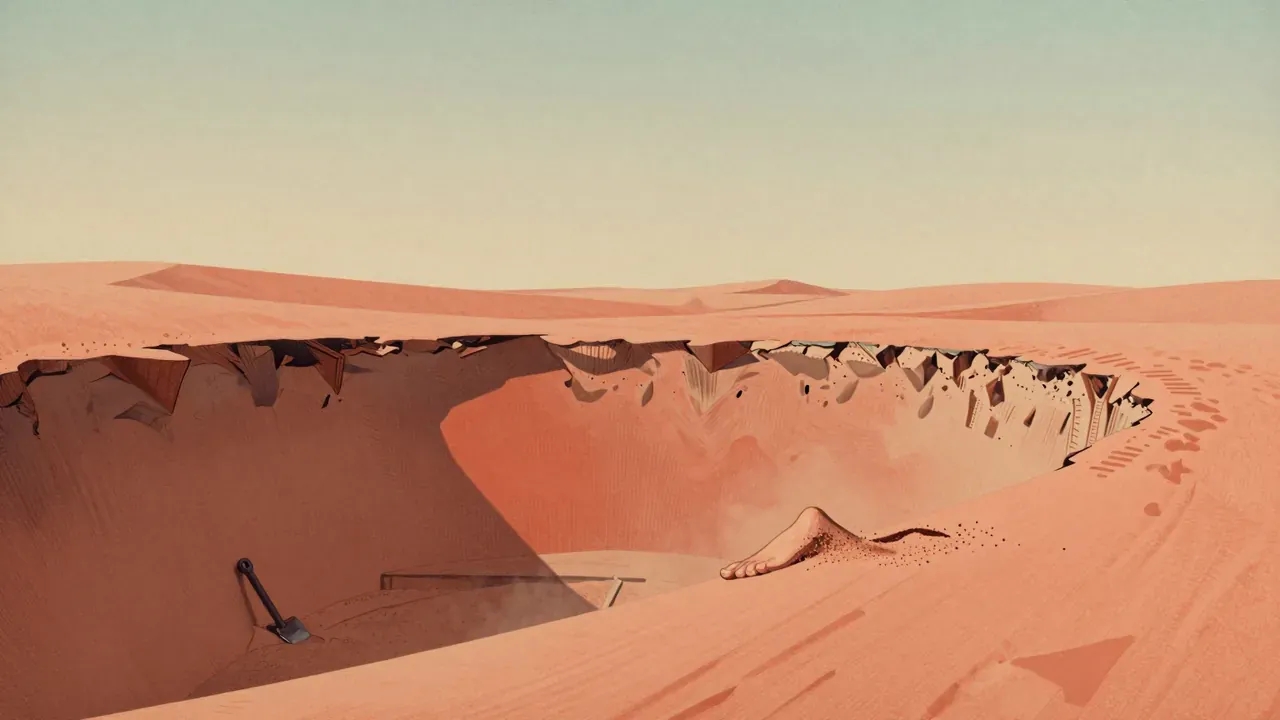
What lands is the suffocating physicality of the sand — not as setting but as antagonist, collaborator, and timekeeper. The camera holds on shovels biting into loose dunes, on feet sinking and dragging, on sweat drying instantly in the sun then reappearing as fresh beads. The rhythm of digging becomes hypnotic, then unbearable, then necessary. The shift from resistance to routine feels earned because it is shown in increments: first Junpei refuses to lift a shovel, then he lifts it reluctantly, then he measures the depth of each scoop, then he adjusts his stance for efficiency. The love between Junpei and the widow does not arrive as romance but as shared exhaustion, mutual observation, quiet complicity. When he discovers capillary water extraction, the moment is not triumphant but weary — a small, practical victory that changes nothing but everything. The final decision to return to the pit is not mystical or sentimental; it is presented as a minor, almost bored gesture — he walks down the ladder without hesitation, as if returning to a room he has already claimed. The film lands because it trusts the audience to follow logic, not emotion, and because its logic is built from repeated, verifiable actions. (157 words)
The gaps in it
What does not land is any attempt to read the film as psychological realism. Junpei’s initial arrogance and later submission are not developed through interior monologue or backstory but through behaviour — which works, until the script asks us to accept shifts in motivation without visible cause. His violent attempt to force himself on the widow, for instance, arrives without sufficient build-up in his character arc or in the film’s own behavioural grammar. Similarly, the villagers’ collective cruelty lacks texture: they are faceless, voiceless except in chorus, functioning more as environmental pressure than people. Their motives — economic, social, punitive — remain opaque, and the film declines to clarify them, which risks reducing them to narrative devices rather than participants in the same system. The black-market cement detail is mentioned once and never revisited, leaving its moral or logistical weight unexplored. The film’s refusal to explain can feel like evasion when it crosses into omission — particularly around power structures beyond the pit. It assumes the viewer will supply context about postwar Japanese rural life, class, or gender roles; without that knowledge, some tensions flatten into abstraction. A viewer expecting social critique may find the film too contained; one seeking existential clarity may find it too stubbornly mute. (159 words)
The work in it
The themes that matter are endurance, adaptation, and the erosion of distinction between constraint and condition. It asks what freedom means when choice is reduced to variations of repetition — dig now or dig later, dig alone or dig with her, dig to survive or dig to understand the sand. It treats labour not as exploitation or dignity but as the primary medium through which identity forms and dissolves. The dune is not a metaphor for society, but for the conditions that make society possible — shifting, unstable, requiring constant maintenance. Time is not linear but cyclical: night brings damp sand and water; day brings heat and slide; rain brings collapse and renewal. The film resists binary readings — captivity is not pure oppression, nor is resignation pure defeat. Even the police report at the end is not irony but punctuation: seven years is not tragedy but duration, a unit of measurement like a bucketful of sand. The film’s central concern is not whether Junpei escapes, but whether escape remains a meaningful category once the terms of existence have changed. It treats human nature not as fixed essence but as responsive surface — shaped by what it touches, what it resists, what it absorbs. (156 words)
The patience of it
This film is for viewers who tolerate long takes, minimal dialogue, and physical repetition as narrative tools — those who watch sand settle and find meaning in its fall. It suits readers of Beckett or Camus, fans of Tarkovsky’s pacing, or anyone who values craft over exposition. It is not for those who require clear motivation, emotional catharsis, or resolution that names itself. People who dislike ambiguity, distrust silence, or expect character arcs to follow cause-and-effect logic will find it withholding, even punitive. Some critics argue its austerity borders on didacticism; others say its refusal to name its themes is its greatest strength. A viewer who values thematic clarity over sensory immersion would reasonably reject it — but that verdict would change only if the film were recut to include explanatory scenes, which would break its central premise. Its value lies precisely in its refusal to translate experience into explanation. To ask it to do so is to misunderstand its method. (159 words)
The settling of it
Yes, it is worth your evening — provided you watch it undistracted, in one sitting, and without expectation of payoff beyond attention itself. Its 123 minutes pass slowly but never inertly; the tension is in the body, not the plot. You will not leave with answers, but with residue: the memory of light on dry sand, the sound of a shovel scraping bedrock, the weight of a rope ladder pulled just out of reach. It rewards patience not with reward but with recalibration — after it ends, stairs feel steeper, dust motes linger longer in sunlight, silence carries more texture. Those who dismiss it as ‘cold’ or ‘remote’ are not wrong, but their verdict depends on valuing warmth over precision, empathy over observation. That preference is valid — but it does not diminish the film’s achievement. Its worth is not in what it gives, but in what it refuses to give, and why. To watch it is to accept an invitation to inhabit uncertainty, not solve it. (158 words)