The weight of the day
Winter Light is a chamber drama in three acts, structured like a piece of music and set almost entirely inside or around a rural Swedish church. It attempts to dramatise the collapse of religious certainty—not as a philosophical debate, but as a physical, vocal, and moral failure in real time. Bergman wrote it after speaking to a clergyman whose parishioner killed himself; the film follows Pastor Tomas Ericsson through a single day in which he fails every person who seeks him—first Jonas Persson, then Märta, then Algot—and finally fails himself. It is not about doubt as abstraction, but about the exhaustion of performing faith when belief has already left the room. The screenplay was completed on 11 August 1961; Bergman shared it with his father, a Church of Sweden minister, and named the protagonist ‘Ericsson’—a deliberate echo. This is not a film about God’s absence so much as about the silence that remains when the last person stops pretending to hear Him. It is the second part of a triptych beginning with Through a Glass Darkly and ending with The Silence, but it stands apart by refusing consolation, narrative symmetry, or even tonal resolution. (158 words)
The look of it
The story unfolds in tight, unbroken sequences: a sparse service, a failed pastoral visit, a letter read aloud in silence, a suicide, a hollow drive, a final empty chapel. Sven Nykvist’s cinematography keeps the light low and flat, using reflectors to soften shadows without warming the image—interiors feel damp, not dim. Ulla Ryghe’s editing avoids rhythm or punctuation; cuts land like breaths caught mid-sentence. Gunnar Björnstrand plays Tomas with a voice thickened by cold and conviction eroded by habit; Ingrid Thulin’s Märta speaks with precise, unadorned diction, her love never theatrical, only persistent. Max von Sydow appears briefly as Jonas, his face slack with dread, not despair. There are no flashbacks, no music beyond diegetic organ, no visual metaphors beyond what the church architecture provides: narrow windows, worn pews, a crucifix seen from below. Bergman shot in Skattunge kyrka’s vicinity but built the interior set with a roof—so the light could be controlled, and the actors’ voices would not echo. The pacing is slow not for effect but because the emotional work is heavy: the scene where Märta first comforts Tomas took eleven takes. This is craft used to hold space for failure, not to ornament it. (159 words)
The silence between notes
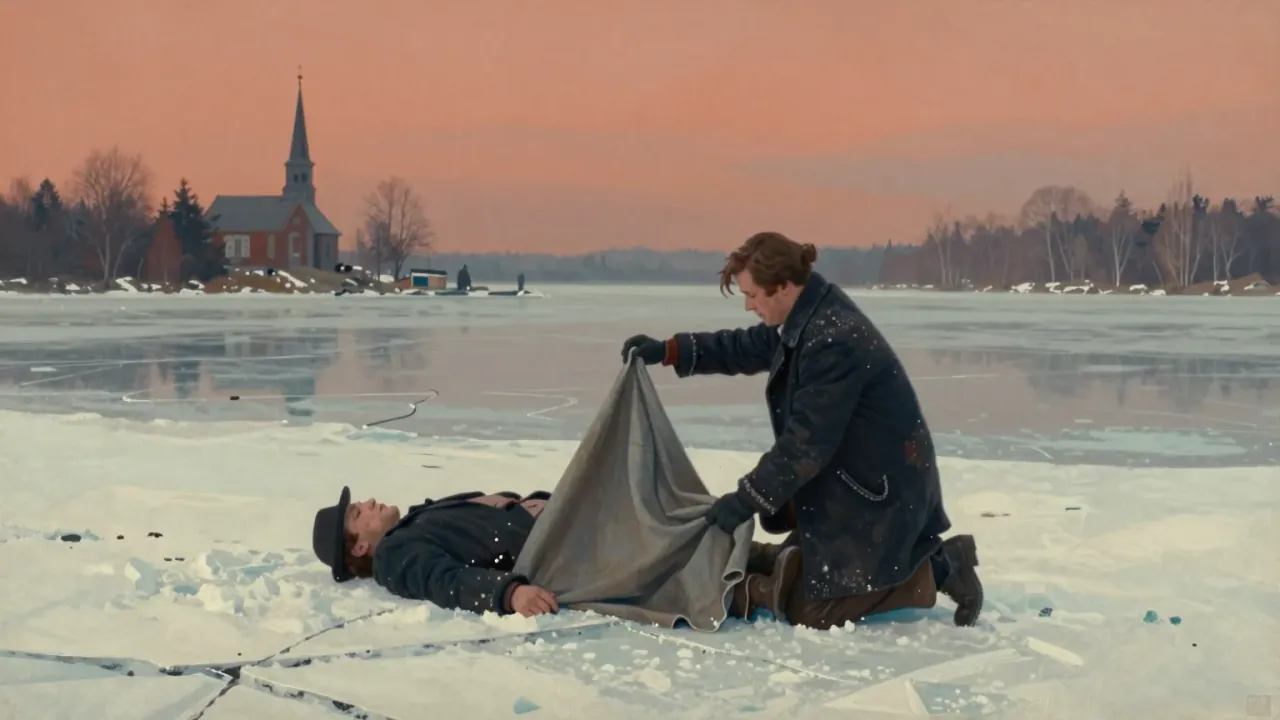
What lands is the weight of silence—not as absence, but as accumulation. When Tomas tells Jonas he has no faith, the line does not arrive with drama but with relief, as if he has been holding his breath since the opening hymn. The camera stays close, not to heighten emotion but to register its depletion: Björnstrand’s eyes do not glisten, his throat does not tighten, he simply stops speaking and looks away. Märta’s embrace after his confession is not met, and the refusal is more devastating than any outburst. The film’s austerity works because it refuses to flatter its characters—or its audience. Even the suicide is shown peripherally: Tomas covers the body with a tarp, then drives off without comment. The organ music, sourced from Bach’s Cello Suite No. 2, was abandoned as ‘contrived’, and the decision holds: the silence between notes matters more than the notes themselves. The final conversation in Märta’s classroom feels less like a climax than a diagnostic report—Tomas names his cruelty plainly, and she accepts it. There is no redemption, no insight, no turning point. What lands is the honesty of that refusal: this is how spiritual exhaustion sounds, looks, and moves. (157 words)
The shape of the argument
What does not land is the structural ambition to mirror chamber music. The three-act shape is visible but not felt; the transitions lack the internal logic of musical development—there is no motif, no variation, no recapitulation. The film’s intellectual scaffolding—the critique of the Church of Sweden, the spider-God motif from Through a Glass Darkly, the Cold War dread over China’s nuclear programme—remains external to the performances. These ideas are present, but they do not animate the scenes. Algot’s question about the Passion, posed late in the film, arrives without preparation: his rheumatism is grounded (Allan Edwall was coached by K.A. Bergman, who had ankylosing spondylitis), but his theological inquiry floats, unmoored from earlier exchanges. Similarly, Tomas’s Lisbon memory is delivered as exposition, not memory—no image, no sound, no texture to anchor it. The film’s rigour sometimes becomes rigidity: the refusal of music, of flashbacks, of expressive lighting, serves the theme but also starves the senses. A viewer expecting psychological texture may find the surfaces too smooth, the silences too uniform. Bergman judged the shoot slower than usual, but the slowness does not always translate into depth—it can settle into stasis. (159 words)
The machinery of belief
The themes that matter are not faith versus doubt, but the ethics of care under scarcity—spiritual, emotional, and physical. Tomas is tired, ill, and isolated; his failures are not moral lapses but systemic ones: the church offers no infrastructure for pastoral crisis, Märta has no community outside him, Jonas has no language for existential terror beyond atomic bombs. Bergman’s criticism of the Church of Sweden is embedded in its emptiness: the second church is deserted except for Algot and Fredrik, and even their presence feels procedural, not communal. The film treats religion not as doctrine but as practice—and shows how easily practice collapses when belief evaporates. The recurring image is the crucifix, seen from below, its arms stretched wide but offering no shelter. This is not nihilism, but a diagnosis: when meaning is no longer assumed, what remains is the responsibility to speak truthfully—even if that truth is indifference, exhaustion, or contempt. The film’s secularism is not hostile but clinical: it watches what happens when the machinery of belief runs down. Christianity here is not a set of answers, but a set of habits—and habits persist long after the reason for them has gone. (156 words)
Who it is for
This film is for viewers who value precision over persuasion, who find clarity in restraint, and who do not require narrative closure to feel engaged. It suits those familiar with Bergman’s other work—or with Bresson’s Diary of a Country Priest, which Bergman cited as influence—because its rhythms assume patience with stillness and trust in subtext. It is not for viewers who rely on performance cues—Björnstrand’s muted delivery, Thulin’s quiet persistence—to signal emotional stakes; nor for those who expect thematic development to unfold through dialogue rather than omission. Someone who finds Through a Glass Darkly emotionally overwhelming may find Winter Light emotionally withholding. A viewer seeking catharsis or moral resolution will leave unsatisfied: the film ends not with transformation but with repetition—Tomas drives again, alone, after failing again. Change the verdict? Only if the film were less rigorous—if it allowed music, or flashback, or a single moment of warmth—but that would make it a different film, not a better one. (158 words)
Is it worth your evening
Yes, it is worth your evening—if you are prepared to sit with discomfort without resolution. Its eighty-one minutes pass slowly not because they are dull, but because they refuse to compress experience into convenience. The film asks for attention, not empathy; it rewards scrutiny, not identification. Someone who watches for plot will find little; someone who watches for texture will find it in the grain of Nykvist’s light, the rasp in Björnstrand’s voice, the way Thulin’s hands rest on a desk without fidgeting. It is not a film to be enjoyed, but one to be reckoned with—like reading a medical report on your own condition. Those who dislike it tend to cite its austerity as coldness, its brevity as insufficiency; they are not wrong, but their objection names the film’s design, not its flaw. A different verdict would require a different film—one with hope, or music, or a third act that offers repair. Winter Light offers none of those. It offers, instead, the clarity of a diagnosis. That clarity is rare. That rarity makes it worth the time. (158 words)