The premise of it
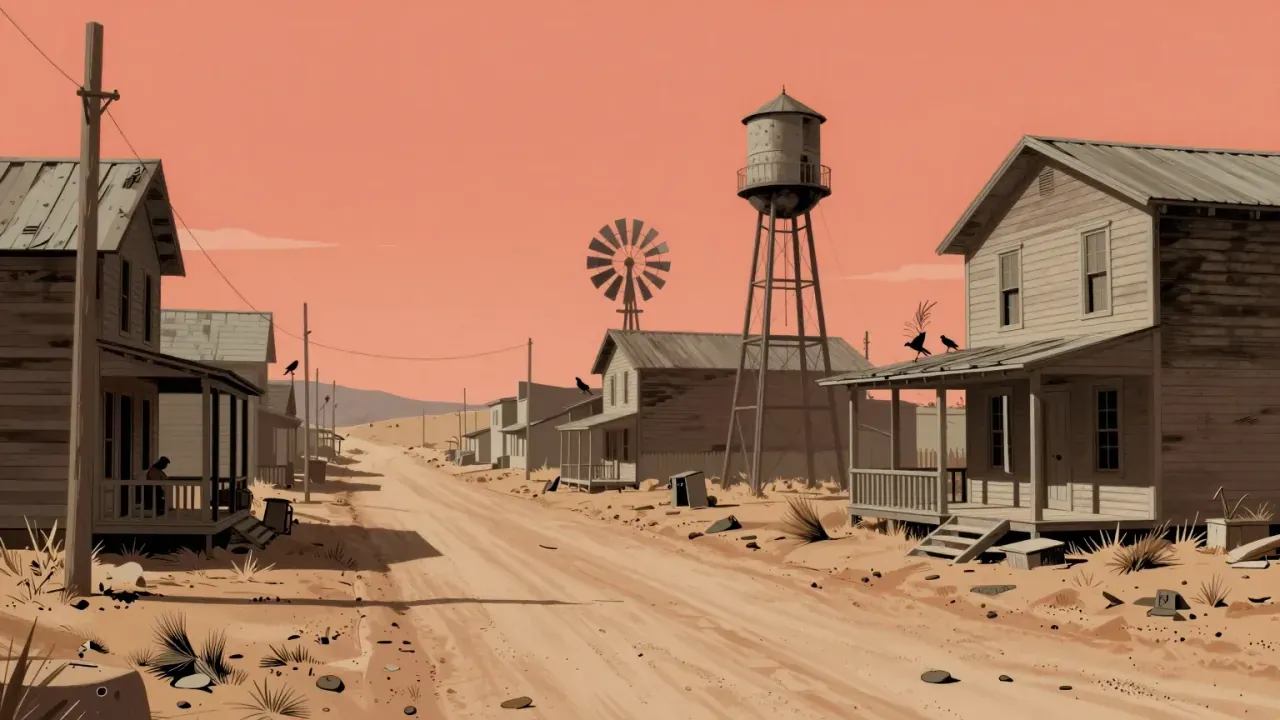
Dead Man is a monochrome western set in the late nineteenth-century American frontier, written and directed by Jim Jarmusch. It follows William Blake, an Ohio accountant who arrives in the company town of Machine only to find his job gone, his life unraveling, and himself fatally wounded in a botched confrontation. The film positions itself as an ‘acid western’ — not a genre parody but a deliberate dislocation: it uses western iconography while rejecting its foundational myths — progress, conquest, individual redemption through violence. Jarmusch replaces linear causality with ritual, recurrence, and poetic logic. The narrative arc is less about survival than transition: Blake’s journey west is not geographic but ontological, from settler consciousness toward dissolution into landscape and spirit world. The film insists on Native epistemology not as backdrop or moral counterpoint, but as structural principle — untranslated Cree and Blackfoot dialogue, Nobody’s layered history, and the refusal of explanatory exposition all serve that aim. It is not a critique of the western so much as a reconstitution of its grammar using different syntax and untranslatable terms.
The look of it
The story unfolds in measured, often silent episodes, paced like breaths between gunshots. Johnny Depp plays Blake with minimal inflection — a vessel rather than a character — while Gary Farmer’s Nobody carries the film’s intellectual and spiritual weight, shifting between wry detachment, fierce tenderness, and sorrowful clarity. Robby Müller’s cinematography renders the Pacific Northwest in high-contrast black-and-white, favouring deep shadow and flat light; interiors are dense with texture, exteriors vast and indifferent. Neil Young’s score — improvised live while watching rough cuts — is raw, atonal, and physically present: guitar feedback mimics wind, distortion stands in for gunfire, silence becomes rhythmic punctuation. Jay Rabinowitz’s editing avoids conventional continuity, holding shots until they tip into unease or reverence. Performances avoid psychological realism: Crispin Glover’s twitching, Iggy Pop’s hollow-eyed preacher, Robert Mitchum’s final, gravel-voiced cameo — all function as glyphs, not people. There is no music cue to signal emotion, no close-up to confirm intention. Every choice resists interpretation, demanding attention instead of empathy.
The rhythm of it
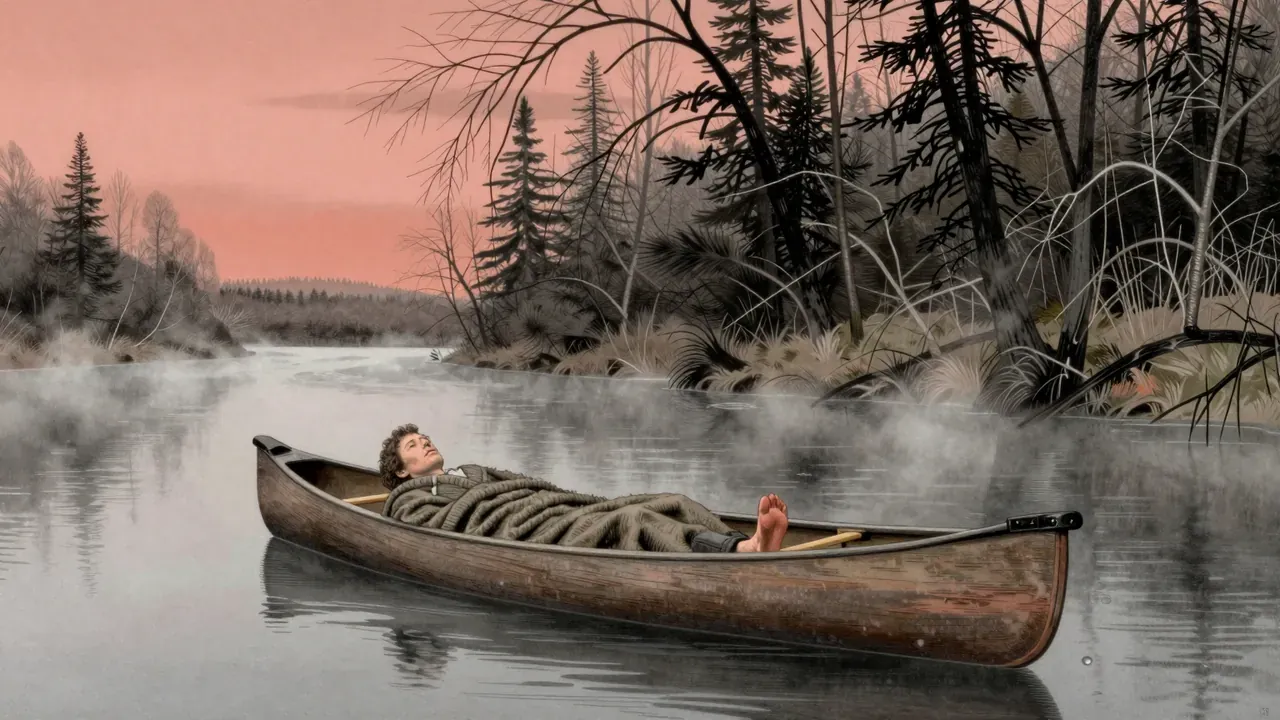
What lands is the film’s unwavering commitment to its own logic. The monochrome palette does not evoke nostalgia but erasure — of colour, of certainty, of historical linearity. Nobody’s backstory, delivered without sentiment or exposition, lands with quiet force: his abduction as a child, his rejection by both white and Indigenous worlds, his renaming as Xebeche — all register not as trauma tropes but as lived conditions of displacement. The visual motif of blood — on Thel’s dress, the fawn’s flank, Blake’s face — gains cumulative resonance, linking violation, sacrifice, and sacrament without explanation. Neil Young’s soundtrack works not as accompaniment but as parallel narration: when his guitar sustains a single note over three minutes of Blake walking, the duration itself becomes meaning. The Makah canoe burial sequence lands with solemn precision — no music swells, no voiceover interprets; the image of Blake adrift, eyes open, is neither tragic nor triumphant but terminally calm. These moments succeed because they refuse to resolve, trusting the viewer to sit within their ambiguity rather than decode it.
The weight of it
What does not land is the film’s reliance on literary reference as structural scaffolding. The William Blake allusions — recited, namedropped, visually echoed — remain ornamental rather than integrated: the poetry feels pasted on, not woven in. When Nobody quotes ‘Auguries of Innocence’, it reads as citation, not conviction. The film assumes familiarity with Blake’s work, yet offers no internal logic to make those lines resonate beyond name recognition. Similarly, the 20th-century cultural references — Benmont Tench, George Drakoulias, Lee Hazlewood — function as private jokes that exclude more than they include, adding texture without thematic weight. Some performances falter under the film’s austerity: Michael Wincott’s sneering industrialist lacks dimension beyond caricature, and Lance Henriksen’s bounty hunter feels stranded between menace and absurdity without grounding. The pacing, while deliberate, occasionally stalls into inertia — a long static shot of mist over water may invite contemplation, but repeated without variation, it begins to feel like delay rather than design. These elements do not collapse the film, but they do leave gaps where cohesion should be.
The thinking of it
The themes that matter are mortality as process, not event; language as boundary and bridge; and colonialism as a condition of perception, not just policy. Blake’s wound is never healed or fatalised — it simply persists, altering his relation to time and sensation. Nobody’s insistence on speaking Cree and Blackfoot untranslated asserts linguistic sovereignty: meaning resides not in translation but in retention. The film treats settler language — English — as inherently inadequate, even violent: Dickinson’s threats, the preacher’s dogma, the marshals’ boasts all sound hollow, performative, brittle. In contrast, Nobody’s silences carry density, his gestures — lighting a pipe, placing a stone — operate as syntax. The film also treats landscape not as setting but as participant: forests breathe, rivers remember, animals witness. This is not mysticism as escape but as accountability — a worldview in which consequence is ecological, not karmic. The central tension is not man versus nature, but one mode of knowing versus another, with the film refusing to arbitrate, only to hold both in sustained, unblinking view.
The watching of it
This film is for viewers who value atmosphere over exposition, who tolerate silence as substance, and who approach cinema as a practice of attention rather than consumption. It rewards patience, discomfort, and willingness to sit with unresolved tension. It is not for those who require narrative propulsion, emotional cues, or psychological coherence — viewers expecting a western with clear stakes, moral arcs, or catharsis will find it alienating. Those who dislike monochrome cinematography, extended takes, or non-diegetic guitar noise will not warm to it. Its pace and abstraction also make it unsuited to distracted viewing: it demands full presence. A viewer who values Jonathan Rosenbaum’s description of it as ‘exciting and important’ may still find its rigour exhausting. What would change the verdict? A tighter edit — trimming ten minutes — would sharpen its focus without sacrificing its meditative quality. But its current form is intentional, not flawed; its difficulty is part of its argument.
The staying of it
Yes, it is worth your evening — provided you approach it on its own terms. It is not entertainment in the conventional sense, nor is it a test of endurance; it is an invitation to recalibrate perception. Two hours spent with Dead Man alters how you see light, hear silence, and understand time — not through instruction, but through sustained immersion in its logic. It repays rewatching not to decode but to deepen: each viewing reveals new textures in Müller’s shadows, new weight in Farmer’s pauses, new resonance in Young’s feedback. Those who dismiss it as pretentious miss its humility — it makes no claim to truth, only to consistency. Others may find its stillness oppressive, its references exclusionary, its ending emotionally withholding. But its power lies precisely there: it refuses to soothe, explain, or conclude. If your evening permits slowness, if you trust images before words, if you can sit with ambiguity without reaching for resolution — then this film earns its duration fully.