The boy and the dog
Bim is a forty-five-minute French drama from 1950, written by Jacques Prévert and Albert Lamorisse and directed by Lamorisse. It is not a feature but a compact, self-contained narrative film — neither documentary nor animation nor short subject in the anthology sense, though its runtime places it near those categories. It attempts something precise: to trace the emotional and moral weight of a child’s attachment to a dog in post-war rural France, using that bond as a lens on loyalty, loss, and quiet social constraint. There is no exposition beyond what the images and actions supply; the film does not explain its world but assumes familiarity with its textures — the stone walls, the narrow lanes, the unspoken hierarchies of village life. Its ambition is modest in scale but exacting in tone: to hold still long enough for a single relationship to register as both ordinary and irreplaceable. It makes no claim to universality, yet its restraint invites attention not to what is said but to what remains unsaid between characters, and between frames. The film’s form is inseparable from its purpose — every cut, every pause, every silence serves the gravity of that central attachment.
How it holds still
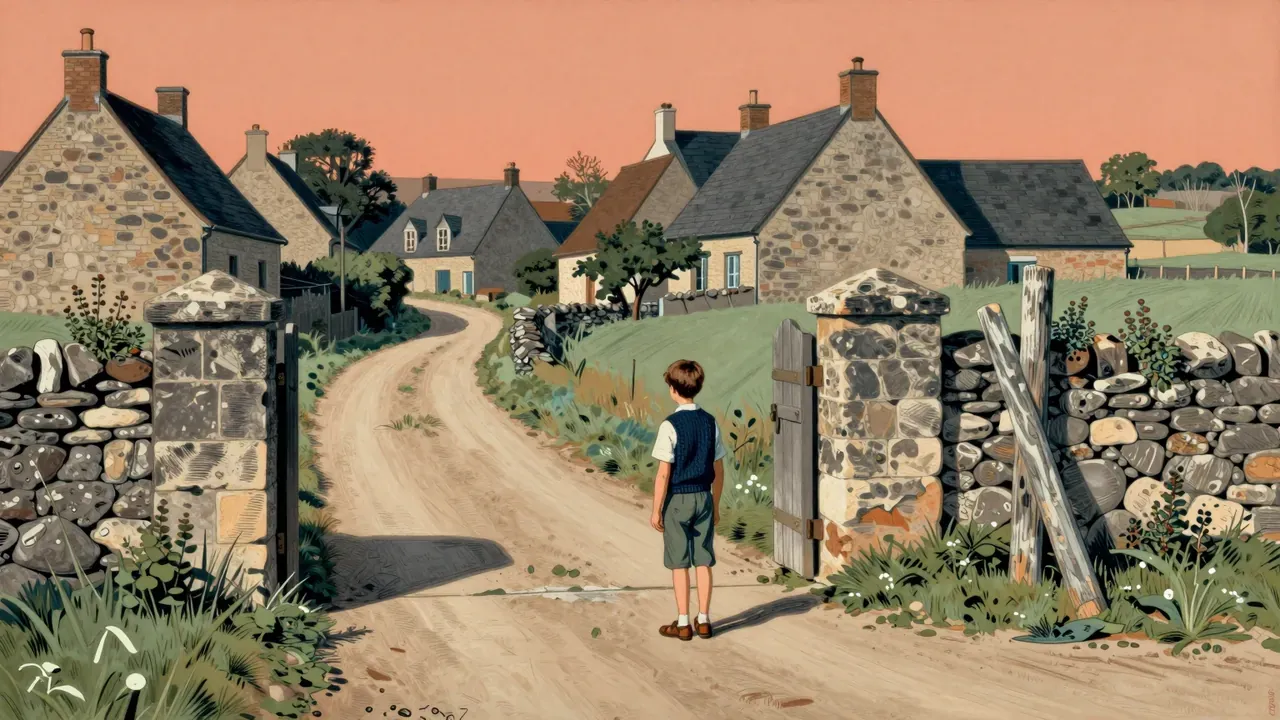
The story follows a boy named Bim and his dog, also named Bim, in a provincial French village where adults move with weary practicality and children inhabit a parallel world of unguarded feeling. Jacques Prévert’s script avoids sentimentality by refusing to name the dog’s fate outright; instead, it lets the boy’s behaviour — his repetition of routines, his avoidance of certain paths, his silence at meals — carry the weight of absence. Albert Lamorisse directs with a stillness that borders on ritual: compositions are balanced but never symmetrical, light is natural and often low, and camera movement is rare and deliberate. There are no professional actors credited, and the performances read as observed rather than performed — the boy’s gestures feel unmediated, his pauses unscripted. The sound design, though undocumented in the fact sheet, functions as a quiet counterpoint: ambient village noise is present but never intrusive, and music is absent. Editing is sparse, favouring duration over rhythm — a shot of the boy standing at a gate may last twelve seconds without cut or variation. This is not minimalism for effect, but economy as ethics: nothing is added that does not serve the boy’s inner state.
What stays in the frame
What lands is the cumulative pressure of small, unremarkable moments: the boy’s hand resting on the dog’s head before school, the way he stops walking when he reaches the spot where the dog used to wait, the way he arranges two bowls side by side at dinner even after the dog is gone. These details do not build to a climax but accrue like sediment, giving the film its quiet authority. The absence is felt not through flashbacks or voiceover but through the boy’s physical recalibration to a world that has shifted beneath him. Lamorisse and Prévert trust the viewer to notice the difference between a gesture made with presence and one made in memory — and they are right to trust. The film’s power resides entirely in this fidelity to behavioural truth: how grief lives in posture, in hesitation, in the refusal to look directly at an empty space. There is no score to cue emotion, no close-up to demand it; the film earns its resonance by withholding, not amplifying. That restraint feels earned, not evasive — a choice rooted in observation, not abstraction.
Where it looks away
What does not land is any attempt to locate the film within a broader social framework. Though set in post-war France, the village feels suspended outside history: there is no reference to rationing, reconstruction, or political change, nor any visible sign of economic strain or ideological tension. The adults remain opaque — not mysterious, but underwritten — their motivations reduced to functional roles: the father who gives instructions, the mother who serves food, the neighbour who offers mild concern. Without deeper context, their distance from the boy’s grief begins to read less as realism and more as narrative neglect. A viewer attuned to class or generational conflict may find the film’s silence on those matters frustrating, not poetic. Similarly, the dog’s disappearance lacks causal clarity: it is implied but never confirmed, and the lack of resolution risks drifting into ambiguity for its own sake. For some, this will feel like discipline; for others, like evasion — a refusal to engage with the very real consequences that shape such a loss in a place where animals are labour, not companions.
The shape of loyalty
The themes that matter are attachment as identity, silence as language, and the asymmetry of mourning — how deeply a child can grieve what adults treat as incidental. The film treats the dog not as symbol but as co-protagonist: its presence defines the boy’s daily geography, his sense of safety, his understanding of reciprocity. When the dog vanishes, the boy does not seek answers but relearns the world’s contours without it — a process the film charts with forensic patience. Closely tied is the theme of unspoken transmission: how values, fears, and boundaries pass between generations not through speech but through repetition, omission, and shared space. The village itself becomes a quiet antagonist — not hostile, but indifferent, its rhythms continuing regardless of private rupture. There is also a subtle meditation on naming: the boy and dog share a name, suggesting equivalence, but the film never resolves whether this is affection, accident, or assertion of parity. These themes do not announce themselves; they settle in the gaps between shots, in the length of a glance held too long, in the weight of a bowl left untouched.
Who it waits for
This film is for viewers who value precision over exposition, who find emotional weight in duration rather than dialogue, and who accept that some losses resist narrative closure. It suits those accustomed to mid-century French arthouse cinema — not as spectacle but as sustained attention. It is not for viewers who require psychological explanation, causal clarity, or character development measured in arcs rather than absences. Those expecting social critique, historical texture, or even conventional dramatic stakes may leave impatient or unmoored. A teacher using it in a film studies class might need to scaffold its silences; a casual viewer seeking narrative propulsion will likely feel stranded. Its value depends on willingness to sit with uncertainty — not as a puzzle to solve, but as a condition to inhabit. That willingness is not universal, and the film makes no effort to persuade otherwise.
What it costs
It is worth your evening if you approach it as a study in restraint — not as entertainment but as calibration. Forty-five minutes is brief, but the film asks for full attention, not background consumption. Its rewards are cumulative and quiet: the way a repeated gesture gains meaning across viewings, the way its stillness sharpens perception of your own surroundings afterwards. It is not ‘enjoyable’ in the usual sense, but it lingers — not because it shocks or charms, but because it refuses to simplify what it observes. Those who dislike ambiguity or demand narrative resolution will find it unrewarding, and rightly so; the film’s integrity lies in its refusal to accommodate them. Its worth is not absolute but conditional: it repays attention only if you meet it on its terms — which are few, exact, and unwavering.