The shape of fate
Underworld is a 1927 silent crime film that sets out to frame urban criminality not as social reportage but as mythic tragedy. It does not aim to explain gangsterism through economics, policing or Prohibition-era conditions; instead, it treats its underworld as a self-contained realm governed by fate, loyalty and fatal misjudgement. Josef von Sternberg, newly reinstated at Paramount after two failed projects, uses the assignment not to chase realism but to impose a stark, stylised order — one where light falls with deliberation, gestures carry weight, and moral ambiguity is rendered in shadow rather than exposition. The film’s ambition is formal and psychological: to condense the arc of a doomed man into ninety minutes without recourse to dialogue, relying instead on composition, rhythm and the physical presence of its leads. It is less concerned with how crime works than with how a man like ‘Bull’ Weed might be undone by love, pride and the quiet betrayal of time itself. Word count: 138.
The weight of a glance
The story follows ‘Bull’ Weed’s patronage of the fallen lawyer ‘Rolls Royce’ Wensel, their bond fraying under the pressure of shared affection for Feathers McCoy. George Bancroft’s Bull is all coiled stillness and sudden violence; Clive Brook’s Rolls Royce moves with the weary precision of a man who has already lost everything but hasn’t yet accepted it. Evelyn Brent’s Feathers is neither moll nor muse — she acts, chooses, hesitates, and her face registers consequence before action arrives. Bert Glennon’s cinematography avoids expressionist distortion: interiors are shallow, streets are narrow and rain-slicked, faces are lit from below only when power shifts. There are no montages of newspaper headlines or police raids; tension builds through duration — a held glance, a delayed cut, a door left ajar. The editing by E. Lloyd Sheldon sustains this tempo, refusing punctuation where silence serves better. Howard Hawks and Robert N. Lee’s script tightens Hecht’s original story into a series of decisive, almost ritualistic encounters — the flower shop ambush, the courtroom silence, the final train platform — each stripped of ornament. Word count: 152.
The strength of silence
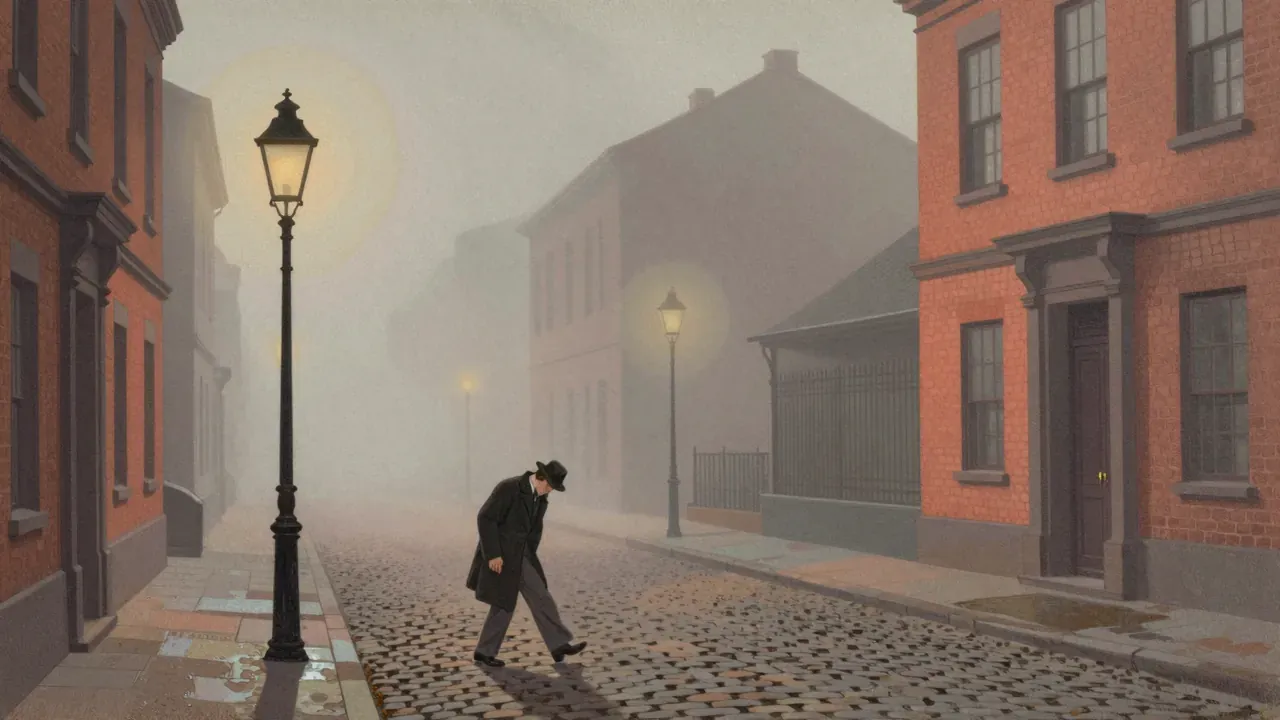
What lands most decisively is the film’s sense of gravity. Its characters move as if weighed down by inevitability, not circumstance — a quality that emerges from Sternberg’s direction, Glennon’s lighting, and the cast’s refusal to underline emotion. The opening sequence, where Rolls Royce stumbles through a fogged city street before being drawn into Bull’s orbit, establishes tone without exposition: disorientation, then absorption, then slow entanglement. The ballroom scene — all sharp tuxedos, laughing faces and looming mirrors — works because it feels like a dream one cannot wake from, not because it is visually extravagant. Even minor figures register: Fred Kohler’s Buck Mulligan is menacing not through bluster but through stillness and proximity; Helen Lynch’s Meg carries grief like a second coat. The film’s restraint makes its moments of rupture — a pistol shot, a slammed door, a single tear — land with physical force. Its power lies in what is withheld: no backstory is given, no motive over-explained, no redemption offered. That economy remains persuasive nearly a century later. Word count: 149.
Where the thread frays
What does not land is the film’s attempt to position Feathers and Rolls Royce’s dilemma as morally complex. Their final hesitation — whether to flee together while Bull faces execution — reads less as anguish than as narrative drift. The film gives them agency earlier, but abandons psychological continuity in its closing stretch, falling back on silent-era convention: a last-minute rescue, a gesture of sacrifice, a fade that asks for pathos without earning it. The courtroom sequence, though formally striking, lacks procedural weight — the judge is a silhouette, the verdict unspoken, the legal machinery absent. Similarly, the rival gang’s threat never acquires texture; Buck Mulligan functions more as a plot device than a counterweight. Sternberg’s disinterest in the mechanics of power leaves some relationships under-anchored: the nature of Bull and Feathers’ bond, for instance, remains opaque, sustained only by glances that may signify possession, habit or something quieter. These gaps do not undermine the film’s stature, but they do limit its emotional reach beyond its central triad. Word count: 150.
The laws beneath the law
The themes that matter are not those of crime or class but of sovereignty and surrender. Bull Weed is not undone by the law or rivals but by his own certainty — that he controls his world, his woman, his protégé. His downfall begins not with arrest but with the moment he stops watching Feathers’ face. The film treats loyalty as a form of blindness, love as a kind of debt, and fate as indifferent architecture: the city’s alleys, stairwells and train platforms are not settings but structures of destiny. There is no social critique here — no indictment of Prohibition, no nod to immigrant marginalisation — only a study of how personal codes collapse when tested against desire. Sternberg’s framing reinforces this: characters are often shot from low angles not to glorify them but to show how little room they have to move. Even the title Underworld refers less to organised crime than to a psychic stratum — a place beneath speech, beneath reason, where decisions are made in the body before the mind catches up. Word count: 146.
The terms of engagement
This film is for viewers who value composition over exposition, mood over momentum, and silence over speech — particularly those already familiar with silent-era grammar or Sternberg’s later work with Dietrich. It rewards patience with texture: the grain of a suit jacket, the way light pools on a tabletop, the weight of a pause before a handshake. It is not for those who require clear cause-and-effect plotting, psychological explanation, or narrative propulsion — the film’s pacing assumes familiarity with elliptical storytelling, and its emotional logic operates outside cause-and-effect chains. Anyone expecting the kinetic drive of Little Caesar or the social grit of The Public Enemy will find it inert. A viewer who dislikes long takes, minimal intertitles or unresolved moral questions would likely disengage early. What would change this verdict? A different score — Robert Israel’s music, while evocative, was composed decades later and sometimes smooths over the film’s jagged edges. A contemporary score, or none at all, might sharpen its austerity. Word count: 149.
The measure of its worth
Yes, it is worth your evening — but only if you watch it as a sculptural object, not a story engine. Its 105 minutes unfold with the deliberation of a clockwork mechanism: every shot calibrated, every performance measured, every cut placed to sustain tension rather than release it. You will not leave with answers, but with impressions — the curve of a fedora brim, the echo of footsteps on stone, the way Bancroft’s eyes narrow just before violence. It repays attention, not consumption. Those who treat film as a delivery system for plot or character arcs may find it withholding; those who see cinema as an arrangement of light, time and gesture will find it richly concentrated. It is not entertainment in the modern sense, but it is deeply, rigorously cinematic — a benchmark for how much can be said without saying anything aloud. Its endurance is not nostalgic but functional: it still works, precisely as intended. Word count: 149.